

News
Ichiba OnePlatform Team - 20/05/2026

In this article
AutoDS has long been positioned as a popular all-in-one automation tool, yet an increasing number of sellers are now actively searching for an AutoDS alternative that better matches their budget, supplier needs, or scaling goals.
This shift is driven by several practical concerns that experienced sellers encounter as they move beyond the early stages of dropshipping. Rising subscription costs, limited features on entry plans, and constraints around supplier flexibility often push store owners to explore other AutoDS competitors. At the same time, new sellers entering the market are more cost-conscious than ever and frequently look for AutoDS alternatives free or at least tools that allow them to start without a heavy upfront commitment.
AutoDS is widely known as an automation platform designed to simplify daily dropshipping operations, especially for sellers running Shopify, WooCommerce, or marketplace stores. Instead of handling product uploads, price changes, and order processing manually, sellers use AutoDS to centralize these tasks into a single workflow.

AutoDS positions itself as an end-to-end automation solution that covers the core operational needs of a dropshipping store. One of its main functions is product sourcing, allowing sellers to import products from supported suppliers directly into their stores with predefined rules for pricing and inventory. This reduces manual listing work and helps maintain consistency across catalogs.
Another key capability is price and stock monitoring, where AutoDS tracks supplier changes and automatically updates product listings to prevent overselling or margin erosion. For sellers managing dozens or hundreds of products, this feature plays a critical role in maintaining store health. Auto order fulfillment further streamlines operations by placing supplier orders automatically once a customer completes checkout, minimizing delays and human error.
AutoDS also handles tracking updates by syncing shipment information back to the store and notifying customers as orders move through the delivery process. Combined with supplier integrations across popular marketplaces and wholesale platforms, these features form the foundation of AutoDS appeal for automation sellers.
Despite its broad feature set, many sellers report limitations that become more noticeable as their stores grow. Monthly subscription cost increases are one of the most common concerns, especially when higher order volumes push users into more expensive plans. For smaller stores or testing phases, these costs can quickly outweigh the benefits.
Feature limitations at lower plans also create friction, as essential automation functions are often restricted unless sellers upgrade. In addition, limited supplier support can be a challenge for those who rely on private suppliers or non-mainstream sourcing channels. This lack of flexibility makes it harder to build a differentiated store or improve shipping times.
Scaling costs and platform complexity further contribute to the search for alternatives. As automation rules, bulk listings, and multi-store management come into play, the learning curve for beginners can feel steep. For these reasons, many sellers start comparing AutoDS competitors or exploring AutoDS alternatives free, aiming to find a tool that balances automation, cost control, and long-term scalability more effectively.
Choosing an AutoDS alternative should never be based on brand popularity alone, especially when dropshipping tools now vary widely in focus and depth. A strong alternative must support daily operations reliably while leaving room for growth as order volume, supplier complexity, and automation needs increase. For most sellers, the real question is not whether a tool offers automation, but whether that automation aligns with how their store actually operates.

Auto fulfillment: At the foundation of any AutoDS alternative is reliable auto fulfillment. This feature ensures customer orders are processed with suppliers automatically, reducing delays and minimizing manual errors. Without stable fulfillment automation, scaling a dropshipping store becomes difficult, and operational risk increases as order volume grows.
Product importing: This is another critical component, allowing sellers to add new items quickly while maintaining consistent titles, pricing rules, and inventory settings.
Stock monitoring: Combined with stock monitoring, this feature helps prevent overselling and protects the store's reputation by syncing supplier availability with live listings. Sellers who rely on fast-moving products often consider this non-negotiable when evaluating AutoDS alternatives free or paid.
Price automation and order tracking: These two features sync to complete the core automation stack. Automated price updates help preserve margins when supplier costs change, while tracking synchronization improves customer communication and reduces support tickets. Together, these features form the baseline functionality that any serious AutoDS competitor must deliver consistently.
Once a store moves beyond initial testing, advanced automation features become increasingly important. Bulk listing capabilities allow sellers to manage large catalogs efficiently, making it easier to test products at scale without excessive manual work. This is especially valuable for sellers operating in trending niches or seasonal markets.
Multi-store management is another key factor for growing operations, enabling sellers to control multiple storefronts from a single dashboard. For those working with private suppliers, seamless private supplier integration is essential, as it allows greater control over pricing, branding, and shipping times compared to marketplace sourcing.
Analytics dashboards and custom automation rules round out the advanced feature set. Clear performance insights help sellers identify profitable products and operational bottlenecks, while custom rules allow automation to adapt to specific business logic. For scaling sellers, these advanced tools often determine whether an AutoDS alternative can support growth sustainably or become a limitation over time.
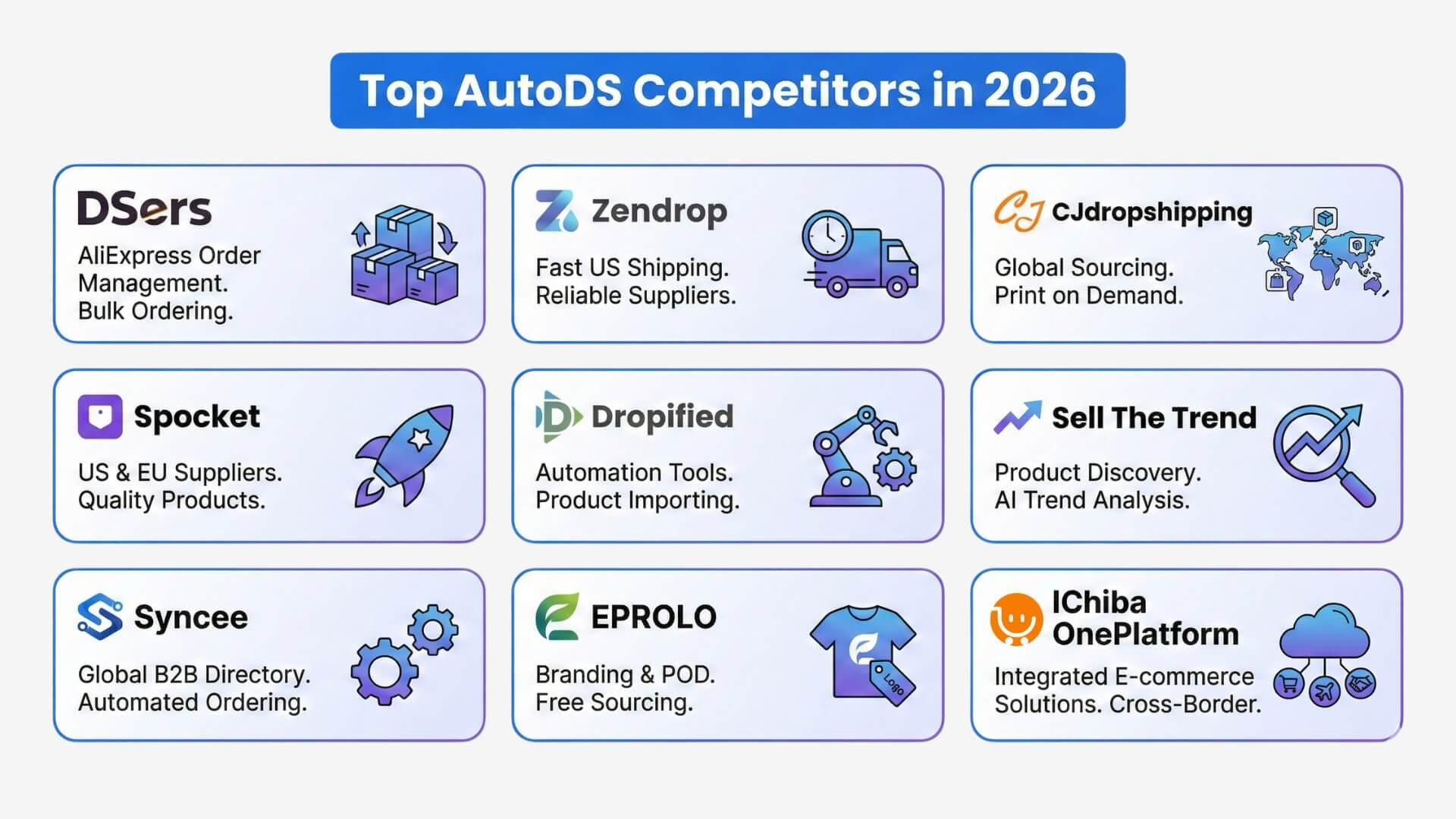
Rather than looking for a tool that simply replicates AutoDS features, sellers are increasingly focused on finding platforms that solve specific pain points. Some prioritize lower costs and simpler workflows, others want better supplier access or faster fulfillment, while scaling sellers often look for deeper automation and analytics. The tools below represent the most relevant AutoDS alternatives based on usage and seller demand in 2026.
DSers
DSers is best suited for beginners and AliExpress stores that want a stable and affordable starting point. Its strongest advantage lies in bulk order processing and tight integration with Shopify, making daily operations easier for small to mid-sized stores. Pricing starts with a free plan and scales gradually, which appeals to sellers searching for an AutoDS free alternative. Supplier coverage is mainly AliExpress, and automation is solid but relatively basic compared to enterprise tools.
Zendrop
Zendrop works well for sellers who prioritize fast shipping and a simplified supplier experience. The platform emphasizes US suppliers and branded packaging options, making it attractive for stores that focus on branding. Pricing is mid-range, with higher tiers unlocking advanced features. Automation is streamlined rather than deeply customizable, which suits sellers who prefer ease of use over complex rule building.
CJdropshipping
CJdropshipping is a popular choice for sellers looking for flexible sourcing and global fulfillment. It offers access to a wide supplier network, product sourcing services, and competitive shipping options. Pricing is largely based on usage levels, with many features available for free, positioning it as a strong AutoDS alternative free for cost-conscious sellers. Automation covers fulfillment, tracking, and inventory, though the interface can feel complex for beginners.
Spocket
Spocket is ideal for sellers targeting US and EU customers who value faster delivery times and higher perceived product quality. Its curated supplier network and focus on branded invoicing make it appealing for niche and premium stores. Pricing is higher than basic tools, and supplier coverage is more limited, but automation reliability and product consistency are key strengths.
Dropified
Dropified caters to sellers who want more control over automation logic and supplier workflows. It supports multiple marketplaces and allows deeper customization compared to simpler tools. Pricing sits in the mid to high range, and supplier coverage is broad but requires more setup effort. This makes Dropified better suited for experienced sellers rather than beginners.
Sell The Trend
Sell The Trend combines product research with automation features, making it useful for sellers focused on trend discovery and testing. Its strengths lie in analytics and market insights rather than pure fulfillment automation. Pricing reflects this added value, and supplier coverage varies depending on the sourcing strategy. Automation is moderate and often paired with external fulfillment tools.
Syncee
Syncee is designed for sellers who work with verified suppliers and want long-term stability over rapid testing. It supports direct supplier integrations and wholesale relationships, which is attractive for brand builders. Pricing depends on product volume, and automation focuses on catalog syncing and order forwarding rather than aggressive scaling features.
EPROLO
EPROLO is a beginner-friendly AutoDS competitor that emphasizes simplicity and low-cost entry. It offers free usage with optional paid upgrades, making it appealing for new sellers testing the market. Supplier coverage includes private labeling and global warehouses, while automation supports core fulfillment and tracking needs without advanced customization.
IChiba OnePlatform
IChiba OnePlatform is best suited for sellers looking for an all-in-one solution that goes beyond traditional dropshipping. It combines product sourcing, order management, fulfillment, and cross-border logistics, particularly for sellers working with suppliers in Asia and targeting international markets. Pricing is flexible based on usage and services, supplier coverage is diverse, and automation is designed to support scaling operations with private suppliers and branded fulfillment.
Tool | Best For | Key Strengths | Pricing Range | Supplier Coverage | Automation Level |
DSers | Beginners, AliExpress stores | Free plan, bulk ordering, easy Shopify integration | Free to low cost | Mainly AliExpress | Basic to medium |
Zendrop | Fast shipping, stores focusing on branding | US suppliers, branded packaging, simple workflow | Mid range | US and global | Medium |
CJdropshipping | Budget sellers, flexible sourcing | Free usage, global fulfillment, sourcing services | Free to usage based | Global suppliers | Medium |
Spocket | US and EU markets, premium products | Fast delivery, curated suppliers, branded invoices | Mid to high | US and EU suppliers | Medium |
Dropified | Advanced users, custom workflows | Deep automation control, multi-platform support | Mid to high | Broad, multi-source | High |
Sell The Trend | Trend-focused sellers | Product research, analytics insights | Mid range | Varies by sourcing | Medium |
Syncee | Brand builders, wholesale models | Verified suppliers, stable long-term sourcing | Volume based | Direct and wholesale suppliers | Medium |
EPROLO | New sellers, low-budget testing | Free entry, private labeling options | Free to low cost | Global warehouses | Basic |
IChiba OnePlatform | Scaling sellers, cross-border operations | All-in-one platform, private suppliers, global logistics | Flexible usage levels | Asia and international | High |
For beginner stores, tools with free plans and simple workflows, such as DSers, CJdropshipping, or EPROL,O are often the safest choice. Sellers who prioritize budget typically prefer low monthly costs and flexible usage pricing, making AutoDS alternatives free or freemium models especially attractive.
Sellers who focus on fast shipping and customer experience tend to gravitate toward platforms like Zendrop or Spocket, where supplier quality and delivery speed are prioritized. Brand-focused stores benefit most from tools that support private labeling, custom packaging, and supplier relationships, while scaling operations usually require platforms with strong automation rules, analytics, and multi-store management capabilities.
Ultimately, the best AutoDS alternative depends less on feature lists and more on how well a platform supports the seller’s current goals while remaining flexible enough to grow with the business.
Free or low-cost automation tools are often the first choice for new dropshipping sellers and for experienced store owners testing new niches. While fully automated enterprise platforms usually require paid plans, there are still several AutoDS alternatives free or partially free that can handle essential operations without immediate financial pressure. The key is understanding what “free” actually means in the context of dropshipping automation.
Most free solutions do not remove manual work entirely, but they can significantly reduce repetitive tasks such as order forwarding, inventory syncing, or basic fulfillment. For sellers with low order volume or those validating product market fit, these tools can be more than sufficient in the early stages.
In practice, complete automation at scale is rarely free, especially when advanced features like bulk processing, custom rules, and private supplier integration are required. However, partial automation is achievable without a monthly subscription, particularly when sellers are willing to trade advanced functionality for lower costs.
Free AutoDS alternatives typically rely on usage-based pricing, limited order caps, or restricted feature access. This model works well for beginners who need operational support but are not yet processing high volumes. It also suits sellers who prefer to control costs tightly during testing phases rather than committing to a full automation stack upfront.

DSers Free Plan
DSers offers one of the most accessible free plans in the market, making it a popular AutoDS free alternative for AliExpress stores. Sellers can manage product imports, basic order fulfillment, and inventory syncing without paying monthly fees. While advanced automation is locked behind paid tiers, the free plan covers the core needs of early-stage stores.
CJdropshipping Free Usage
CJdropshipping stands out by allowing sellers to use most of its sourcing and fulfillment services without a fixed subscription. Costs are mainly tied to product and shipping fees, which makes it attractive for budget-conscious sellers. Automation features include order processing, tracking updates, and inventory management, though interface complexity may require a learning period.
Shopify Manual Fulfillment
For sellers just starting out, Shopify’s built-in manual fulfillment tools can function as a basic AutoDS alternative free of charge. Orders are processed manually, but inventory tracking and customer notifications are handled within the platform. This approach works best for very low-volume stores or for sellers who want full control before introducing automation software.
IChiba OnePlatform
IChiba OnePlatform offers a flexible entry point for sellers who want to combine sourcing, fulfillment, and logistics without committing to high upfront software fees. Certain features and workflows can be accessed without a traditional subscription, positioning it as a practical AutoDS alternative for sellers focused on cross-border fulfillment and private supplier collaboration. As order volume grows, sellers can selectively adopt paid services rather than upgrading an entire automation suite at once.
Is there a free AutoDS alternative?
Yes, there are several tools that can function as a free AutoDS alternative, especially for beginners or low-volume stores. Platforms like DSers and CJdropshipping offer free plans or usage access that cover core functions such as product importing, order fulfillment, and tracking updates. While these tools may limit advanced automation or scaling features, they are often sufficient for testing products and validating a dropshipping business model without upfront software costs.
Which tool is better than AutoDS?
There is no single tool that is objectively better than AutoDS for every seller. The best option depends on your priorities, such as cost control, supplier flexibility, shipping speed, or automation depth. Some sellers prefer CJdropshipping for its free access and global sourcing, while others choose Zendrop or Spocket for faster shipping. For scaling operations with private suppliers and cross-border logistics, platforms like IChiba OnePlatform may offer advantages that AutoDS does not fully cover.
Does AutoDS work with all suppliers?
AutoDS does not support all suppliers. Its integrations are limited to specific marketplaces and approved suppliers, which can be restrictive for sellers who rely on private suppliers or custom fulfillment arrangements. This limitation is one of the main reasons sellers explore AutoDS competitors that offer more flexible supplier integration or direct sourcing options.
How do I migrate from AutoDS?
Migrating from AutoDS usually involves exporting product data, order history, and pricing rules, then importing them into your new automation tool. Most AutoDS alternatives support CSV imports or guided onboarding to simplify this process. To reduce risk, sellers often migrate in stages, starting with new products or a secondary store, before fully transitioning their main operations to a different platform.
Finding the right AutoDS alternative in 2026 is less about replacing one tool with another and more about aligning your automation stack with how your dropshipping business actually operates. As supplier ecosystems expand and competition increases, sellers need tools that support flexibility, cost control, and scalable workflows rather than one-size-fits-all solutions.
Ultimately, the best AutoDS alternative is the one that matches your current stage while remaining adaptable as your business evolves. By understanding your priorities and comparing tools based on real operational needs, you can choose a platform that supports sustainable growth instead of becoming a bottleneck as order volume and complexity increase.

Work with us
Our solutions
Address:
 〒136-0082, Japan, Tokyo, Koto-ku, Shinkiba 3-5-6, 5F
Connect us:


Japan
〒136-0082, Japan, Tokyo, Koto-ku, Shinkiba 3-5-6, 5F
Texas, USA
1606 Audrey Dr, Garland, TX 75040, United States
California, USA
1316 John Reed Ct, City of Industry, CA 91745, United States