

News
Ichiba OnePlatform Team - 21/05/2026
In this article
As the global ecommerce industry becomes more competitive, many online sellers are searching for smarter ways to scale their businesses without dealing with inventory risks or complex fulfillment operations. This shift has led to the rapid growth of the B2B dropshipping platform model, where retailers can connect directly with suppliers, automate product sourcing, and streamline order fulfillment through a single ecosystem.
For beginners, choosing the right platform can simplify the process of launching an online store and finding reliable suppliers. For growing businesses, an all in one B2B dropshipping platform provides deeper automation, better supplier management, and stronger operational control across multiple sales channels.
However, not all B2B platforms for dropshippers offer the same features, pricing structures, or supplier quality. Some platforms focus on low-cost product sourcing, while others prioritize branded packaging, faster shipping, or advanced integrations with ecommerce systems like Shopify and WooCommerce. Understanding these differences is essential before selecting a platform that aligns with your business goals and long-term growth strategy.
As ecommerce continues to evolve, many online businesses are moving away from traditional inventory models and adopting more flexible supply chain solutions. A B2B dropshipping platform acts as the bridge between retailers and suppliers, allowing sellers to source products, automate fulfillment, and manage operations through a centralized system. Instead of purchasing large amounts of inventory upfront, retailers can partner with suppliers who handle storage, packaging, and shipping directly to customers.
For modern ecommerce businesses, especially those operating across multiple markets, a B2B platform for dropshippers provides access to supplier networks, automation tools, and logistics infrastructure that would otherwise require significant time and investment to build independently.
A B2B dropshipping platform is a business-to-business system that connects online retailers with manufacturers, wholesalers, or suppliers who fulfill orders on the retailer’s behalf. The platform serves as the operational layer that simplifies sourcing, product management, order routing, and communication between both parties.
Unlike traditional wholesale models, retailers do not need to purchase inventory in bulk before making sales. Instead, products are listed in an online store first, and suppliers only ship items after customers place orders. This model reduces financial risk while allowing sellers to test products and scale faster.
One important distinction is the difference between B2B and B2C dropshipping. In a B2C model, suppliers often focus on individual consumer orders with limited customization or wholesale pricing benefits. A B2B dropshipping platform, on the other hand, is designed to support businesses that need stronger supplier relationships, better pricing structures, branding flexibility, and operational scalability.
Another key element is the role of intermediaries versus direct supplier integration. Some platforms operate as intermediaries, managing supplier communication and fulfillment processes on behalf of retailers. Others provide direct integration with manufacturers or warehouses, giving sellers more control over pricing, inventory visibility, and branding opportunities. Businesses that plan to scale long-term often prefer platforms with deeper supplier integration because they offer greater efficiency and customization capabilities.
Although each platform has its own ecosystem and workflow, most all in one B2B dropshipping platforms follow a similar operational process that connects retailers, suppliers, and customers seamlessly.
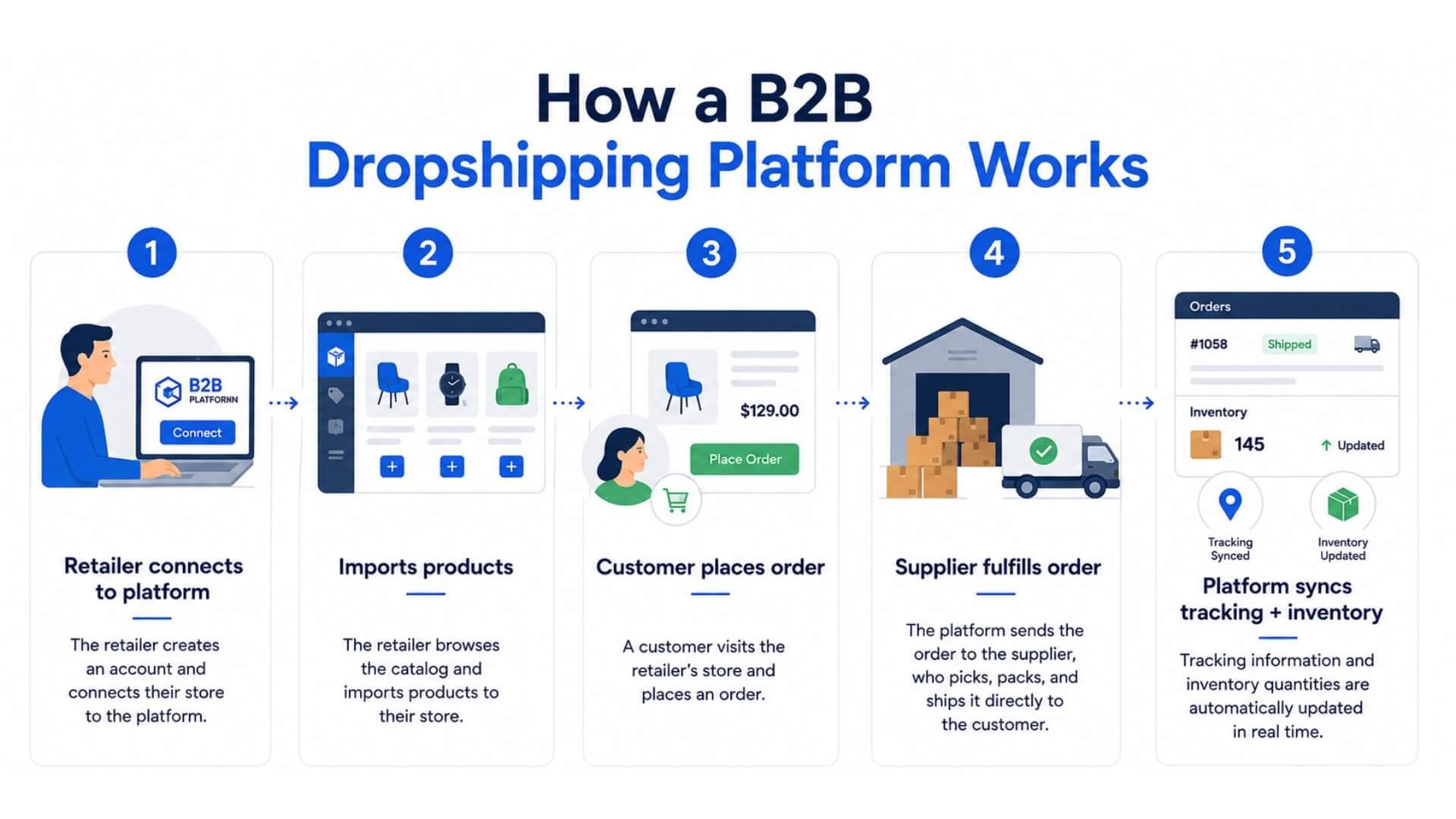
The process begins when a retailer signs up for a B2B dropshipping platform and integrates their ecommerce store. Most platforms support major ecommerce systems such as Shopify, WooCommerce, and Magento, making it easier to synchronize products and manage orders from a single dashboard.
After connecting to the store, the retailer browses supplier catalogs and imports selected products into their online storefront. Product information, such as images, descriptions, pricing, and inventory levels, is automatically synced through the platform.
When a customer purchases a product from the retailer’s online store, the order details are automatically transferred to the supplier through the platform. This automation minimizes manual processing and reduces the risk of fulfillment errors.
The supplier prepares, packages, and ships the product directly to the customer. Depending on the platform and supplier agreement, retailers may also access custom packaging, private labeling, or branded invoice services to strengthen their brand identity.
Once the order is shipped, the platform updates tracking information automatically and synchronizes inventory levels across connected sales channels. This helps retailers maintain accurate stock visibility while improving customer communication and fulfillment transparency.
As competition in ecommerce becomes more intense, online sellers need more than just access to products and suppliers. A modern all in one B2B dropshipping platform is designed to centralize sourcing, automation, fulfillment, and business management into a single operational ecosystem. Instead of relying on disconnected tools and manual workflows, retailers can manage multiple aspects of their business more efficiently while improving scalability and customer experience.
One of the most important components of a B2B dropshipping platform is its supplier ecosystem. The quality of suppliers directly impacts product reliability, shipping performance, and customer satisfaction. Platforms with strong supplier networks give retailers access to a wider range of products while reducing sourcing risks.
Reliable platforms typically work with verified suppliers that have passed screening processes related to product quality, shipping performance, and fulfillment consistency. This verification helps retailers avoid common problems such as counterfeit products, poor communication, delayed shipments, or inaccurate inventory levels.
For beginners, working with verified suppliers reduces operational uncertainty and creates a more stable foundation for business growth. For experienced sellers, supplier verification supports long-term scaling and brand reputation management.
Different platforms focus on different supplier regions. Some specialize in global sourcing networks, offering products from countries such as China, Japan, Vietnam, Europe, or the United States. Others focus on regional supplier ecosystems to provide faster domestic shipping and localized fulfillment advantages.
Global sourcing often provides lower product costs and larger catalogs, while regional sourcing improves delivery speed and customer trust. Many businesses use a hybrid sourcing strategy that combines both approaches depending on target markets and product categories.
As ecommerce brands mature, many sellers look beyond generic products and begin investing in brand differentiation. Some all in one B2B dropshipping platforms support private label and white label services, allowing retailers to customize packaging, add logos, or create branded product experiences.
Private labeling helps businesses build stronger brand recognition and customer loyalty, while white label services allow sellers to market pre-manufactured products under their own brand identity. These features are especially valuable for businesses planning long-term growth rather than short-term product testing.
Automation is one of the biggest advantages of using a B2B platform for dropshippers. Without automation, managing products, inventory, orders, and customer updates across multiple channels can quickly become overwhelming as order volume increases.
Leading platforms integrate directly with major ecommerce systems such as Shopify, WooCommerce, and Magento. These integrations allow retailers to synchronize products, pricing, inventory, and order information automatically between the platform and their online stores.
Many all-in-one platforms offer automated order routing, where customer purchases are sent directly to suppliers without manual intervention. Inventory synchronization is equally important because it updates stock availability in real time across all connected sales channels. These automation tools help prevent overselling, improve order accuracy, and reduce administrative workload for sellers managing large product catalogs.
Advanced businesses often require custom workflows or integration with third-party systems such as ERP software, CRM platforms, or warehouse management tools. Platforms with API capabilities provide greater flexibility for businesses that need deeper customization and scalable operational infrastructure.
Profitability is one of the main reasons businesses adopt a B2B dropshipping platform. The right platform should help retailers maintain healthy margins while remaining competitive in the market.
Most B2B platforms offer wholesale pricing structures that allow retailers to purchase products at lower prices than through standard retail sourcing. Some suppliers also offer tiered pricing discounts based on order volume or long-term partnerships.
Traditional wholesale models often require high minimum order quantities, which can create financial risk for smaller businesses. Many modern B2B dropshipping platforms offer low- or zero-MOQ options, allowing retailers to test products without large upfront investments. This flexibility is especially useful for beginners who want to validate product demand before scaling inventory commitments.
Some platforms include automated pricing tools that adjust retail prices based on supplier costs, competitor pricing, or profit margin targets. Dynamic pricing helps retailers remain competitive while protecting profitability in rapidly changing markets.
Fast and reliable shipping has become a critical factor in ecommerce success. Customers increasingly expect transparent tracking, shorter delivery times, and consistent fulfillment experiences.
Leading B2B platforms provide multiple shipping methods based on customer location, product type, and delivery urgency. Some suppliers offer express shipping solutions, while others focus on cost-efficient international delivery.
Businesses targeting premium customer segments often prioritize faster shipping options to improve conversion rates and customer satisfaction.
Some all in one B2B dropshipping platforms provide warehousing services that allow retailers to store inventory closer to target markets. Warehousing support can significantly reduce delivery times and shipping costs while improving inventory management efficiency.
This feature becomes increasingly important as businesses scale internationally.
Platforms with multi-country fulfillment networks allow businesses to ship products from different warehouse locations worldwide. This improves delivery performance and reduces logistical challenges for cross-border ecommerce operations.
Data-driven plays a major role in ecommerce growth. Advanced B2B dropshipping platforms provide analytics tools that help businesses track performance, identify trends, and optimize operations.
Centralized dashboards allow retailers to monitor revenue, order volume, product performance, and customer behavior in real time. These insights help businesses identify top-performing products and make faster operational decisions.
Profit tracking tools calculate margins, shipping costs, advertising expenses, and supplier pricing automatically. This visibility helps retailers understand overall business performance and identify opportunities to improve profitability.
Some platforms use historical sales data and market trends to forecast product demand and inventory requirements. Demand forecasting helps businesses reduce stock issues while improving supply chain planning and sales performance.
Choosing the right B2B platform for dropshippers depends on several factors, including target market, budget, product category, shipping requirements, and scalability goals. Beginners often prioritize ease of use and supplier access, while more advanced sellers typically look for automation, API flexibility, and custom branding capabilities.
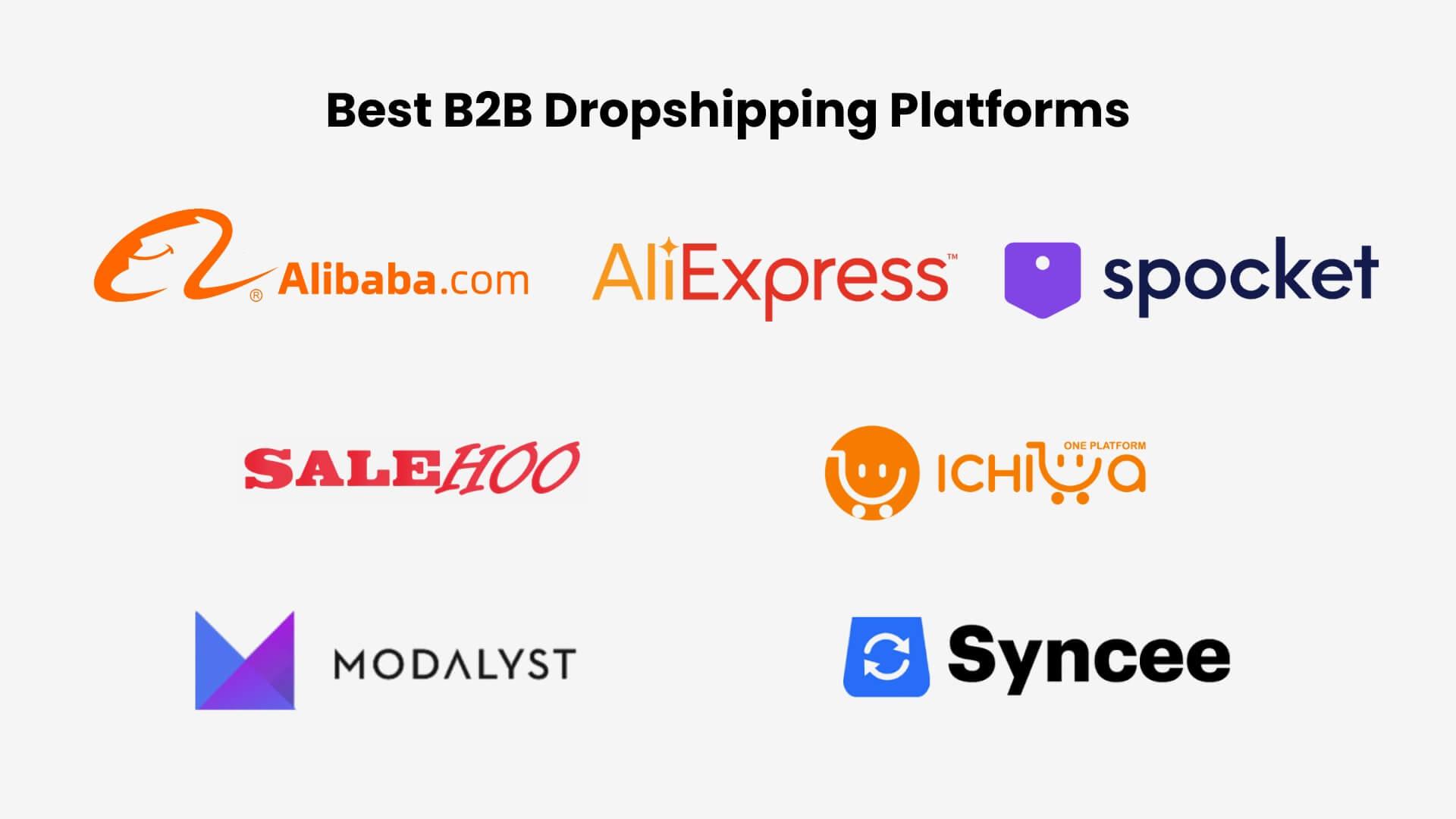
Alibaba and AliExpress are among the largest global sourcing ecosystems in ecommerce. While Alibaba primarily focuses on wholesale and bulk purchasing, AliExpress supports smaller order quantities and dropshipping-friendly workflows. Together, they create a hybrid B2B sourcing environment suitable for businesses at different stages.
One of the biggest advantages of these platforms is product variety. Sellers can access millions of products across categories such as electronics, fashion, beauty, home goods, and accessories. Pricing is often highly competitive because many suppliers are manufacturers or direct exporters.
However, supplier quality can vary significantly, and shipping times may be inconsistent depending on the supplier and destination market. Retailers usually need to spend time evaluating suppliers carefully before scaling operations.
Pros
Massive product catalog
Competitive wholesale pricing
Low entry barrier for beginners
Flexible supplier options
Cons
Supplier quality inconsistency
Longer shipping times in some regions
Communication challenges with certain suppliers
CJdropshipping has become one of the most popular all in one B2B dropshipping platforms due to its strong balance between sourcing, automation, and fulfillment support. The platform offers product sourcing services, branded packaging options, and global warehouse networks.
Unlike traditional marketplaces, CJdropshipping acts as both a sourcing partner and fulfillment provider. Retailers can request custom sourcing for trending products and access warehousing support in multiple countries.
Pros
Global warehouse support
Product sourcing assistance
Branding and private label features
Strong automation capabilities
Cons
Product catalog smaller than AliExpress
Some shipping methods may still require optimization
Spocket focuses heavily on suppliers based in the United States and Europe, making it attractive for businesses targeting Western markets that demand faster shipping and higher product quality standards.
The platform integrates seamlessly with Shopify and WooCommerce while offering curated supplier partnerships. Many sellers use Spocket to improve customer experience through shorter delivery times and premium product positioning.
Pricing tends to be higher compared to Asian sourcing platforms, but businesses may benefit from stronger branding opportunities and better customer satisfaction rates.
Pros
Faster shipping for US and EU markets
Curated supplier network
User-friendly interface
Strong ecommerce integrations
Cons
Higher product costs
Smaller product selection compared to global marketplaces
SaleHoo operates differently from many traditional dropshipping platforms because it focuses primarily on supplier directories and research tools rather than direct fulfillment management.
The platform provides access to verified suppliers and educational resources that help beginners understand product sourcing and supplier evaluation. SaleHoo is often recommended for new ecommerce entrepreneurs because of its simplicity and supplier transparency.
However, businesses seeking advanced automation or integrated fulfillment may eventually need additional operational tools beyond the SaleHoo ecosystem.
Pros
Verified supplier directory
Beginner-friendly resources
Affordable entry cost
Strong supplier transparency
Cons
Limited fulfillment automation
Fewer advanced operational features
Syncee is designed for retailers who want access to global suppliers while maintaining strong integration capabilities with ecommerce platforms. It supports automated product uploads, inventory synchronization, and order management.
One major advantage of Syncee is its supplier diversity, which includes regional suppliers from multiple countries. This allows businesses to build more flexible sourcing strategies based on target markets and shipping requirements.
Pros
Wide supplier diversity
Multi-platform integration support
Automated inventory management
Flexible sourcing options
Cons
Premium features require higher plans
Product pricing varies between suppliers
Modalyst focuses on curated suppliers, branded products, and premium ecommerce experiences. The platform supports both independent brands and private label sourcing opportunities.
Retailers using Modalyst often prioritize fashion, beauty, and lifestyle niches where branding and product quality play a major role in customer retention. The platform offers strong Shopify integration and simplified product management, though product costs can be higher compared to mass sourcing marketplaces.
Pros
Curated premium suppliers
Strong branding opportunities
Easy product management
High-quality product selection
Cons
Higher supplier pricing
Smaller catalog compared to larger marketplaces
Zendrop was built specifically for ecommerce automation and fast fulfillment workflows. The platform provides product sourcing, inventory management, and automated order fulfillment through a simplified dashboard.
One of Zendrop’s strongest advantages is its focus on improving shipping performance and operational efficiency for Shopify sellers. The platform also supports branded packaging and subscription automation features.
Pros
Strong automation tools
Faster fulfillment options
Beginner-friendly interface
Branding support available
Cons
More focused on the Shopify ecosystem
Limited supplier diversity compared to broader marketplaces
IChiba OnePlatform is an all in one B2B dropshipping platform designed to support global ecommerce sellers through supplier connectivity, fulfillment services, and operational automation. The platform focuses on connecting international sellers with suppliers from Japan and Vietnam while providing centralized order and logistics management.
One of its key strengths is the combination of cross-border fulfillment infrastructure and supplier sourcing support. Sellers can manage product imports, warehousing, shipping, and fulfillment through a unified ecosystem, which simplifies international ecommerce operations.
The platform is particularly suitable for businesses looking to access Japanese supplier markets while maintaining scalable fulfillment workflows for global customers.
Pros
Access to Japan and Vietnam supplier networks
Integrated fulfillment services
Multi-channel operational support
Suitable for cross-border e-commerce growth
Cons
Smaller ecosystem compared to older global marketplaces
Supplier selection may depend on niche categories
Platform | Supplier Type | Integration | Pricing | Best For |
Alibaba / AliExpress | Global manufacturers and wholesalers | Shopify, WooCommerce, third-party apps | Mostly free access with product costs | Beginners and low-cost sourcing |
CJdropshipping | Global sourcing and fulfillment suppliers | Shopify, WooCommerce, eBay | Free access with shipping fees | Scaling ecommerce stores |
Spocket | US and EU suppliers | Shopify, WooCommerce | Monthly subscription plans | Faster shipping markets |
SaleHoo | Verified supplier directory | Limited direct integrations | Membership-based pricing | Supplier research and beginners |
Syncee | International supplier marketplace | Shopify, Wix, WooCommerce | Free and premium plans | Flexible multi-region sourcing |
Modalyst | Curated and branded suppliers | Shopify, Wix | Subscription based | Premium niche brands |
Zendrop | Automated fulfillment suppliers | Shopify focused | Free and paid plans | Ecommerce automation |
IChiba OnePlatform | Japan supplier ecosystem | Multi-channel ecommerce support | Custom business solutions | Cross-border fulfillment and sourcing |
As ecommerce operations become more complex, many online sellers struggle with supplier management, order fulfillment, inventory tracking, and scaling limitations. A B2B dropshipping platform helps simplify these challenges by centralizing operations into a more efficient system. Instead of manually coordinating multiple suppliers and disconnected tools, retailers can manage sourcing, fulfillment, automation, and analytics through one ecosystem.
For both beginners and growing ecommerce brands, using an all in one B2B dropshipping platform can improve operational efficiency, reduce business risks, and create stronger long-term growth opportunities.
One of the biggest advantages of a B2B platform for dropshippers is the ability to scale operations without significantly increasing manual workload. As order volume grows, businesses that rely on spreadsheets, manual inventory updates, and supplier messaging often experience delays, fulfillment errors, and operational inefficiencies.
Automation features such as product synchronization, inventory updates, order routing, and shipment tracking help retailers eliminate repetitive administrative tasks. Instead of processing each order manually, businesses can automate large portions of the fulfillment workflow. This allows sellers to spend more time focusing on growth activities such as marketing, customer acquisition, and brand development rather than operational maintenance.
As ecommerce stores grow, handling larger order volumes becomes increasingly difficult without scalable infrastructure. An all in one B2B dropshipping platform provides the systems needed to manage thousands of products and orders across multiple sales channels simultaneously.
Strong supplier relationships are one of the most important factors in long-term e-commerce success. Businesses that maintain stable partnerships with reliable suppliers often gain better pricing, faster fulfillment support, and improved product consistency.
Many platforms encourage ongoing collaboration between retailers and suppliers rather than one-time transactional sourcing. As sellers scale their order volume, they often gain access to priority support, customized fulfillment options, and exclusive product opportunities.
Long-term supplier partnerships also improve communication efficiency and operational reliability over time.
Businesses with consistent order volume may be able to negotiate better wholesale pricing or lower shipping costs directly through suppliers on the platform. Reduced sourcing costs can significantly improve overall profitability, especially for stores operating at scale.
Profit margin management is one of the biggest challenges in ecommerce, especially in highly competitive product categories. A B2B platform for dropshippers helps improve profitability by reducing sourcing costs, improving operational efficiency, and minimizing unnecessary intermediaries.
Because many B2B platforms connect retailers directly with manufacturers or wholesalers, sellers can often access lower product pricing compared to traditional retail sourcing channels. This creates more flexibility for competitive pricing while maintaining healthy margins.
Traditional supply chains often involve multiple intermediaries, each adding additional costs to the product. Many all in one B2B dropshipping platforms streamline the sourcing process by connecting retailers directly with suppliers or fulfillment partners.
Dropshipping businesses face several operational risks, including unreliable suppliers, delayed shipments, poor product quality, and refund disputes. A structured B2B dropshipping platform helps reduce these risks through supplier verification systems, centralized communication, and dispute management tools.
Many platforms carefully review suppliers before allowing them into the ecosystem. Supplier verification processes may include product quality checks, shipping performance monitoring, and operational evaluations. Working with verified suppliers lowers the risk of inventory inconsistencies, fraudulent behavior, and customer complaints.
Reliable platforms typically provide structured refund and dispute management systems that protect both retailers and customers. If issues such as damaged products, delayed deliveries, or incorrect shipments occur, businesses can resolve problems more efficiently through platform support channels. This additional layer of protection helps sellers maintain customer trust while minimizing financial losses caused by fulfillment issues.
With so many ecommerce tools and supplier ecosystems available today, selecting the right B2B dropshipping platform can feel overwhelming, especially for new entrepreneurs entering the market for the first time. While many platforms offer similar core functions, the ideal solution depends heavily on your business stage, operational goals, target market, and long-term growth strategy.

Different stages of ecommerce growth require different operational tools and supplier structures. A platform that works well for beginners may not provide enough scalability for more advanced businesses.
For beginners, ease of use is often the most important factor. New sellers usually benefit from platforms that provide simple dashboards, guided onboarding, and access to ready-to-sell products without requiring technical knowledge.
At this stage, businesses should focus on:
Low startup costs
User-friendly product importing
Basic store integrations
Reliable supplier access
Educational resources and support
Platforms such as AliExpress, SaleHoo, and Zendrop are commonly used by beginners because they reduce operational complexity while allowing sellers to test products with minimal financial risk.
As businesses begin generating consistent sales, operational efficiency becomes more important. Intermediate sellers often manage larger product catalogs, multiple marketing channels, and increasing order volumes.
At this stage, businesses typically require:
Automated inventory synchronization
Faster order processing
Multi-channel integrations
Branded fulfillment options
Better analytics and reporting
Platforms such as CJdropshipping, Spocket, and Syncee are often suitable for growing ecommerce stores because they provide stronger automation and fulfillment support.
Advanced ecommerce businesses usually operate across multiple regions, sales channels, and supplier networks simultaneously. These businesses often require more control over logistics, branding, and operational infrastructure.
At this level, businesses should prioritize:
API connectivity
ERP and warehouse integrations
Multi-warehouse fulfillment
Advanced reporting tools
Custom operational workflows
Private label and branding support
An advanced all in one B2B dropshipping platform should function as a scalable operational ecosystem rather than just a product sourcing tool. Businesses focused on international expansion often look for platforms with flexible fulfillment infrastructure and cross-border logistics capabilities.
Before choosing a B2B platform for dropshippers, it is important to evaluate both operational features and supplier quality carefully. Even platforms with strong marketing claims may not align with your actual business requirements. Below are some of the most important factors to consider during the evaluation process.
Supplier reliability directly impacts customer satisfaction and business reputation. Before selecting a platform, review supplier ratings, fulfillment history, product quality consistency, and communication responsiveness. If possible, order sample products to evaluate packaging quality, shipping speed, and overall customer experience firsthand.
Shipping performance plays a major role in ecommerce conversion rates and customer retention. Businesses targeting customers in the United States or Europe may benefit from platforms that offer local warehousing or regional fulfillment centers. Long shipping times often lead to higher refund requests and lower customer trust, especially in competitive product categories.
A platform should integrate smoothly with your ecommerce systems, marketplaces, payment tools, and operational software. Businesses using platforms such as Shopify or WooCommerce should confirm that synchronization features work reliably before scaling operations. Strong integration capabilities reduce manual work and improve workflow efficiency across the business.
Some platforms advertise low entry costs while charging additional fees for premium integrations, automation features, or fulfillment services. Carefully review subscription plans, transaction fees, shipping costs, and supplier pricing structures before making a decision. Transparent pricing helps businesses forecast operational expenses more accurately and avoid unexpected costs as order volume increases.
What is a B2B dropshipping platform?
A B2B dropshipping platform is a system that connects online retailers with manufacturers, wholesalers, or suppliers who handle product fulfillment on the retailer’s behalf. Instead of purchasing inventory upfront, sellers list products in their online stores and suppliers ship orders directly to customers after purchases are made.
Most modern platforms also include automation tools for inventory synchronization, order processing, shipment tracking, and supplier management. An all in one B2B dropshipping platform helps businesses centralize sourcing, fulfillment, and operational workflows in one ecosystem.
Which is the best B2B platform for dropshipping beginners?
The best platform for beginners depends on budget, technical experience, and business goals. Platforms such as AliExpress and Zendrop are often recommended for beginners because they offer low startup costs, easy product importing, and simple store integrations.
For beginners who want access to verified suppliers and educational resources, SaleHoo can also be a strong option. New sellers should prioritize ease of use, supplier reliability, and automation features when choosing a platform.
Are B2B dropshipping platforms profitable?
Yes, B2B dropshipping platforms can be profitable when businesses choose the right products, suppliers, and marketing strategies. Profitability often depends on factors such as product margins, advertising costs, shipping performance, and customer retention.
Many retailers use wholesale supplier pricing and automation tools to improve operational efficiency and maintain healthy profit margins. Businesses that focus on branding, niche selection, and customer experience typically achieve better long-term profitability compared to stores that compete only on low pricing.
How do I find reliable suppliers on B2B platforms?
Finding reliable suppliers requires careful evaluation and testing. Most ecommerce businesses review supplier ratings, order history, customer feedback, shipping performance, and communication responsiveness before working with a supplier long-term.
Do B2B platforms support private labeling?
Yes, many all in one B2B dropshipping platforms support private label and white label services. These features allow businesses to customize packaging, add branded logos, include personalized inserts, or sell products under their own brand identity.
Platforms such as CJdropshipping and IChiba often provide branding and fulfillment customization options for growing ecommerce businesses. Private labeling is especially valuable for businesses that want to build stronger brand recognition, improve customer loyalty, and create higher perceived product value over time.
As ecommerce competition continues to grow worldwide, choosing the right B2B dropshipping platform has become an important strategic decision for online businesses. Whether you are launching your first ecommerce store or scaling an existing operation, the right platform can simplify supplier sourcing, automate fulfillment workflows, improve shipping efficiency, and support long-term business growth.
An all in one B2B dropshipping platform does more than connect retailers with suppliers. It creates a centralized ecosystem where businesses can manage products, inventory, orders, analytics, and logistics more efficiently across multiple sales channels. From automation tools and verified supplier networks to private labeling and global fulfillment support, these platforms help ecommerce sellers operate with greater flexibility and scalability.
Ultimately, the best B2B platform for dropshippers is the one that aligns with your business stage, target market, and long-term growth strategy. By investing in the right platform early, ecommerce entrepreneurs can build stronger supplier relationships, improve customer satisfaction, and create a more sustainable and profitable online business.

Work with us
Our solutions
Address:
 〒136-0082, Japan, Tokyo, Koto-ku, Shinkiba 3-5-6, 5F
Connect us:


Japan
〒136-0082, Japan, Tokyo, Koto-ku, Shinkiba 3-5-6, 5F
Texas, USA
1606 Audrey Dr, Garland, TX 75040, United States
California, USA
1316 John Reed Ct, City of Industry, CA 91745, United States