

News
Ichiba OnePlatform Team - 20/05/2026
In this article
Picking the best dropshipping items is not the same as picking what’s “trending.”
In real dropshipping, durable winners usually win for 3 basic reasons: they’re easy to sell (clear angle), easy to deliver (light, compact), and easy to support after purchase (fewer defects, fewer returns). The “looks amazing on video” items that are fragile, claim-heavy, or thin-margin can burn profit fast-especially when ads keep getting more expensive and marketplaces enforce policies harder.
This guide helps you pick products that can survive real costs-ads, fees, refunds, and support. You’ll learn how to spot ops-friendly winners, what to sell by niche with concrete angles, how Amazon vs eBay changes what’s safe to list, and how to validate fast before you waste time on listings and creatives.
If you want a simple rule: the best item to dropship is the one that stays profitable after fees, refunds, and support-not the one that looks best on video.
A best product for dropshipping isn’t just something that sells once. It’s something you can keep selling without getting buried by refunds, disputes, and support tickets.
I judge products in two passes. First pass: will a buyer “get it” fast enough to click and buy? Second pass: can you ship it cleanly without turning support into a full-time job? If a product fails either pass, it’s not a winner - it’s future refunds.
If you’re starting from scratch, a messy workflow is a silent refund machine - wrong variants, late tracking updates, missed order sync. If you want a shortlist of tools that keep ops clean, see Best Free Dropshipping Software & Platforms in 2026.
If the pain is obvious, conversion is cheaper. Pet hair, clutter, car smell, awkward corners to clean - buyers don’t need education. They need a quick “that’s me.”
If your angle needs a paragraph, your CPA will punish you. The best items feel instantly “useful” or “gift-safe,” so buyers buy before they overthink.
This is boring, but it pays the bills. Lower shipping cost, fewer damages, fewer “box arrived crushed” tickets - especially cross-border.
Sizing categories (especially apparel) can spike returns fast unless you have excellent size charts, consistent supplier QC, and clear buyer expectations. If you’re starting out, it’s usually not worth the return risk.
Fragile items break - and cross-border handling makes that worse. Fewer breakage cases means fewer refunds, fewer angry reviews, and less time lost in support.
Repeat purchase is underrated. If customers can re-order every 30-90 days (consumables, replacement parts, pet upkeep), your CAC pays back faster and scaling feels less fragile.
Margin is not “selling price minus product cost.” It’s what’s left after ads, platform fees, shipping, refund buffer, and defect handling. If 1-2 defect cases can wipe out profit, it’s not a real winner-even if it “sells.”
The safest winners don’t depend on logos, characters, or regulated claims. Less IP and compliance risk means fewer takedowns, fewer ad rejections, and fewer “is this legit?” tickets.
Some products look plain but sell extremely well in the US because they fit daily habits. Your taste is one signal - the market is the judge. Test small, read the data, then scale.
Some categories look profitable on the surface, but they’re high-risk-especially if you want a stable shortlist of best dropshipping products to sell.
Anything that leans on brand names, logos, character IP, or “look-alikes” can trigger takedowns, ad restrictions, and buyer trust issues (“is this fake?”). If you want durability, avoid products that rely on someone else’s brand equity.
Glass, ceramics, thin plastics, and items that require perfect packaging are refund magnets. “Box arrived damaged” is one of the fastest paths to 1-star reviews-even when the product inside works.
If the product is interchangeable, buyers don’t compare stories - they compare price. Think generic phone cases, basic USB cables, screen protectors, plain socks, simple bottle openers, or “random kitchen gadget #218” with 50 identical clones. Without local fulfillment or a brand edge, you’ll bleed on fees and returns.
Seasonality can spike revenue, but it can also collapse your store after the season ends. If you don’t have a rotation plan, demand drops and your ads stop working.
Shipping cost, damage risk, and returns can eat your margin. These products often look great on paper and fail in real ops.
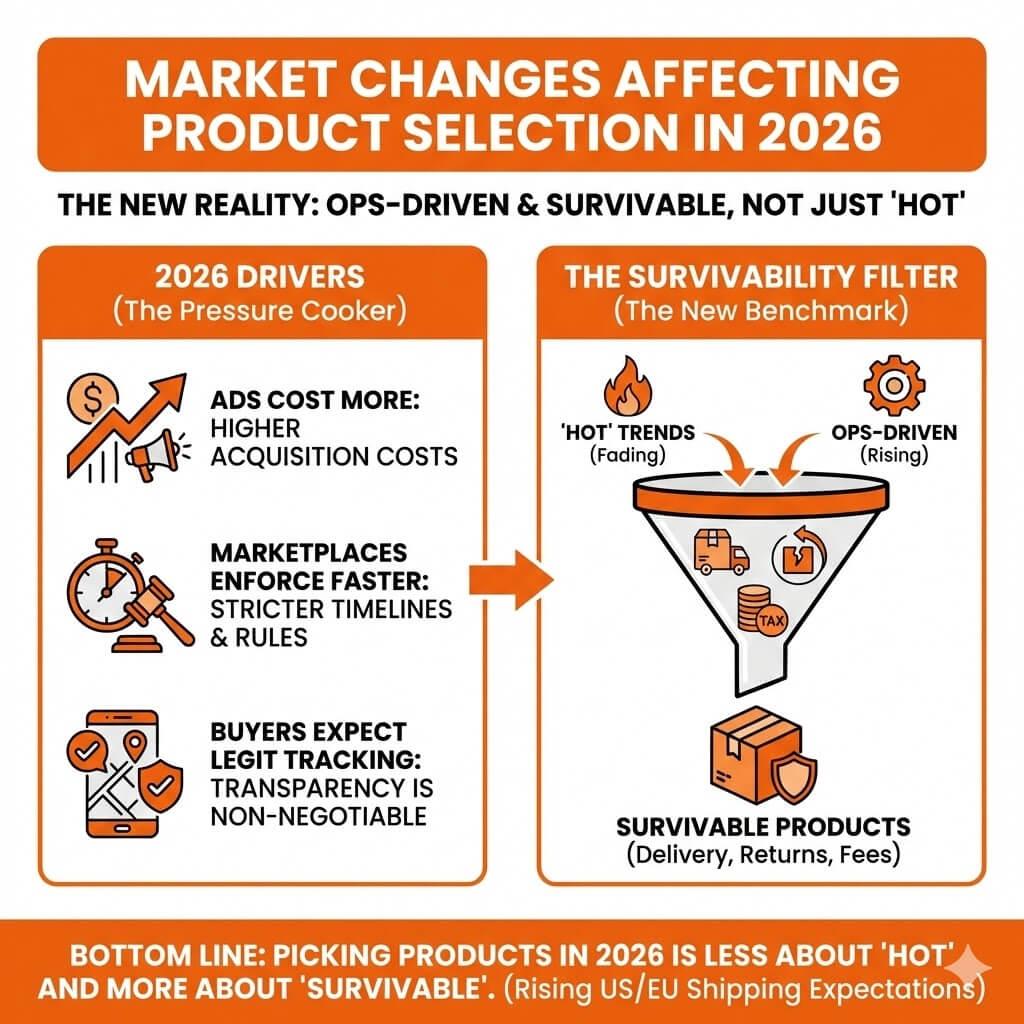
In 2026, product selection is more ops-driven than ever. Ads cost more, marketplaces enforce faster, and buyers expect tracking that looks legit. So the real filter isn’t “hot.” It’s whether the product can survive delivery, returns, and fees.
Bottom line: picking products in 2026 is less about “hot” and more about “survivable.”
Shipping expectations keep rising, especially in the US and EU. If you want a practical benchmark for delivery speed by region, see 17 Fastest Dropshipping Suppliers for 2026.
Below are the best products to dropship in 2026 - practical, easy to explain, and easier to deliver without dispute spikes.
Pet products are evergreen because demand repeats and buying is emotional. Winners usually solve a clear pet-owner problem: shedding, odors, hygiene, or keeping the pet entertained.
A few product directions that are usually safe to start with:
Grooming tools (deshedding combs, grooming gloves, lint rollers)
Lightweight interactive toys (simple, durable)
Hygiene accessories (basic cleaning tools)
Compact travel accessories, as long as sizing is clear
A quick warning: bulky pet beds can create high returns when reality doesn’t match photos. Pet wins long-term when you use real photos and honest descriptions-UGC can drive conversion hard in this niche.
This niche is a goldmine because the use case is obvious and content is easy (before/after). The winners are small “life friction” fixes: storage, cleaning, organizing, and convenience.
Product ideas:
Space-saving organizers (hooks, drawer dividers, pantry organizers)
Simple mechanical kitchen tools (easy to clean, low failure risk)
Cleaning gadgets (non-electric or low-failure designs)
Home organization tools for desk, bathroom, kitchen
Avoid cheap motorized tools unless your supplier QC is solid-technical failures can spike refunds quickly.
Fitness sells when content hits the pain: posture, daily discomfort, or at-home training. Stick to simpler accessories if you want fewer disputes.
Product ideas:
Resistance bands
Yoga accessories
Massage devices (simple, low-failure designs)
Smart posture correctors (only if you set expectations clearly)
If you sell posture correctors or “relief” products, avoid overpromises. Many disputes come from “I expected this to fix everything instantly.”
Beauty can scale fast because short content sells. It’s also a category where claims and compliance can bite you if you over-market.
Product ideas:
Makeup organizers
Storage and organization accessories
Simple tools with low claim risk
Facial massagers
Devices like LED skincare tools can work, but only if supplier quality is stable and your product page is very clear. Otherwise, refunds and chargebacks can become expensive fast.
Automotive is consistent because demand is broad. Winners are usually simple, universal add-ons.
Product ideas:
Phone mounts
Interior organizers
Convenience add-ons with obvious use cases
LED lighting kits (generic, low-claim, clear compatibility notes)
Avoid items with complex compatibility or installation. “Not fit” disputes can climb quickly.
A product can be perfect and still fail if your supplier ships messy. If you’re selling to US buyers, see Best Dropshipping Suppliers for the USA Market.
Amazon rewards consistency: clean tracking, predictable delivery, low return friction. eBay rewards detail: long-tail intent, compatibility notes, and fast issue handling. The same product can be “safe” on one channel and a refund magnet on the other.
Amazon buyers expect predictable delivery, clean tracking, and easy returns. That’s why stable categories tend to perform better:
Household essentials that ship well
Compact pet accessories
Simple kitchen tools
Universal car accessories
On Amazon, the goal isn’t “highest margin.” The goal is lowest operational volatility. A single high-refund SKU can hurt account health and performance across your store.
eBay is more flexible for long-tail and niche behavior. Categories that often work:
Simple electronics accessories (not complex devices)
Common automotive parts and accessories
Home accessories
Some collectibles (only if you’re careful with authenticity and IP)
On eBay, detailed descriptions and fast issue handling matter a lot for keeping ratings clean.
One thing people underestimate: your product choice is an after-sales decision. On buyer-friendly channels, returns can be easy even after the item is used. So you want products that are hard to break, hard to misunderstand, and easy to pack - otherwise your margin disappears in refunds.
On eBay, details and issue handling keep your rating alive. If you need supplier options that fit eBay workflows, see Dropshipping suppliers for eBay: The Best & Free Options.
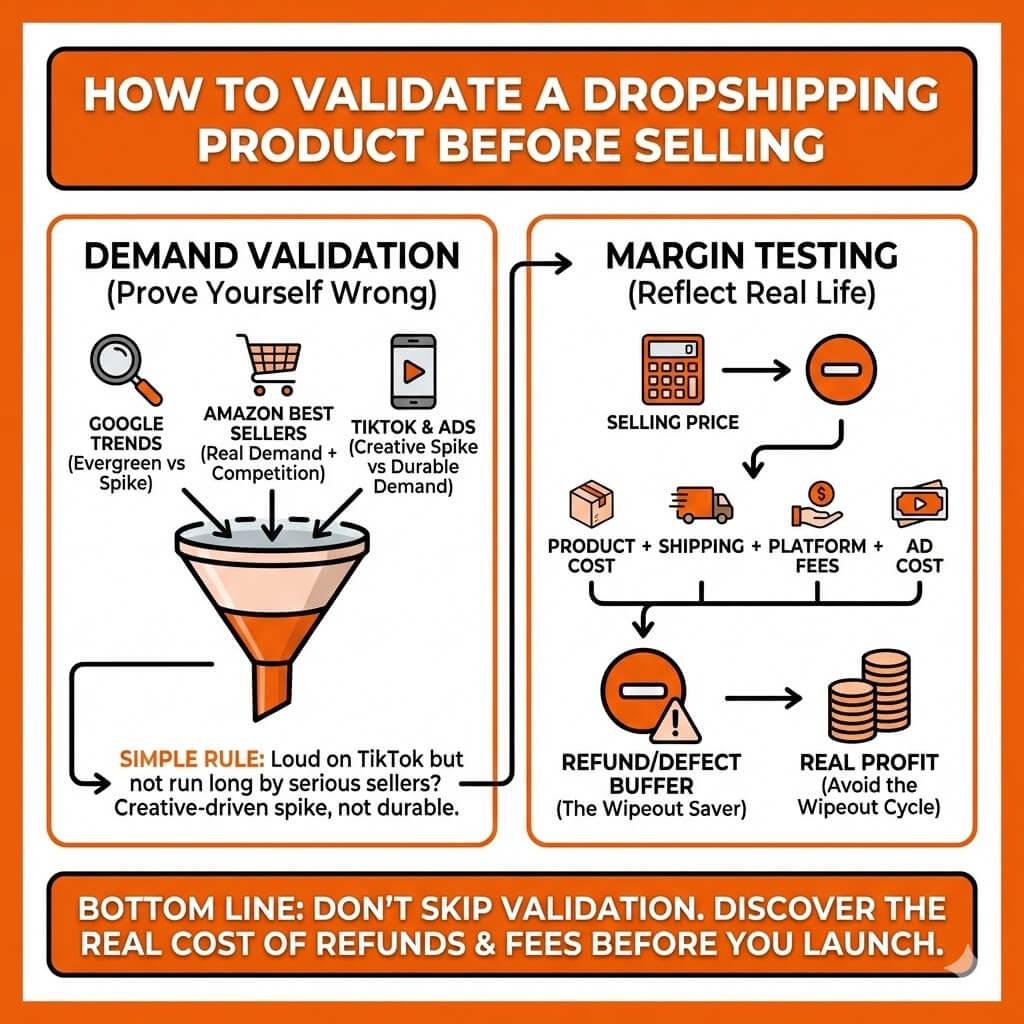
Most sellers don’t lose because they “picked the wrong niche.” They lose because they skip validation, then discover the real cost in refunds and fees.
Validate like you’re trying to prove yourself wrong. Use a few signals together:
Google Trends: evergreen vs short spike
Amazon Best Sellers: real buying behavior + competition
TikTok: creative angles (not proof of durable demand)
Competitor stores
Ad libraries
A simple rule: if a product is loud on TikTok but serious sellers don’t run it for long, it may be a creative-driven spike, not a durable product.
Before you build listings and ads, run one fast calculation:
Real profit = Selling price - Product cost - Shipping - Platform fees - Ad cost - Refund/defect buffer
That buffer is what saves you from the “looks profitable → refunds wipe it out” cycle-especially in beauty, toys, and electronics accessories.
What is the best product to dropship in 2026?
There’s no single “best product” for everyone. The easiest winners are usually problem-solving, lightweight, low-breakage products with a clear use case that can be understood in seconds.
What niche is most profitable in dropshipping?
Durable profit comes from low disputes, stable delivery, and manageable returns. Pet, home/kitchen problem solvers, and simple fitness accessories tend to be more stable than “hot” niches with higher risk.
What products should beginners dropship?
Start with compact, simple items that are easy to describe and low risk for compliance and defects. Avoid branded/IP-heavy products, fragile items, and complex electronics.
How do I find winning products?
Combine marketplace data (Amazon/eBay), trend signals (TikTok), competitor observation, and a quick margin test that includes a refund buffer.
What are evergreen dropshipping products?
Pet essentials, home organization, cleaning tools, basic fitness accessories, and universal car accessories are often evergreen because they solve repeated daily problems.
If you want the best dropshipping products to sell, don’t start with “what’s trending.” Start with “what survives ops.”
When you pick products with clear demand, low delivery risk, fewer defects, and honest descriptions, you create room to scale ads without refunds destroying profit. If you want to go deeper on shipping speed, tracking stability, and supplier reliability, check the related guides below.

Work with us
Our solutions
Address:
 〒136-0082, Japan, Tokyo, Koto-ku, Shinkiba 3-5-6, 5F
Connect us:


Japan
〒136-0082, Japan, Tokyo, Koto-ku, Shinkiba 3-5-6, 5F
Texas, USA
1606 Audrey Dr, Garland, TX 75040, United States
California, USA
1316 John Reed Ct, City of Industry, CA 91745, United States