

News
Ichiba OnePlatform Team - 20/05/2026
In this article
In 2026, dropshipping is no longer about selling random products to everyone. Successful sellers focus on niches that solve specific problems, match consumer behavior, and allow room for branding and upselling. Whether you are searching for the best dropshipping niches for beginners or aiming to identify the best niche for dropshipping with high profit potential, understanding market dynamics is now a competitive advantage, not an optional skill.
This guide is going to dig deep into the best niches for dropshipping, from beginner-friendly categories with manageable competition to high-profit niches driven by strong demand and clear purchase intent. You will also learn how experienced sellers research, validate, and avoid risky niches, so you can launch with confidence and build a store that survives beyond its first few months.
The best dropshipping niches for beginners are not necessarily the most exciting ones, but the ones that combine stable demand, simple logistics, and clear customer intent. These niches allow new sellers to focus on learning core skills such as product testing, ad optimization, and customer support without being overwhelmed by operational complexity.
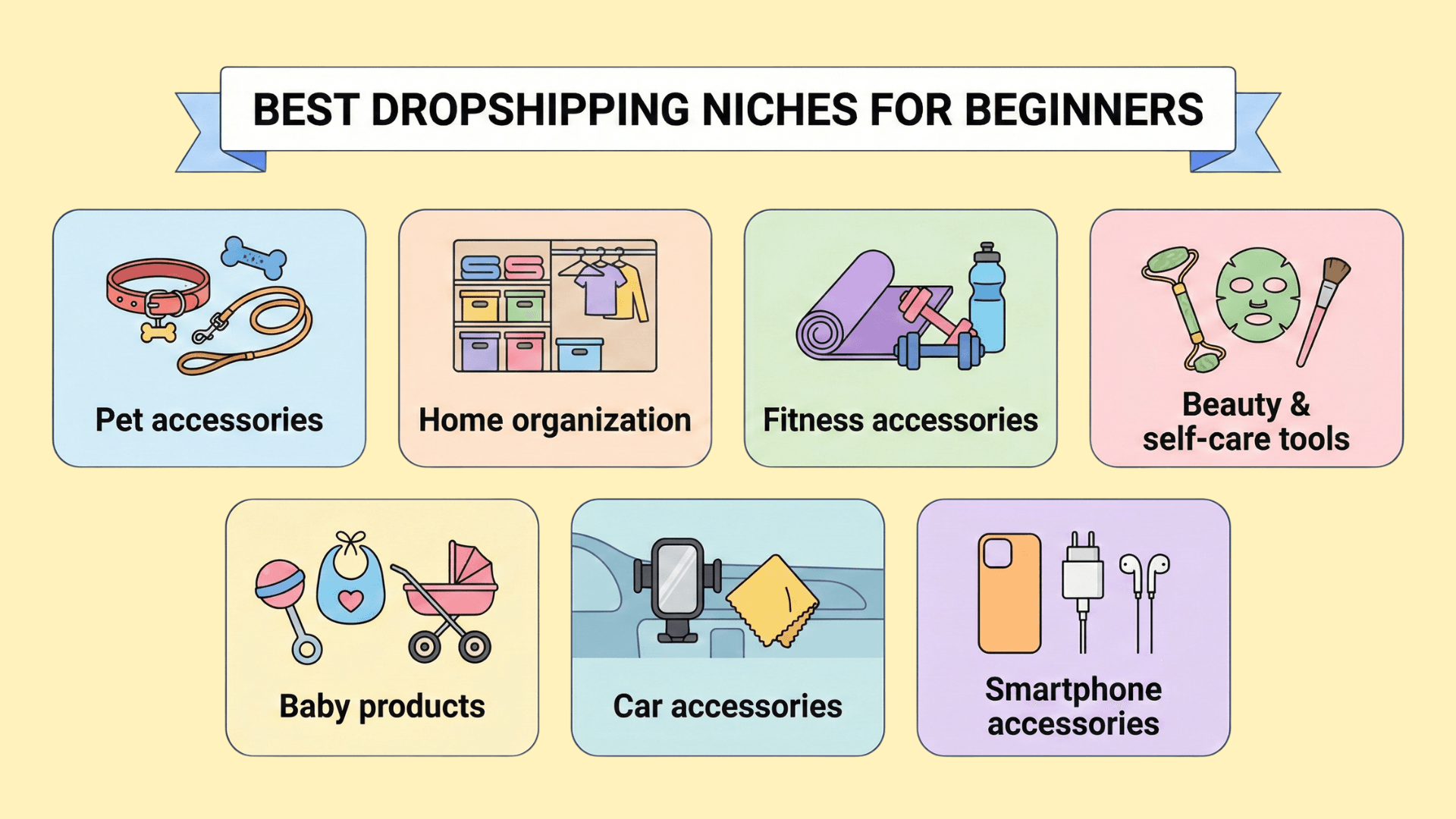
Pet accessories are often seen as one of the safest niches for beginners entering dropshipping. The market is driven by strong emotional attachment, consistent spending habits, and a customer base that actively looks for solutions to everyday pet challenges. Pet owners tend to be forgiving toward new brands as long as the product appears useful and safe, which makes early testing and iteration less risky compared to more technical niches.
Pet owners often treat spending on their pets as a necessity rather than discretionary spending. Products that improve comfort, hygiene, safety, or entertainment directly support the well-being of the pet, making purchase decisions feel justified and even emotionally rewarding.
Marketing also comes naturally in this niche. Pet content performs exceptionally well on social platforms because it triggers positive emotions and relatability. Short videos showing pets enjoying a product or benefiting from it can quickly capture attention and build trust, lowering the barrier for both organic reach and paid advertising.
Most pet accessories are priced between 15 and 40 USD, which strikes a balance between affordability and perceived quality. Buyers are generally comfortable spending within this range, especially when the product is positioned as improving their pet’s daily life.
From a seller's perspective, this price range leaves enough room to absorb advertising costs while still appealing to impulse buyers. It also allows for flexible pricing strategies, such as limited-time offers or bundle deals, without undermining perceived value.
Margins in the pet accessories niche are typically medium to high, particularly for products with a strong emotional angle or a clear problem-solving function. Items that promise comfort, safety, or improved behavior often support higher markups because owners prioritize their pet’s needs over price comparisons.
Competition in this niche is high, but it is also heavily segmented. Rather than targeting all pet owners, beginners can narrow their focus to specific animals, breeds, sizes, or usage scenarios. This approach reduces direct competition and allows more personalized messaging.
Well-performing products in this niche include grooming gloves, automatic feeders, interactive toys, portable water bottles for pets, and pet car seat covers. Accessories that improve daily routines, support outdoor activities, or reduce mess tend to receive strong engagement. Products that are durable, easy to clean, and safe for pets are especially valued and often generate repeat purchases and positive reviews.
As living areas become smaller in urban environments and multifunctional homes become more common, the need for smart storage and organization solutions grows steadily. For beginner dropshippers, this niche is especially approachable because the products are intuitive, easy to explain, and solve problems that customers immediately recognize in their daily lives.
The biggest strength of the home organization niche lies in how clearly it addresses everyday pain points. Cluttered drawers, messy kitchens, overcrowded closets, or wasted space under sinks are problems most households face at some point.
Because these frustrations are universal, marketing does not require heavy education or persuasion. Simple demonstrations, such as before-and-after visuals or short videos showing how a product transforms a space, are often enough to communicate value instantly.
Another reason this niche works well is its repeat purchase potential. Customers rarely stop at one organizer. Once they experience a small improvement in one area of the home, they are more likely to apply the same solution to other rooms.
Most home organization products fall within the 20 to 50 USD price range, which is a comfortable psychological zone for many buyers. At this level, products are perceived as practical upgrades to the home rather than impulse gadgets or risky purchases. Customers are generally willing to spend this amount because the products promise long-term utility and daily convenience.
Margins in the home organization niche are typically moderate, but they can improve significantly with smart offer structuring. Selling single items often leads to average margins, while higher profitability usually comes from bundles, sets, or multi-unit deals. For example, offering a complete drawer organization set or a full under-sink storage solution increases perceived value while justifying a higher price point.
Because many organizational products are lightweight and non-electronic, shipping costs tend to be manageable. This helps protect margins and reduces the risk of returns caused by technical issues.
Competition in this niche is moderate, which makes it accessible for beginners who are willing to niche down strategically. Instead of targeting home organization broadly, successful sellers often focus on specific contexts such as small apartments, family homes, kitchens, bathrooms, or wardrobe organization.
Common and proven products in this niche include drawer organizers, foldable storage boxes, under-sink shelving systems, closet organizers, and kitchen space-saving solutions. These items perform well because they solve visible problems and are easy to showcase in real-life settings. Products that are modular, stackable, or adjustable tend to attract more interest, as they adapt to different home layouts and customer needs.
Unlike large fitness equipment, these products are typically used to enhance existing workout routines rather than replace them, which lowers the barrier to purchase. Customers do not need to place full trust in a new brand to buy a small accessory, especially when the product promises immediate and practical benefits.
Fitness accessories are used by gym-goers, home workout enthusiasts, yoga practitioners, and even people recovering from minor injuries or looking to stay active at home. This variety allows sellers to tailor their messaging to different lifestyles without changing the core product offering.
Health and fitness continue to be priorities rather than short-lived trends. Even consumers who do not consider themselves highly athletic are increasingly interested in maintaining mobility, posture, and basic strength.
Many purchases in this niche are driven by specific goals or discomforts, such as improving flexibility, reducing muscle soreness, or correcting posture during daily activities. These clear motivations make marketing more straightforward, as sellers can focus on problem-solution messaging rather than abstract brand positioning.
Most fitness accessories are priced between 10 and 35 USD, which places them in a low-risk category for consumers. This price range encourages impulse purchases and makes customers more willing to try new products, even from unfamiliar brands.
Margins in the fitness accessories niche are generally moderate on individual items, but profitability improves significantly through smart offer design. Bundling complementary products, such as resistance bands with a stretching strap or a foam roller with a massage ball, increases perceived value while raising average order value.
Competition in the fitness accessories market is high, but demand remains consistently strong throughout the year. Rather than competing head-on with generic products, beginners can improve their chances by focusing on specific workout styles, such as yoga, pilates, home strength training, or rehabilitation-focused fitness.
Targeting specific pain points, such as wrist support, lower back relief, or posture correction for desk workers, also helps differentiate offerings. By narrowing the audience and sharpening the value proposition, new sellers can avoid price wars and build relevance within a smaller but more engaged customer base.
Well-performing products in this niche include resistance bands, posture correctors, yoga straps, foam rollers, grip strength trainers, and mobility tools. Accessories that are compact, versatile, and easy to store tend to attract higher interest, especially among home workout users. Products that support multiple exercises or fitness levels are particularly appealing, as they offer greater perceived value without increasing complexity.
Beauty and self-care tools are especially appealing for beginner dropshippers who plan to rely on short videos, influencer content, and visual storytelling. This niche performs well on platforms like TikTok and Instagram because products are easy to demonstrate, and results can often be shown in a short amount of time. Transformation content, such as before and after routines or daily self-care rituals, naturally attracts attention and encourages engagement.
Many consumers are looking for more affordable alternatives to salon treatments or professional beauty services. Tools that promise convenience, time savings, or visible improvements at home resonate strongly with this mindset. Buyers often feel they are making a smart investment by purchasing a one-time tool instead of paying recurring service fees.
The demand in this niche is also driven by social proof. When consumers see real people using a tool and sharing their experience, trust builds quickly. This makes beauty and self-care tools particularly suitable for user-generated content, influencer reviews, and tutorial marketing that clearly demonstrates how the product fits into a daily routine.
Most beauty and self-care tools are priced between 15 and 45 USD, which strikes a balance between affordability and perceived quality. This range allows products to feel accessible without being viewed as disposable or low-value.
For sellers, this pricing supports flexibility in promotions, such as limited-time discounts or bundle offers, while still maintaining reasonable profit margins.
Margins in this niche are often high, particularly for tools that create a strong visual impact or benefit from viral exposure. Many products have relatively low manufacturing costs compared to their perceived value, especially when presented with premium branding and thoughtful packaging.
Competition in beauty and self-care tools is intense, but the market evolves quickly. New tools, techniques, and trends regularly emerge, creating opportunities for beginners to enter early before products become widely available.
Sellers who move quickly, test new products, and adapt their messaging can capture attention while interest is still growing. Focusing on specific concerns, such as skincare routines for busy professionals or scalp care for stress relief, also helps reduce direct competition.
Popular products in this niche include facial cleansing brushes, jade rollers, scalp massagers, LED beauty tools, and electric nail care devices. Tools that are easy to use, safe for home application, and visually engaging tend to perform best. Products that can be incorporated into daily routines or self-care rituals often achieve stronger repeat engagement and word-of-mouth sharing.
>> See more: Top beauty dropshipping suppliers
Baby products attract a highly motivated and emotionally invested buyer group. Parents and caregivers are consistently looking for ways to improve safety, comfort, and convenience in their daily routines.
For beginner dropshippers, this niche can be rewarding when approached carefully, especially by focusing on non-medical, non-consumable items that do not involve health claims or ingestion. Products that simplify childcare tasks or improve everyday organization tend to perform better than novelty items.
Parents actively search for products that make childcare easier, safer, and more manageable. Many purchases are driven by daily necessities, such as feeding, sleeping, traveling, or organizing baby essentials. Because these needs are constant, demand remains relatively stable throughout the year.
Decisions in this niche are often made based on the problems of the parents. When parents experience inconvenience or stress, they are more willing to invest in tools that offer clear and immediate benefits. Marketing works best when it highlights real-life scenarios and shows how the product integrates naturally into everyday parenting routines.
Most baby accessories fall within the 20 to 50 USD range, reflecting the importance parents place on quality, durability, and reliability. Buyers are generally less price sensitive in this niche compared to others, especially when the product directly affects their child’s comfort or safety.
This pricing range allows sellers to position products as thoughtful solutions rather than cheap alternatives. Clear descriptions, messaging of safety, and professional presentation help justify the price and build confidence among cautious buyers.
Margins in the baby products niche are typically medium, but they improve significantly for items that are well designed and solve specific problems. Products that reduce stress, save time, or improve organization tend to perform better than generic accessories.
Bundling related items, such as organizers with travel accessories, can increase average order value while maintaining relevance. Emphasizing design quality, ease of use, and usability in the long run also helps support healthier margins without relying on aggressive discounts.
Competition is moderate to high, as many sellers are attracted to the consistent demand in this niche. However, trust plays a much larger role than in impulse markets. New sellers can stand out by providing clear product information, transparent usage instructions, and realistic expectations rather than exaggerated claims.
Narrowing the focus to specific parenting situations, such as travel with infants or small space living, can also reduce direct competition. When messaging feels honest and practical, parents are more likely to engage and convert.
Common examples of baby products suitable for dropshipping include baby monitors, bottle warmers, diaper organizers, baby travel accessories, and safety locks. Products that are intuitive, durable, and easy to clean tend to receive better feedback. Items that support daily routines and reduce mental load for parents are especially attractive and often generate repeat purchases or referrals.
Car accessories appeal to a wide range of drivers who want to improve comfort, organization, or visual appeal inside their vehicles. From daily commuters to rideshare drivers and road trip enthusiasts, this niche covers multiple use cases without requiring complex technical knowledge. For beginner dropshippers, car accessories are relatively easy to work with because most products are durable, lightweight, and simple to demonstrate through photos or short videos.
Many people spend a significant amount of time in their cars each day, whether for commuting, work, or family responsibilities. As a result, drivers are often willing to invest in affordable accessories that reduce inconvenience, improve organization, or add a personal touch to their vehicle.
Marketing in this niche is effective because problems are easy to visualize. Messy interiors, limited storage, or awkward phone placement can be quickly highlighted and solved within seconds of a demonstration. This makes car accessories particularly suitable for short video content and straightforward problem-solving messaging.
Most car accessories are priced between 15 and 40 USD, which feels reasonable for items that enhance daily driving experiences. This price range encourages impulse purchases while still allowing products to be positioned as useful upgrades rather than unnecessary add-ons.
For sellers, this pricing offers flexibility to test different products and promotions without a large upfront investment. It also allows room for discounts or bundle offers without significantly impacting perceived value.
Margins in the car accessories niche are generally medium on individual items, but profitability improves when complementary products are offered together. For example, organizers can be bundled with seat gap fillers or phone mounts to create a more complete interior solution.
Upsells work well because many accessories address related problems. Once a customer is already improving their car interior, they are more likely to add another small item that enhances the overall experience.
Competition is moderate, especially for generic products that appeal to a broad audience. However, sellers can reduce competitive pressure by narrowing their focus. Targeting specific car types, driving habits, or usage scenarios helps differentiate offerings and messaging.
Well-performing products in this niche include car organizers, phone mounts, seat gap fillers, interior LED lights, and dashboard storage solutions. Accessories that are easy to install, do not require tools, and fit a wide range of vehicles tend to attract higher interest. Products that combine practicality with subtle aesthetic improvements often see stronger engagement and repeat purchases.
Smartphone accessories continue to be one of the most accessible niches for beginner dropshippers, thanks to universal demand and constant product refresh cycles. Nearly every consumer owns a smartphone, and most users purchase accessories multiple times throughout the lifespan of their device. This creates a large and continuously renewing customer base, making it easier for new sellers to find buyers without needing to educate the market.
Smartphone accessories solve everyday usage needs that consumers experience firsthand. Protection, convenience, charging efficiency, and personalization are all ongoing concerns for smartphone users. Because these needs are familiar and immediate, purchasing decisions are often quick and require little deliberation.
Many buyers do not research extensively before purchasing accessories, especially when prices are low. Visual appeal, perceived usefulness, and compatibility messaging play a major role in conversions. This makes marketing more straightforward, as sellers can focus on clear demonstrations and lifestyle scenarios rather than complex explanations.
Most smartphone accessories are priced between 10 and 30 USD, which places them firmly in the impulse purchase category. This price range lowers psychological resistance and encourages buyers to add items to their cart without extended consideration.
For sellers, lower price points allow rapid testing of multiple products and creatives with limited budgets. It also makes accessories suitable for bundle deals or buy more save more offers that increase order value without raising perceived risk.
Margins in the smartphone accessories niche range from medium to high, depending on differentiation. Generic items tend to face price pressure, while accessories with unique designs, added functionality, or premium materials support stronger pricing.
Branding and presentation play an important role in margin optimization. Custom packaging, clear compatibility labeling, and strong visual identity can elevate simple products and justify higher price points. Accessories that combine multiple functions, such as charging and mounting, often perform especially well.
Competition in this niche is very high, particularly on major marketplaces. However, beginners can still find opportunities by focusing on micro niches rather than the entire smartphone user base. Targeting specific phone models, lifestyles, or use cases helps reduce direct competition.
Creative branding also makes a difference. Positioning accessories around productivity, content creation, travel, or gaming allows sellers to speak to a defined audience rather than competing solely on price. Story-telling marketing and consistent visuals help build recognition even in crowded spaces.
Popular smartphone accessories include phone stands, charging cables, wireless chargers, magnetic mounts, and camera lens attachments. Products that improve daily usability, support content creation, or enhance charging convenience tend to perform best. Accessories that are compact, durable, and compatible with multiple devices often generate repeat purchases and positive customer feedback.
While beginner niches focus on ease of entry, high-profit niches are built around strong buyer intent, clear problem-solving value, and the ability to support premium pricing. In 2026, the best niche for dropshipping is no longer defined by cheap products alone, but by how well a niche aligns with lifestyle shifts, technology adoption, and long-term consumer behavior. The niches below stand out because they allow sellers to charge more, upsell effectively, and build stronger brands rather than stores that just have one flagship product.
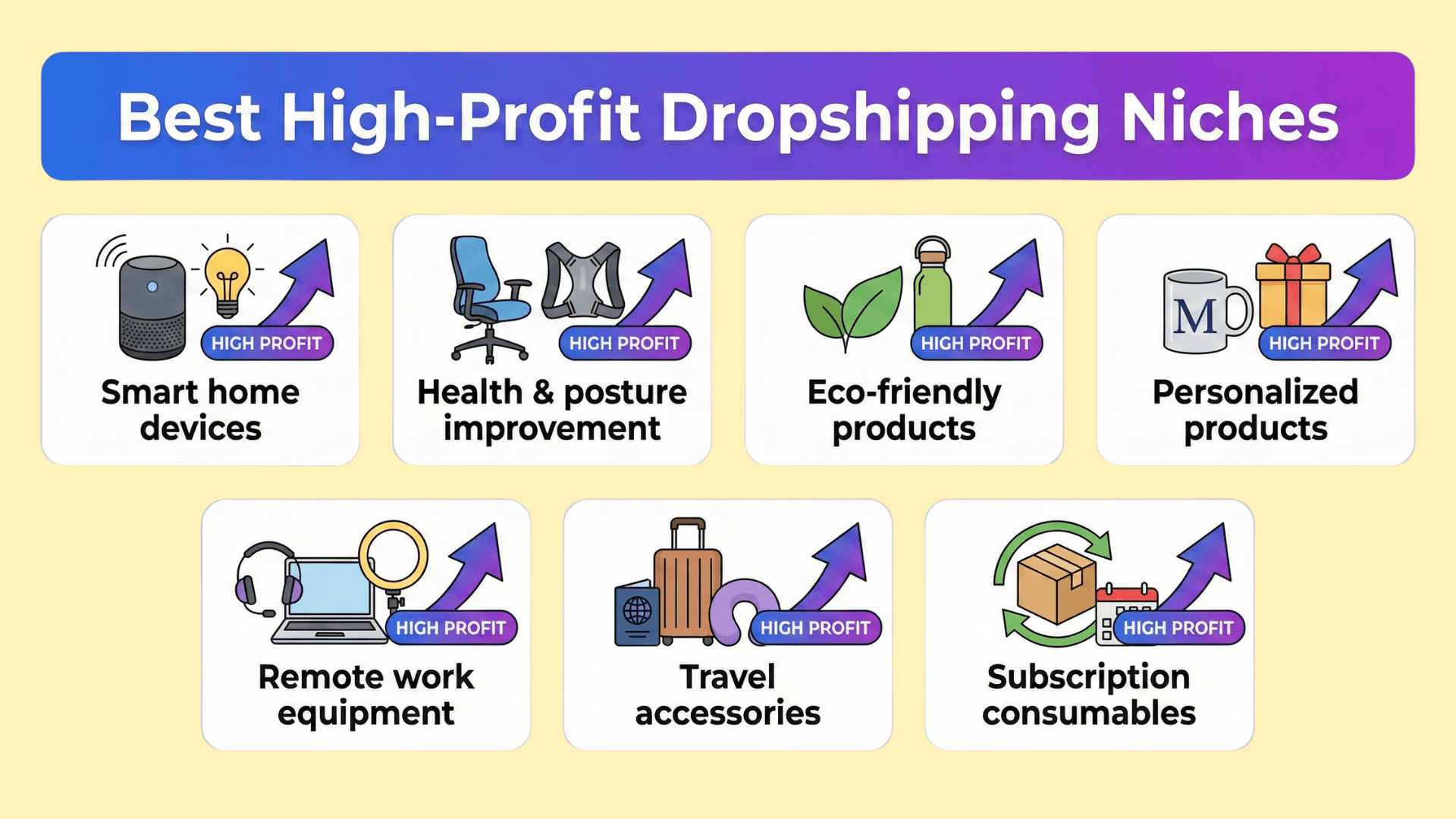
Smart home devices are steadily moving from optional tech upgrades to everyday household essentials. As prices become more accessible and setup processes simpler, adoption is expanding beyond early adopters to mainstream consumers. This shift opens the door to a much broader market that includes families, renters, and remote workers.
Rather than buying everything at once, many users build their smart home gradually. This behavior supports long term demand as consumers continuously add new devices that integrate with existing systems.
Health and posture improvement has evolved into a special niche rather than a trending one. Buyers are no longer experimenting out of curiosity but actively searching for products that help them feel better in daily life.
Extended screen time and remote work routines have made discomfort and posture issues increasingly common. As a result, consumers are motivated to purchase tools that promise relief or long-term prevention.
Eco-friendly products have transitioned from niche alternatives to preferred choices for a growing segment of consumers. Sustainability is now closely tied to lifestyle identity, which allows sellers to position products as valuable decisions rather than simple functional purchases.
Demand is fueled by rising environmental awareness, regulatory influence, and a cultural shift toward conscious consumption. Buyers actively look for reusable, low-waste, or long-lasting products that align with their values, often showing higher brand loyalty once trust is established.
Personalized products stand out because they compete on meaning rather than price. Customization creates emotional attachment, which not only supports higher price points but also reduces direct comparison with mass-produced alternatives.
Many purchases in this niche are tied to specific moments such as gifting, celebrations, or self-expression. This gives sellers a clear context for marketing and messaging. Because buyers already expect a premium experience, upsells feel natural when framed as enhanced personalization, upgraded materials, or gift options.
As hybrid work becomes a permanent reality, remote work equipment continues to see consistent demand. Consumers increasingly view their home workspace as a lasting investment rather than a temporary setup, which changes how they evaluate product quality and value.
Purchasing decisions in this niche are highly practical. Buyers prioritize comfort, productivity, and durability because products are used daily. This behavior supports higher average order values and lower return rates. Sellers can expand revenue by offering workspace bundles, ergonomic upgrades, or accessories that improve overall work efficiency.
Travel accessories benefit from a blend of aspiration and necessity. As global travel rebounds and flexible lifestyles grow, consumers seek products that make travel smoother, lighter, and more organized.
Purchasing intent is especially strong during trip planning phases, when buyers are actively preparing for the trip. This creates great demand that converts well with the right messaging. Sellers often increase order value by packaging products into travel kits or offering destination and seasonal collections.
Subscription consumables represent a shift from one-time transactions to sustainable customer relationships. Products that are used regularly and require replenishment naturally fit into this model, especially when convenience is the main selling point.
Because these purchases are habitual and often essential, buyer commitment tends to be higher once the initial decision is made. Profitability grows over time through retention rather than constant customer acquisition. Upselling opportunities include premium plans, bundled subscriptions, and complementary products that extend the customer’s routine or lifestyle.
Finding a winning niche is not about intuition or copying what other sellers are doing at the surface level. Professional dropshipping sellers follow a structured research and validation process that reduces risk and increases the probability of sustainable success.
Professional sellers rarely rely on a single idea or a single data source when searching for the best dropshipping niches. Instead, they follow a step-by-step workflow that filters out weak opportunities early and focuses attention on niches with real commercial potential.
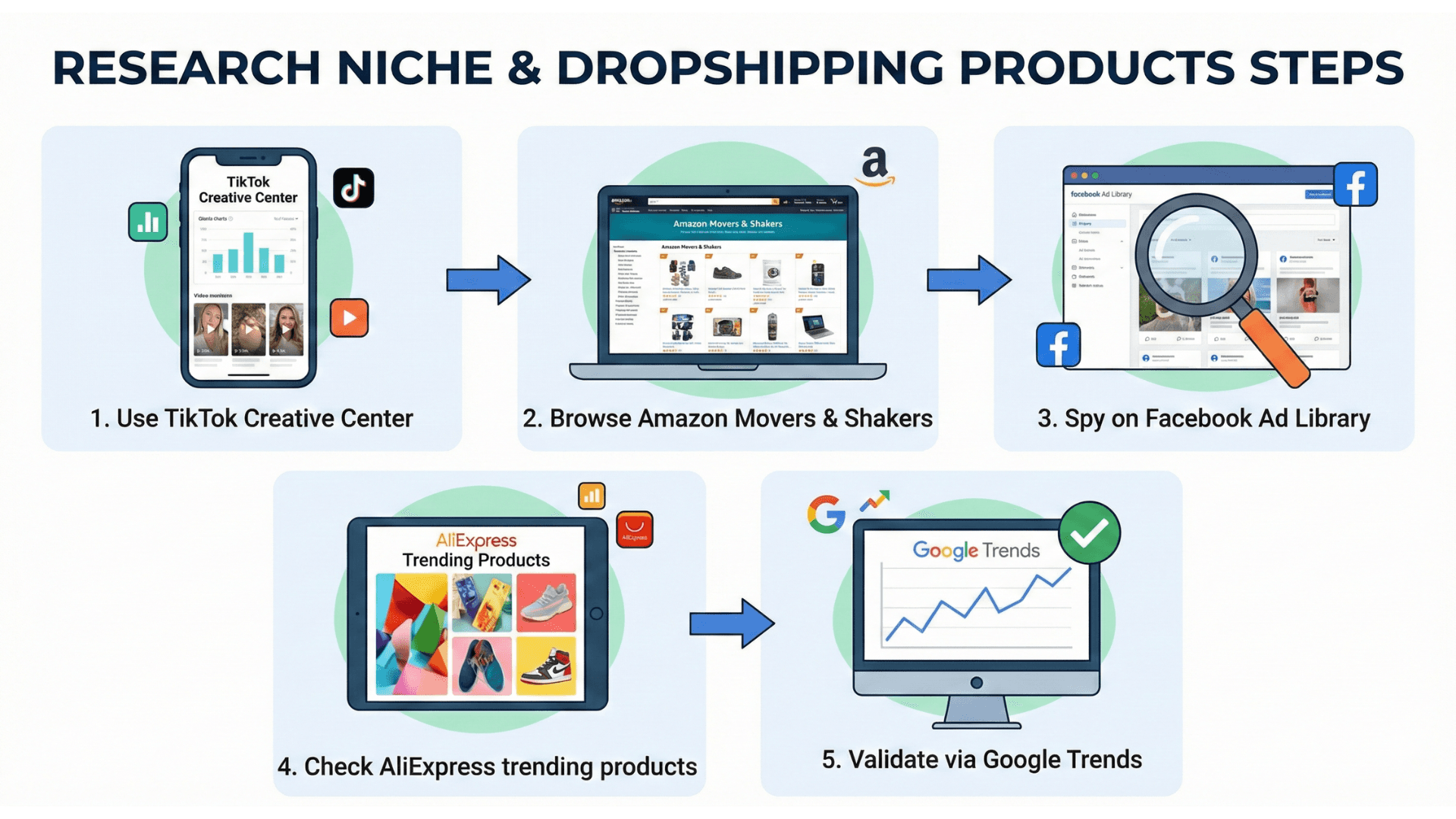
The first step is to observe how users interact with products in a natural content environment. TikTok Creative Center allows sellers to analyze trending ads, top-performing creatives, and engagement metrics across different regions. When a product or niche consistently appears with strong engagement and multiple creators promoting similar concepts, it usually indicates early demand rather than one-time virality.
After spotting early interest, sellers move to Amazon Movers and Shakers to confirm whether that interest translates into actual purchases. Products that rapidly climb rankings within a category often reflect real demand backed by consumer spending.
Once demand is confirmed, analyzing the Facebook Ad Library helps sellers determine whether a niche can support paid advertising at scale. Ads that have been running for extended periods suggest that the advertiser is profitable or at least breaking even. By reviewing ad copy, creatives, and landing pages, sellers gain insight into messaging angles, emotional triggers, and competitive intensity within the niche.
At this stage, sellers evaluate whether the niche is operationally viable. Browsing AliExpress trending products helps assess supplier availability, cost structure, and product variations. This step is not about copying products directly, but about understanding whether reliable sourcing exists and whether there is room to improve quality, packaging, or perceived value.
Before committing to a niche, sellers must ensure that demand is not purely seasonal or declining. Google Trends provides a broader time horizon, allowing sellers to evaluate whether interest is stable, growing, or fading. A niche that shows consistent demand over multiple years is far more suitable for brand building than one driven by short-term hype.
Professional dropshipping sellers do not rely on tools to replace thinking, but to accelerate decision-making and reduce blind spots. Each tool serves a specific purpose in the niche research process, from spotting early trends to validating long-term demand. Understanding how and when to use these tools is essential for identifying the best dropshipping niches rather than chasing short-lived opportunities.
Minea is primarily used to analyze advertising performance across multiple platforms, including Facebook, TikTok, and Pinterest. Sellers use Minea to identify products and niches that attract sustained ad spend, which is often a strong signal of profitability.
By filtering ads based on engagement, duration, and geographic targeting, sellers can quickly spot patterns that indicate scalable niches. Minea is especially useful for understanding creative angles and messaging that resonate with buyers within competitive markets.
Sell The Trend focuses on product discovery and trend validation, making it valuable during the early ideation phase. Sellers use this tool to explore emerging products, track sales velocity, and evaluate saturation levels within a niche. Rather than relying solely on trending labels, experienced sellers look for products with steady upward movement and reasonable competition scores.
AdSpy is a deep research tool designed for competitive analysis. Professional sellers use AdSpy to study how established brands and high-volume advertisers structure their campaigns. By analyzing ad copy, creative formats, and landing page strategies, sellers gain insight into what works at scale within a niche.
Google Trends remains one of the most important tools for validating durable niche viability. Sellers use it to assess demand stability over months and years, identify seasonal patterns, and compare interest across regions. A niche with consistent or growing search interest is far more suitable for building a sustainable dropshipping business than one driven by temporary hype.
TikTok Creative Center is a powerful free tool for understanding content-driven demand. Sellers use it to analyze trending creatives, popular hashtags, and audience engagement metrics. This tool is especially valuable for identifying niches that perform well with short-form video and influencer marketing. When a niche shows repeated creative formats and consistent engagement, it often indicates strong market appetite rather than a one-off trend.
Before launching any product or niche, professional sellers move through a structured validation process to confirm that demand, logistics, and profitability align. This step is critical for avoiding wasted ad spend and operational headaches. Instead of relying on excitement or assumptions, sellers evaluate multiple factors that collectively determine whether a niche truly belongs among the best dropshipping niches.
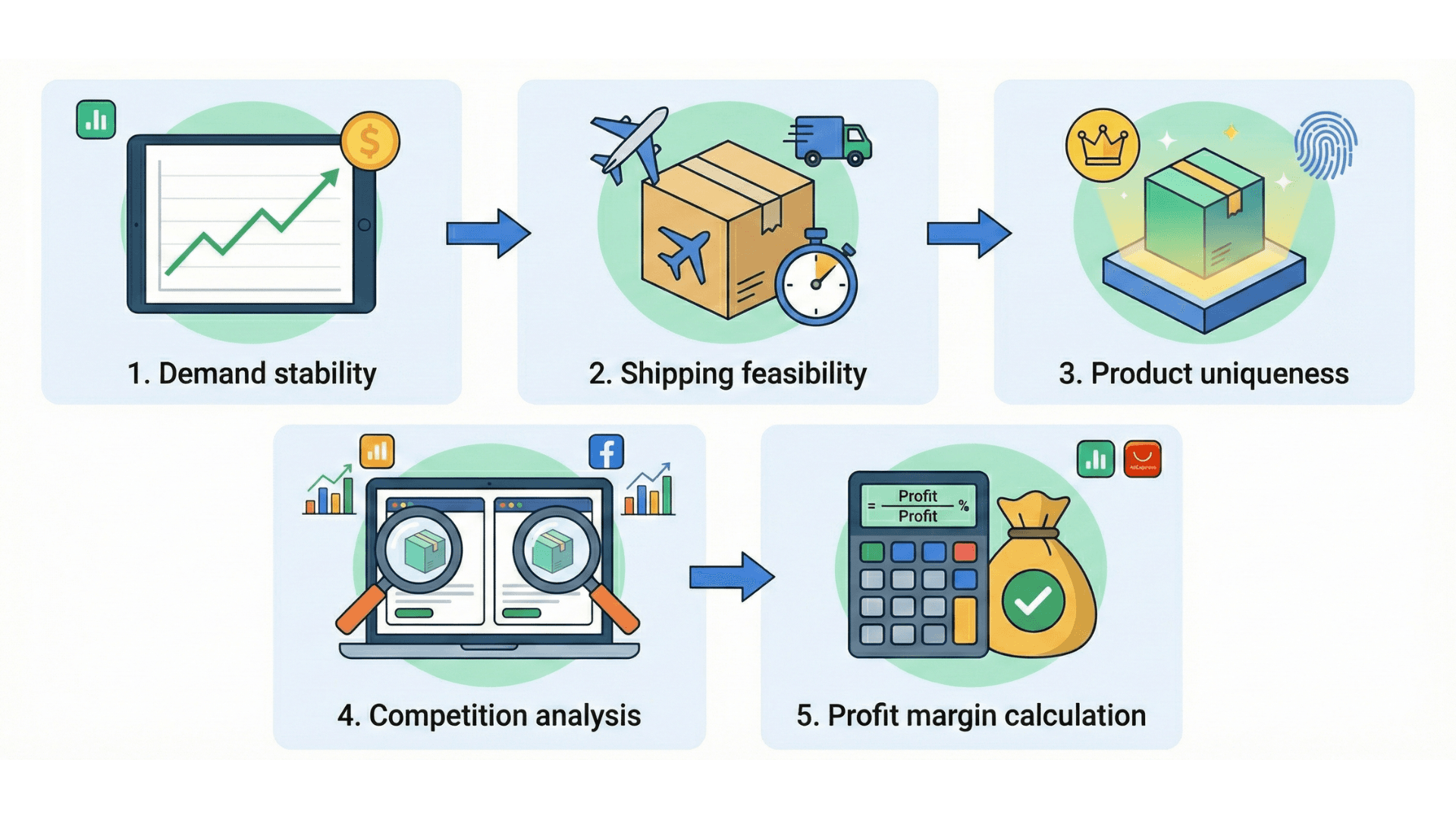
The first validation step is confirming that demand is stable rather than driven by short-term hype. Sellers analyze search trends, ad longevity, and content consistency across platforms to see whether interest holds over weeks and months. Niches with steady engagement and recurring buyer questions are far more suitable for long-term scaling than those showing sharp spikes followed by rapid decline.
Logistics can make or break a dropshipping business. Sellers evaluate product size, weight, fragility, and shipping routes to ensure reasonable delivery times and costs. Products that are easy to pack, unlikely to break, and compatible with multiple shipping methods reduce refund rates and customer complaints, which is especially important when scaling paid traffic.
Even in competitive markets, products can succeed if they are positioned correctly. Sellers examine whether a product can be differentiated through design, functionality, packaging, or branding. Niches that allow storytelling, meaningful messaging, or lifestyle positioning tend to perform better than those competing purely on price.
Understanding the competitive landscape helps sellers avoid entering markets dominated by strong brands with large budgets. This step involves reviewing ad volume, pricing strategies, creative quality, and brand presence. Niches with moderate competition and clear gaps in positioning often offer better opportunities for new sellers.
High revenue does not always mean high profit. Sellers calculate margins by factoring in product cost, shipping, advertising, platform fees, and customer support expenses. Niches that maintain healthy margins after paid traffic are far more scalable and sustainable over time.
Knowing which niches to avoid is just as important as identifying the best dropshipping niches. Many sellers fail not because dropshipping does not work, but because they enter markets with poor margins, excessive competition, or hidden risks that only appear after spending money on ads.
Oversaturated niches are markets where too many sellers offer nearly identical products with little room for differentiation. In these niches, competition is driven almost entirely by price, which quickly erodes margins and makes scaling extremely difficult.
Generic phone cases are a classic example. While demand is massive, buyers have endless options across marketplaces and local retailers, making it hard to justify premium pricing or build brand loyalty.
Cheap jewelry often attracts beginners because of low sourcing costs, but intense competition and low perceived value lead to razor-thin margins and high return rates.
Fidget toys experienced explosive growth during their peak trend phase, but demand quickly collapsed once the novelty faded. Niches driven purely by hype tend to burn out faster than sellers can adapt.
Basic clothing items such as plain T-shirts or generic hoodies suffer from sizing issues, quality complaints, and extremely strong competition from established fashion brands.
High-risk niches may look profitable on the surface, but they carry operational, legal, or customer satisfaction risks that can quickly damage a store.
Medical claims products are particularly dangerous. Items that promise to cure, treat, or prevent health conditions often violate advertising policies and can lead to account bans or legal issues.
Copyrighted items, including products featuring movie characters, logos, or celebrity images, expose sellers to intellectual property claims and store shutdowns.
Fragile items such as glassware or delicate electronics result in higher shipping damage rates, refunds, and negative reviews, especially when fulfillment quality is inconsistent.
Heavy shipping products dramatically increase delivery costs and reduce impulse buying behavior. These products also make it harder to compete with local sellers who can ship faster and cheaper.
Many sellers underestimate how platform policies and regulations affect niche selection. Ignoring compliance risks often leads to ad account suspensions or forced product removal.
Health claims restrictions are tightly enforced by major ad platforms. Even indirect claims related to weight loss, pain relief, or medical benefits can trigger ad rejections.
Trademark issues arise when sellers unknowingly use protected brand names or product designs in listings or ads. This risk increases in popular niches with established brands.
Ad platform bans often occur in niches associated with misleading claims, unsafe products, or deceptive marketing practices. Recovering from a banned account can be costly and time-consuming.
How do I know if a niche is profitable?
A niche is profitable when demand, margins, and scalability align. Sellers should look beyond popularity and analyze whether customers are actively spending money, not just engaging with content.
Consistent ad activity, stable search interest, and the ability to price products with healthy margins after advertising costs are strong indicators. Running small test campaigns is often the most reliable way to confirm profitability before fully committing.
Can I change niches later?
Yes, changing niches is common and often necessary as sellers gain experience. Many successful stores started in one niche and pivoted after learning what worked and what did not. Skills such as product research, advertising, and conversion optimization are transferable across niches, making it easier to adapt when market conditions change.
How many products should a niche store have?
Most niche stores perform best with a focused product selection rather than a large catalog. For beginners, starting with five to ten closely related products allows for clearer branding and simpler testing. As data accumulates, sellers can expand their product range based on proven demand and customer feedback rather than adding products at random.
What niches have the highest margins?
Niches with the highest margins typically solve clear problems, support branding, and allow perceived value to exceed production cost. High margins are less about the niche itself and more about positioning, differentiation, and how well the product is marketed.
Finding the best dropshipping niches is not about copying what is trending today, but about understanding how demand, buyer intent, and profitability come together over time. Sellers who succeed in 2026 are those who approach niche selection strategically, using data, structured validation, and realistic expectations instead of shortcuts.
Dropshipping continues to evolve, and opportunities still exist for sellers who are willing to research deeply and execute thoughtfully. By applying the frameworks and insights in this guide, you can confidently identify the best niche for dropshipping, adapt as the market changes, and build a business that grows beyond short-term trends.

Work with us
Our solutions
Address:
 〒136-0082, Japan, Tokyo, Koto-ku, Shinkiba 3-5-6, 5F
Connect us:


Japan
〒136-0082, Japan, Tokyo, Koto-ku, Shinkiba 3-5-6, 5F
Texas, USA
1606 Audrey Dr, Garland, TX 75040, United States
California, USA
1316 John Reed Ct, City of Industry, CA 91745, United States