

News
Ichiba OnePlatform Team - 27/05/2026

In this article
China remains the biggest sourcing hub for dropshipping. However, winners do not rely on the cheapest listing. Winners build a supplier setup that dispatches consistently, keeps tracking clean, and holds QC steady over time.
If you are comparing China suppliers for dropshipping, you likely want fewer refunds from quality issues, faster delivery with reliable tracking, less manual fulfillment work, and branding options that protect trust and AOV. In this guide, you will find 5 popular marketplaces, 10 supplier platforms and networks, and a practical checklist to choose based on processing, communication, QC, and delivery consistency.
China offers unmatched catalog depth. You can test more niches without getting stuck on supply. In dropshipping, testing speed is a real edge. You can launch new SKUs fast, validate demand, spot complaint patterns, and scale only proven winners.
Still, depth only helps when you filter well. Without clear rules, it becomes a sea of SKUs and raises QC risk.
China gives you multiple price tiers for positioning. You can source budget items for impulse buys. As competition rises, you can move to mid-tier to cut refunds. When you want to build a brand, you can source premium builds to lift AOV.
A wide range also gives you a real backup plan. If one supplier raises prices or runs out, you can switch faster.
Once a product proves demand, China supports a faster path to branding. You can move from a generic listing to brand assets without switching markets.
Common upgrades include:
custom packaging (boxes, labels, seals)
inserts (thank-you cards, manuals, coupons)
logo printing and private label
The key is control. OEM/ODM only pays off when you control QC and lead time. If you do not, branding looks nice but the customer experience still fails.
China sourcing comes with a full tool stack. You get agents, supplier platforms, and automation apps. When you use them well, they reduce manual work and fulfillment errors.
However, tools amplify what you already have. If QC and dispatch are unstable, automation scales mistakes and refunds faster.
Two suppliers can sell “the same product” with very different QC. They may use the same photos and name, yet materials and finishing can differ a lot.
How to avoid it:
Sample every SKU before you run ads
Define an acceptance checklist (packaging, surface defects, missing parts)
For complaint-prone SKUs, require QC photos or videos per batch
Most seller pain is not “shipping is slow.” It is “shipping is unpredictable.” Labels get created but never scan. Tracking breaks mid-route. Sometimes the line changes without notice.
How to avoid it:
Pick tracked lines for customer orders
Watch for “tracking uploaded but no carrier scan”
Publish delivery expectations by service level (Standard vs Priority vs VIP)
Slow dispatch breaks your delivery promise, even with a fast carrier. Many stores fail because of pre-ship delay, not transit delay.
How to avoid it:
Ask for a processing SLA (paid → dispatch)
Prefer suppliers and platforms with standardized pick-pack workflows
Map bestsellers to the fastest fulfillment path
Language and time zones create mistakes. Unclear requirements cause wrong variants and missed escalations when issues happen.
How to avoid it:
Standardize a message template (SKU, variant, order ID, photo requirements)
Keep a clear escalation path (agent, platform support, account manager)
Track supplier response time as a KPI
Cross-border returns cost a lot. If you lack evidence, refunds become the default. This is worse when customers lose patience.
How to avoid it:
Align your store policy with cross-border reality (reship and refund rules)
Keep evidence packs (QC images, dispatch proof, tracking scans)
Avoid off-platform payments and undocumented promises
These marketplaces are popular because they are easy to start with and easy to test products. But as you scale, the risks show up. QC varies, processing is inconsistent, and tracking can be unreliable. Use them for discovery, then move to a tighter workflow once you have winners.
AliExpress is popular because the barrier is low. You can test many products without dealing with factories directly. If you are new, it helps you learn demand signals and niche complaint patterns.
Common shipping ranges sellers mention:
AliExpress Standard Shipping: often 15-30 days, sometimes longer by season and destination
AliExpress Premium Shipping: often 7-15 days
AliExpress works best when you do three things early. Prioritize recent reviews, sample winners before scaling ads, and avoid untracked economy lines for customer orders.
Helpful guide: AliExpress Dropshipping Guide
Many sellers use Banggood for electronics and gadgets. Its catalog feels more curated than open marketplaces. That can reduce risk from sloppy listings and wrong specs. Still, the catalog is smaller, and pricing may be higher.
Before you scale electronics, confirm warranty and returns handling. Also, confirm shipping method options for each target market.
1688 is common for sellers with proven winners who want factory-adjacent pricing. It helps when you move to bulk or prepare for a private label. In return, operations get harder. You face language barriers, negotiation, minimums, and QC and packing steps.
Treat 1688 as a scale channel, not a beginner channel. Start with one niche and build a repeatable QC and shipping playbook.
Taobao is strong for trend discovery. You can spot what sells fast in China. However, Taobao is not built for cross-border workflows. To run it smoothly, you often need an agent or platform for sourcing and fulfillment.
Use Taobao for discovery first. Then operationalize with an agent or platform once demand is proven.
Global Sources is popular because it supports more serious B2B discovery. It helps you reach manufacturers and vet suppliers with more context. However, it is not click-to-fulfill. You still need a fulfillment setup, shipping lines, and clear SLAs.
If you want higher quality, request samples and certifications when needed. Also, lock lead time and QC steps before you list products.

At scale, the problem is not “finding suppliers.” The problem is connecting supplier → store in a clean operating flow. You need routing, QC, dispatch, tracking, and exception handling. That is why supplier platforms and networks exist. They bundle layers of ops so you do less manual work.
CJDropshipping often feels like you have an ops partner. It supports sourcing, offers warehousing options, and provides shipping lines. For viral SKUs, it can help you move faster early on.
Still, verify processing SLA per SKU. Also, verify tracking reliability on your top routes. Test a small batch before scaling.
DSers is common for Shopify sellers using AliExpress. It reduces manual work through product mapping and bulk ordering. However, DSers does not ship orders itself. Speed still depends on the AliExpress seller and the shipping line you choose.
DSers works best after you have filtered stable sellers and reliable tracked lines.
AutoDS fits multi-supplier operations. It monitors price and stock changes and helps reduce oversell risk. However, automation has a downside. It scales both good and bad outcomes quickly.
If you use AutoDS, audit supplier reliability first. Then set clear rules for tracking anomalies and stock changes.
IChiba fits sellers who want an ops hub: listing → order → fulfillment → tracking. The value comes from centralized visibility and operational control. It can reduce handoffs across tools and help standardize team workflows.
If you evaluate it, confirm supported lanes, processing SLAs by destination, and branding options for proven winners.
EPROLO is often mentioned for sourcing plus branding support and express options by market. It can fit sellers who want to move toward private labels earlier.
Treat published ranges as targets, not promises. Test orders by market before you set customer-facing expectations.
SourcinBox supports network-style workflows. The key is understanding which lines apply to which countries. You also need to confirm scan SLAs and peak season exceptions.
Use each lane calculator by country and run test orders to validate tracking continuity.
HyperSKU is often used for special lines. Yet special line performance depends on route and SKU. Some items get excluded due to size or product attributes.
Test first. Then set promises only after you see scan timing and real delivery outcomes.
Topdser leans into workflow tools for AliExpress and 1688. It can fit teams that need role-based ops. Still, shipping depends on the supplier and carrier line.
If you scale with Topdser, keep a QC step for complaint-prone SKUs.
Yakkyofy is more agent-style and offers multiple lines. The key is line rules. You must confirm which SKUs qualify and how peak surcharges work.
Before you scale, ask them to confirm eligibility for your top SKUs.
Zendrop is often mentioned because it provides clearer expectation-setting through averages and support. However, an average is not a guarantee. This matters even more in peak season.
If you use Zendrop for expectations, keep promises conservative and track route performance weekly.
Quick Comparison Table for Supplier Platforms
Supplier platform | Best for | Shipping reality | Branding options | Supplier type |
CJDropshipping | Sourcing + fulfillment bundle | Varies by line/route | Service-dependent add-ons | Agents + factories |
DSers | AliExpress automation | Depends on AliExpress seller + line | Supplier-dependent | AliExpress |
AutoDS | Multi-supplier automation + monitoring | Depends on underlying supplier + method | Supplier-dependent | Multi-supplier |
IChiba OnePlatform | Ops hub + routing (service-dependent) | Varies by lane/setup | Service-dependent | Multi-source |
EPROLO | Sourcing + branding + express options | Varies by market/line | Service-dependent | Agents + factories |
SourceInBox | Network + fulfillment support | Varies by lane | Service-dependent | Agents + factories |
HyperSKU | Special lines + sourcing support | Varies by lane/route | Service-dependent | Agents + factories |
Topdser | AliExpress/1688 sourcing tools | Depends on supplier + chosen line | Supplier-dependent | AliExpress/1688 |
Yakkyofy | Agent-style service + multiple lines | Varies by line | Service-dependent | Agents + factories |
Zendrop (China/Pro) | Estimates + platform support | Averages vary by country/route | Limited/paid add-ons | Supplier network |
Shipping is not one number. It is processing time plus transit time. Many sellers only look at transit. Yet processing breaks delivery promises more often.
A practical approach is simple. Pick one or two main routes, such as the US. Then test two service levels: Standard and Priority. Once you see scan timing and real delivery, expand to the UK, EU, and AU.
Questions to ask (copy and paste):
What is the processing SLA for this SKU (paid → dispatch)?
After dispatch, how fast is the first carrier scan?
For US/UK/EU/AU, which line stays most stable?
What is your peak season surge policy?
If speed is your main lever, compare benchmarks here: Fastest Dropshipping Suppliers
Most QC failures repeat small issues. Think scratches, missing parts, broken seals, or weak packaging. That is why QC needs a clear checklist by product type.
Test functionality for electronics. Stress-test packaging for fragile items. If a SKU shows complaints, require QC photos or videos per batch before dispatch.
A “cheap” supplier with unstable dispatch costs more. Slow support does the same. You must measure operations, not feelings.
Track these items:
dispatch consistency by day
stock transparency (real vs virtual)
tracking red flags (label created but no scan)
response SLA and escalation path
Branding can lift AOV and trust. However, it can also add lead time and QC complexity. The safe rule is simple. Enable branding only after demand and operations stabilize.
Then negotiate packaging, inserts, logo printing, and QC steps for branded batches.
Do not look only at product price. True cost includes shipping fees, packaging inserts, taxes and duties by market, and payment or FX fees.
If you skip this math, you can earn “fake profit” and lose money through refunds and support.
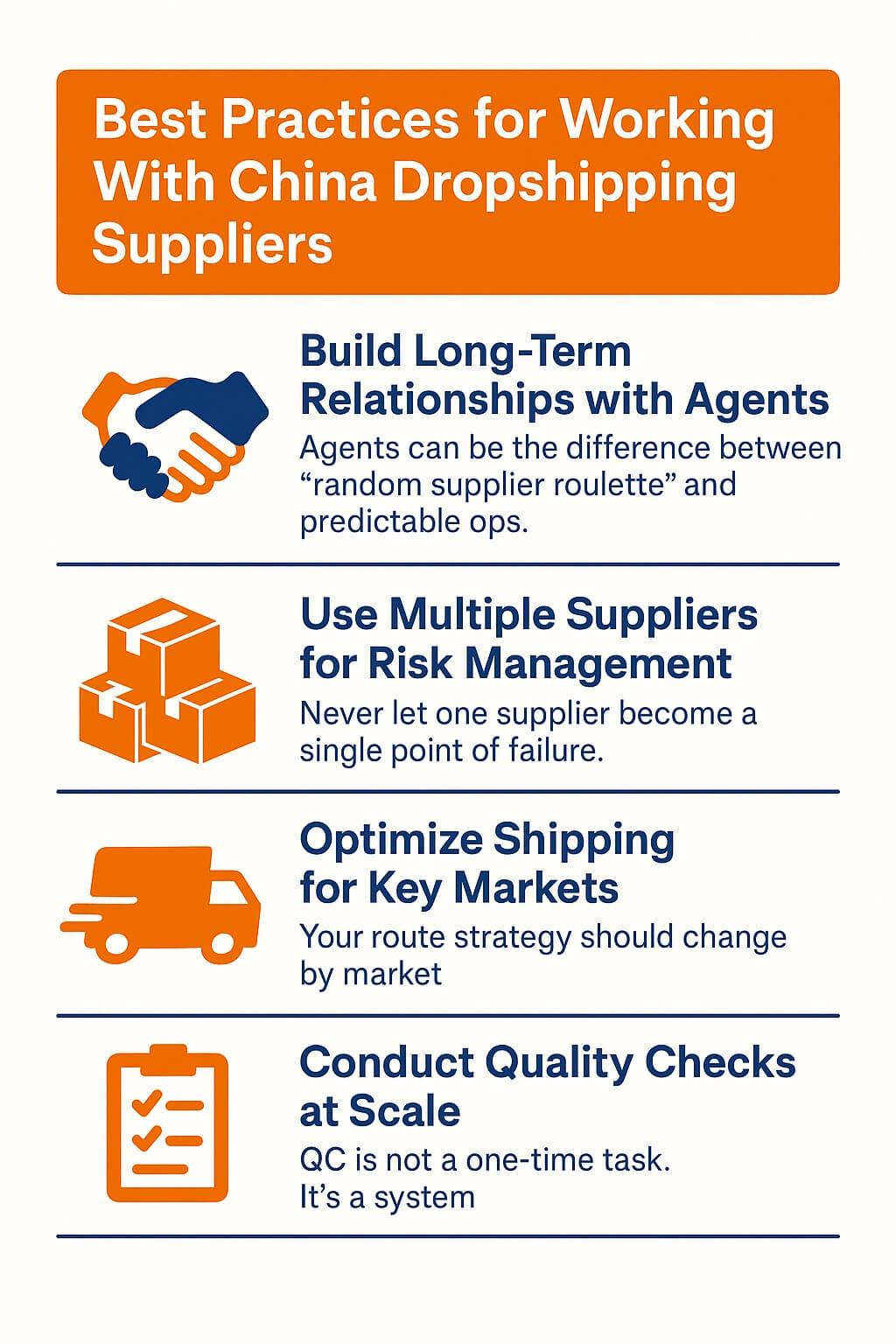
A strong agent does more than find products. They help you handle exceptions. Think wrong items, missing parts, broken tracking, or urgent dispatch needs during scaling.
Once volume proves itself, agents can help you negotiate pricing, speed up support, and secure stock for winners.
Avoid a single point of failure. For bestsellers, keep at least two sources. This reduces stockouts and prevents downtime when one supplier fails. It also lets you A/B test quality and processing.
Route strategy changes by market. In the US, stable tracking and clean handoff matter most. In the UK and EU, duty and tax compliance plus stable carriers reduce customs delays. In AU, line reliability is often the biggest lever.
To reduce customs delays:
Keep product descriptions and invoice values consistent
Avoid restricted items and unclear HS/HTS descriptions
Keep promises conservative during peak season
QC is not a one-time task. It is a system. Use monthly sampling and QC photos or videos for complaint-prone SKUs. Track supplier performance like ops metrics.
Key KPIs:
Defect rate
Late dispatch rate
Reship/refund rate
“Tracking scan within X hours” rate
If you run Shopify, automation reduces address errors, delayed tracking, and manual workload.
Common approaches:
DSers for AliExpress-based workflows
AutoDS for multi-supplier automation and monitoring
CJDropshipping for sourcing + fulfillment in one
IChiba OnePlatform for ops visibility + routing (service-dependent)
A simple rule: automate only after you’ve validated supplier quality. Automation scales what you already have.
Start with AliExpress to test demand and learn your niche’s complaint patterns. Once you have winners, move to a supplier network/platform to improve QC, processing SLAs, and shipping consistency.
Speed comes from the shipping line + dispatch SLA. Supplier platforms with dedicated/special lines often outperform random marketplace sellers, but you still need test orders to validate.
Use priority/special lines, reduce processing time, and keep inventory accuracy high. For winners, consider warehousing or a platform that can route to faster lanes.
Use methods with buyer protection, avoid off-platform payments, and document everything. Keep evidence packs (order details, QC photos/videos, tracking scans) for disputes.
China sourcing still works - when you manage the operational reality. If you want reliable outcomes, prioritize shipping predictability (not just “fast claims”), tighten QC and acceptance standards, and treat supplier/platform operations-processing, communication, and tracking-as performance metrics you actively monitor.
If you want fewer tools and cleaner ops, explore One-stop Dropshipping Solutions or review a broader supplier shortlist here: Reliable Dropshipping Suppliers.

Work with us
Our solutions
Address:
 〒136-0082, Japan, Tokyo, Koto-ku, Shinkiba 3-5-6, 5F
Connect us:


Japan
〒136-0082, Japan, Tokyo, Koto-ku, Shinkiba 3-5-6, 5F
Texas, USA
1606 Audrey Dr, Garland, TX 75040, United States
California, USA
1316 John Reed Ct, City of Industry, CA 91745, United States