

News
Ichiba OnePlatform Team - 27/05/2026
In this article
Running a dropshipping business at scale is no longer just about finding winning products or launching ads quickly, because operational control has become the real competitive advantage. As order volumes grow and supplier networks expand, sellers start facing hidden challenges such as inventory mismatches, delayed fulfillment, pricing inconsistencies, and overwhelmed support teams. This is where dropshipping management software plays a critical role, not as a simple automation add-on, but as the operational backbone of a sustainable dropshipping business.
In this guide, we will break down what a modern dropshipping management tool really does, the operational problems it solves, and how to choose the right system based on your business stage. Whether you are running a Shopify store, expanding into multiple marketplaces, or preparing to scale with private suppliers and warehouses, understanding how dropshipping management software works will help you protect margins, reduce errors, and build a more resilient fulfillment operation.
A dropship management system connects stores, suppliers, and fulfillment workflows into one unified platform. Instead of relying on separate tools for product importing, inventory syncing, order processing, and tracking updates, sellers can manage all operational processes in a single environment. This approach reduces manual work, minimizes errors, and provides better visibility across the supply chain.
Unlike basic automation apps that focus on narrow functions, dropshipping management software is designed for end-to-end operational control. It supports consistent execution across sales channels, improves data accuracy, and enables sellers to scale without increasing operational overhead. For sellers serious about long term growth, effective dropshipping management is not optional but foundational.
A reliable dropshipping management tool is defined by its ability to automate and synchronize critical operational workflows. These core functions are what separate true management platforms from simple automation utilities.

Order routing and fulfillment automation allows orders to be automatically assigned to the correct supplier based on predefined rules such as stock availability, location, or cost. This ensures faster fulfillment while reducing the risk of manual routing errors.
Real-time inventory synchronization keeps product stock levels updated across all connected stores and suppliers. When inventory changes at the supplier level, listings are adjusted instantly, helping prevent overselling and order cancellations.
Supplier mapping and SKU management provide a structured way to link store SKUs with multiple supplier SKUs. This is especially important when working with backup suppliers or managing the same product across different fulfillment sources.
Price and stock rule automation enables sellers to protect margins by setting dynamic pricing rules based on supplier cost changes, currency fluctuations, or inventory thresholds. This removes the need for constant manual price monitoring.
Tracking number synchronization and customer notifications ensure that tracking data flows automatically from suppliers to sales channels. Customers receive timely updates, while support teams spend less time responding to order status inquiries.
While many sellers start with simple automation apps, these tools are often limited to isolated tasks such as product importing or basic price syncing. As operations grow, relying on multiple disconnected apps creates data silos, workflow conflicts, and operational blind spots.
A full dropshipping management software solution focuses on end-to-end control rather than automation. It manages how orders move through the system, how suppliers interact with inventory data, and how pricing and fulfillment rules are enforced consistently.
In contrast, basic automation apps handle only specific actions without understanding the broader operational context. This makes them suitable for early-stage sellers but increasingly risky for businesses managing higher order volumes or multiple suppliers. Choosing a proper dropshipping management tool allows sellers to move from reactive fixes to structured, scalable operations.
As dropshipping operations scale, most sellers discover that growth does not fail due to traffic or product demand, but because internal processes can no longer keep up. Managing multiple suppliers, fluctuating inventory, and increasing order volume without a structured system leads to operational friction that directly impacts revenue and customer satisfaction. A well-implemented dropshipping management software is designed to eliminate these pain points by bringing structure, visibility, and automation into daily operations.
When sellers rely on spreadsheets or disconnected automation apps, operational bottlenecks appear quickly and compound over time. These issues often remain hidden until they begin affecting customer experience and profitability.
Overselling due to stock delays is one of the most common problems in unmanaged dropshipping operations. Supplier inventory updates are often delayed or incomplete, leading stores to sell products that are no longer available. This results in cancellations, refunds, and negative reviews that damage the store's credibility.
Order errors across multiple suppliers increase when orders must be manually reviewed or routed. Sending an order to the wrong supplier, duplicating fulfillment, or missing fulfillment deadlines becomes more likely as order volume grows.
Inconsistent pricing and margin erosion occur when supplier costs change, but store prices are not updated in time. Without automated pricing rules, sellers may unknowingly sell at lower margins or even at a loss, especially when working with multiple currencies and suppliers.
Customer support overload becomes unavoidable when order status, tracking information, and delivery updates are not synchronized automatically. Support teams spend excessive time answering repetitive questions instead of focusing on higher value customer interactions.
Implementing a structured dropshipping management tool leads to measurable improvements across key operational metrics. These improvements are not just internal efficiencies, but indicators of a healthier and more scalable business.
Order processing time decreases as orders are automatically routed, placed, and confirmed without manual intervention. Faster processing improves supplier relationships and reduces fulfillment delays.
Cancellation and refund rates decline when inventory accuracy improves, and fulfillment errors are minimized. Fewer cancellations translate directly into higher platform trust scores and better account health.
On-time delivery rates improve because orders are sent to the right supplier immediately and tracking updates are synchronized without delay. Reliable delivery performance strengthens customer trust and increases repeat purchase rates.
Gross margin stability increases when pricing rules and cost changes are managed automatically. Sellers gain better control over profitability and can scale order volume without sacrificing margins.
Choosing the right dropshipping management software is less about brand names and more about whether the system can support your operational reality. As order volume increases and supplier networks become more complex, missing features quickly turn into structural weaknesses. The best solutions are built to reduce manual dependency, maintain data accuracy, and support scalability across multiple sales channels.
A reliable dropship management system should not only automate routine tasks but also provide sellers with control mechanisms that protect margins, ensure fulfillment reliability, and simplify supplier coordination. Understanding which features are essential and which are designed for scaling helps sellers avoid overpaying for tools that do not match their business stage.
Every effective dropshipping management tool shares a set of foundational features that support daily operations. Without these core capabilities, automation remains fragile and difficult to scale.
Multi-supplier order routing enables the system to automatically assign orders to the most appropriate supplier based on availability, cost, location, or predefined priority rules. This reduces fulfillment delays and lowers the risk of manual routing errors.
Real-time inventory and price synchronization ensures that stock levels and product pricing remain accurate across all connected stores. When supplier data changes, listings are updated instantly, preventing overselling and pricing mismatches.
Auto-ordering and bulk fulfillment enable orders to be placed automatically with suppliers or fulfillment partners. Bulk processing further reduces operational overhead and helps sellers manage peak order volumes efficiently.
Supplier failover logic provides built-in protection against supplier disruptions. When a primary supplier runs out of stock or fails to fulfill, the system can reroute orders to backup suppliers without manual intervention.
Profit margin and pricing rules enable sellers to define minimum margins, dynamic markups, and cost-based pricing adjustments. This feature is critical for maintaining consistent profitability as supplier costs fluctuate.
Multi-store and multi-channel support allows sellers to manage multiple storefronts and marketplaces from a single dashboard. Centralized control simplifies operations and reduces the complexity of managing data across platforms.
As sellers move from growth to scale, operational demands shift from basic automation to system reliability and flexibility. Advanced features in dropshipping management software are designed to support higher order volumes and more complex supply chains.
Warehouse and private agent integration enables sellers to combine traditional dropshipping with private fulfillment solutions. This hybrid approach improves delivery speed and gives sellers greater control over inventory and branding.
Branded invoice support allows businesses to present a more professional customer experience. Custom invoices strengthen brand credibility and help differentiate stores in competitive markets.
ERP and accounting integration connect order and inventory data with financial systems. This ensures accurate reporting, simplifies reconciliation, and supports better decision-making at scale.
API access and custom workflows provide flexibility for businesses with unique operational requirements. Open APIs allow sellers to build custom integrations, automate complex workflows, and connect external systems without platform limitations.
Not all dropshipping management software is built for the same type of seller or business model. Some tools focus on deep Shopify automation, while others are designed for sellers operating across multiple marketplaces and regions. Evaluating tools based on real use cases rather than feature lists helps sellers choose a dropshipping management tool that aligns with their operational complexity and growth plans.
The following platforms are grouped by primary use case, highlighting how each solution supports different dropshipping management needs.

For Shopify sellers, seamless store integration and automation depth are critical. These tools are designed to manage product data, supplier connections, and fulfillment workflows directly within the Shopify ecosystem.
AutoDS is widely used by Shopify sellers who require strong automation for product importing, pricing updates, and order processing. The platform supports multiple suppliers and provides automation that helps reduce manual work during daily operations.
DSers with advanced workflows are well-suited for sellers working with large product catalogs and AliExpress suppliers. Its strength lies in bulk order processing, supplier mapping, and flexible fulfillment rules that support higher order volumes.
Inventory Source focuses on real-time inventory synchronization and supplier data accuracy. Shopify sellers who work with multiple suppliers benefit from its centralized catalog management and automated stock updates across connected stores.
IChiba OnePlatform is designed for sellers sourcing products from Japan and Asia while selling internationally. The platform combines dropshipping management, supplier coordination, and cross-border fulfillment workflows, making it suitable for Shopify sellers targeting global markets with complex supply chains.
Sellers operating across multiple sales channels require a higher level of system coordination. Multi-channel dropshipping management tools centralize orders, inventory, and fulfillment across marketplaces and storefronts.
Sellbrite is a strong option for sellers managing listings across marketplaces such as Amazon, eBay, and Walmart. It provides centralized order routing, inventory synchronization, and channel-specific controls that simplify multi-channel operations.
Linnworks is built for businesses handling high order volumes and complex fulfillment networks. Its strength lies in advanced automation, inventory control, and system reliability for sellers managing multiple suppliers and warehouses.
Orderhive offers a balanced solution for growing sellers who need inventory management, order processing, and basic accounting integration. The platform supports multi-channel sales while maintaining operational visibility from a single dashboard.
Selecting dropshipping management software should be a strategic decision rather than a reaction to operational stress. Different business stages require different levels of automation, control, and system flexibility. A tool that works well for a beginner may become a limitation at scale, while an enterprise-level system may create unnecessary complexity in the early stages.
Understanding your current operational needs and future growth direction helps ensure that your dropshipping management tool supports long-term efficiency instead of creating technical debt. The goal is to choose a dropship management system that grows with your business rather than one you outgrow quickly.
At the beginner stage, sellers typically prioritize cost control and simplicity. Order volume is still manageable, and supplier networks are limited. A basic dropshipping management tool with essential automation, such as order syncing, inventory updates, and simple pricing rules, is usually sufficient. Over-investing in complex systems at this stage can slow down learning and execution.
During the growth stage, operational complexity increases as product catalogs expand and multiple suppliers are introduced. Sellers need deeper automation, better inventory accuracy, and structured supplier mapping. A more advanced dropshipping management software becomes critical to prevent errors, reduce manual workload, and maintain a consistent customer experience across sales channels.
At the scale stage, reliability and redundancy become the top priorities. High order volume exposes weaknesses in supplier performance, system stability, and data accuracy. Sellers at this level require a robust dropship management system with backup supplier logic, advanced workflow automation, API access, and integration with warehouses or private agents. The focus shifts from speed of setup to operational resilience.
While feature lists can look impressive, certain warning signs indicate that a tool may not be suitable for serious dropshipping management. Identifying these red flags early helps sellers avoid costly migrations later.
A lack of real-time stock synchronization is a major risk factor. Delayed or manual inventory updates increase the likelihood of overselling and customer dissatisfaction.
Poor or incomplete supplier documentation makes it difficult to onboard new suppliers or troubleshoot fulfillment issues. Transparent workflows and clear supplier mapping are essential for scaling.
Limited automation rules restrict how sellers can manage exceptions and pricing logic. Without flexible automation, manual intervention becomes unavoidable as order volume grows.
Being locked in ecosystems prevents sellers from adapting to new suppliers, channels, or fulfillment models. A strong dropshipping management tool should offer flexibility rather than force dependency on a narrow supplier network.
Scaling a dropshipping business is not about adding more products or suppliers without structure. Sustainable growth depends on whether operational workflows can handle higher volume without increasing error rates or manual workload. Well-designed dropshipping management workflows allow sellers to grow order volume while maintaining control over fulfillment, inventory, and customer experience.
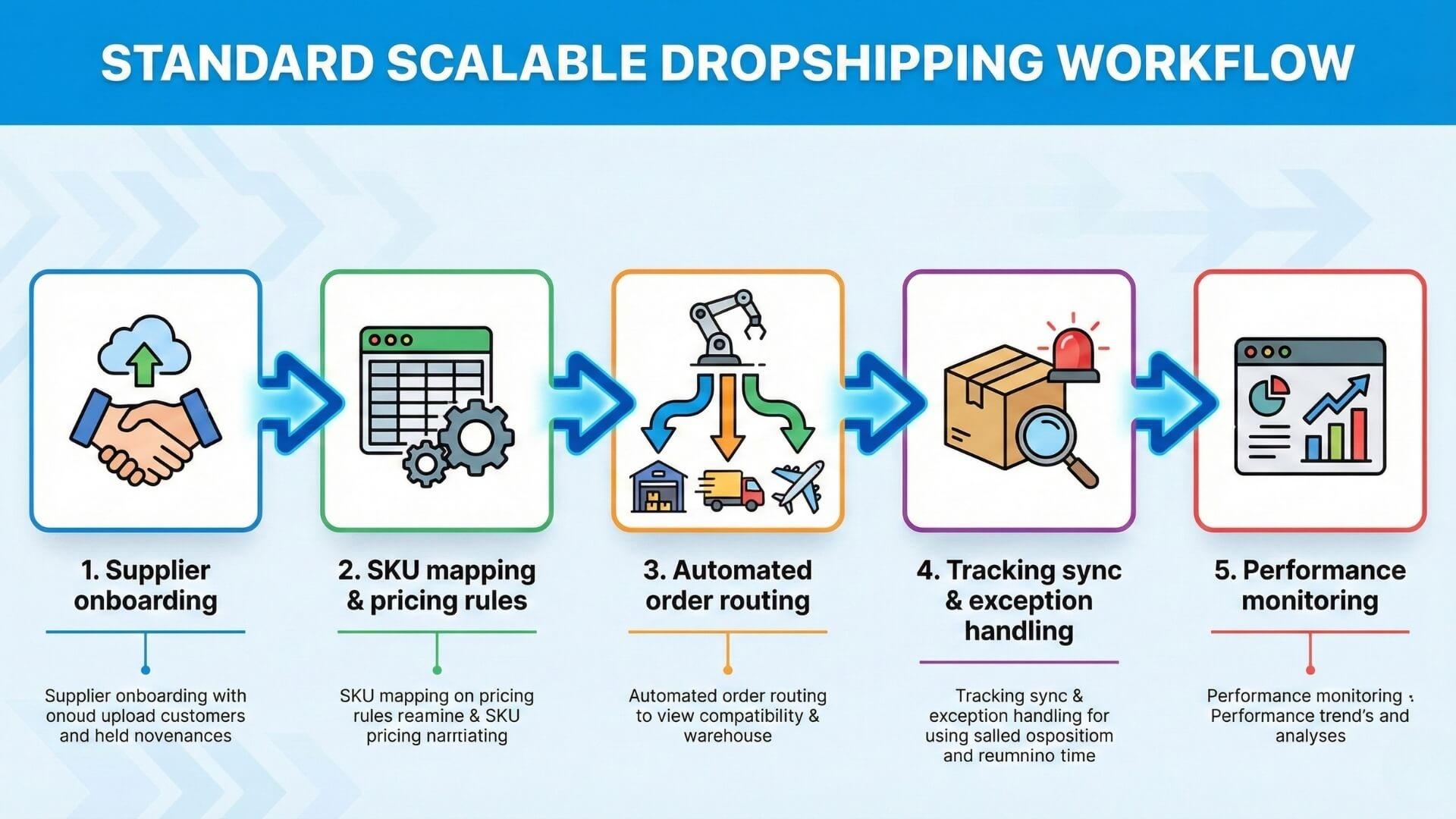
A scalable workflow begins with structured supplier onboarding and data alignment. Before products go live, suppliers are connected to the system, SKUs are mapped correctly, and inventory and pricing rules are defined. This foundation prevents data conflicts and fulfillment errors later.
Once products are active, SKU mapping and pricing rules ensure that listings remain aligned with supplier data. Price adjustments and stock updates occur automatically based on real-time inputs, protecting margins and preventing overselling.
During order placement, automated order routing assigns each order to the appropriate supplier or fulfillment source. Orders are processed instantly without manual review, improving fulfillment speed and reducing delays.
After fulfillment, tracking synchronization, and exception handling, ensure that tracking numbers are updated across all sales channels. Any irregularities, such as delayed shipments or failed fulfillment,s are flagged automatically for review.
Ultimately, performance monitoring enables sellers to assess supplier reliability, fulfillment speed, and order accuracy. These insights support continuous optimization and data-driven decision-making.
Supplier onboarding
SKU mapping & pricing rules
Automated order routing
Tracking sync & exception handling
Performance monitoring
Even with automation, exceptions are inevitable in dropshipping. What separates scalable operations from fragile ones is how these exceptions are handled systematically.
Backup supplier logic enables the system to reroute orders when a primary supplier runs out of stock or fails to fulfill. This reduces cancellations and protects customer trust without requiring manual intervention.
Auto pausing listings prevents further sales of affected products when inventory issues or supplier delays are detected. This proactive control minimizes negative customer experiences and support escalations.
Customer notification workflows ensure transparent communication during delays or changes. Automated updates reduce support workload while maintaining a professional and reliable brand image.
As dropshipping businesses grow, mistakes in operational management often become more costly than product or marketing errors. Many sellers adopt dropshipping management software but fail to use it strategically, leading to inefficiencies that limit scalability. Understanding these common pitfalls helps sellers avoid preventable disruptions and build more resilient operations.
Effective dropshipping management requires a balance between automation, data accuracy, and human oversight. When systems are misconfigured or relied on blindly, automation can amplify problems rather than solve them.
Over-automating without monitoring
Over-automating without monitoring is a frequent mistake among growing sellers. While automation reduces manual workload, a lack of performance monitoring allows small issues such as supplier delays or pricing errors to escalate unnoticed. Regular system reviews and exception tracking are essential for maintaining control.
Relying on a single supplier
Relying on a single supplier creates significant operational risk. Supplier outages, stock shortages, or fulfillment delays can halt sales entirely. A proper dropship management system should support multiple suppliers and backup routing to protect order continuity.
Ignoring data accuracy
Ignoring data accuracy undermines the effectiveness of any dropshipping management tool. Incorrect SKU mapping, outdated supplier information, or inconsistent pricing rules lead to fulfillment errors and margin losses. Clean data and structured onboarding processes are critical for long-term success.
Choosing tools based only on price
Choosing tools based only on price often results in hidden costs later. Low-cost tools may lack essential features such as real-time inventory sync or automation flexibility, forcing sellers to migrate systems as they scale. Evaluating software based on operational fit rather than monthly fees leads to better outcomes.
What is the best dropshipping management software?
The best dropshipping management software depends on your business model, sales channels, and supplier structure. For Shopify sellers, tools with deep store integration and automation depth are often the best fit.
For sellers operating across multiple marketplaces, a more comprehensive dropship management system with centralized order and inventory control is usually required. Instead of looking for a one-size-fits-all solution, sellers should evaluate how well a tool supports their operational complexity and future growth plans.
Do beginners need dropship management tools?
Beginners do not always need a full-featured dropshipping management system at the start, but having basic management capabilities can prevent early operational mistakes. Simple dropshipping management tools help new sellers avoid overselling, reduce order errors, and build structured workflows from day one. As order volume grows, these tools become increasingly important to maintain consistency and control.
Is dropshipping management software worth the cost?
For sellers handling more than a small number of daily orders, dropshipping management software is often worth the investment. The cost is offset by reduced manual labor, fewer fulfillment errors, lower cancellation rates, and improved customer satisfaction. Effective dropshipping management also protects profit margins by automating pricing and cost adjustments that are difficult to manage manually.
Can one tool manage multiple suppliers?
Yes, a proper dropshipping management tool is designed to manage multiple suppliers within a single system. It allows sellers to map SKUs across suppliers, define priority rules, and implement backup supplier logic. This capability is essential for reducing supplier dependency and maintaining fulfillment continuity as the business scales.
What’s the difference between dropshipping automation and management?
Dropshipping automation focuses on individual tasks such as product importing, order syncing, or price updates. Dropshipping management, on the other hand, takes a system-level approach by controlling how orders, inventory, suppliers, and pricing interact across the entire operation. A true dropshipping management software provides end-to-end visibility and structured workflows rather than isolated automation features.
Building a profitable dropshipping business today requires more than finding suppliers and automating orders. As competition increases and customer expectations rise, operational control becomes a defining factor of long-term success. Dropshipping management software provides sellers with the structure needed to manage inventory accuracy, supplier coordination, pricing stability, and fulfillment performance at scale.
Rather than relying on fragmented tools or manual workflows, a unified dropship management system allows sellers to shift from reactive problem-solving to proactive operations. By centralizing data and automating critical processes, effective dropshipping management reduces errors, protects margins, and improves customer experience across sales channels.
Whether you are just starting or preparing to scale into multiple markets, choosing the right dropshipping management tool is a strategic investment. When aligned with your business stage and growth goals, the right system not only simplifies daily operations but also creates a strong foundation for sustainable and scalable growth in the dropshipping industry.

Work with us
Our solutions
Address:
 〒136-0082, Japan, Tokyo, Koto-ku, Shinkiba 3-5-6, 5F
Connect us:


Japan
〒136-0082, Japan, Tokyo, Koto-ku, Shinkiba 3-5-6, 5F
Texas, USA
1606 Audrey Dr, Garland, TX 75040, United States
California, USA
1316 John Reed Ct, City of Industry, CA 91745, United States