

News
Ichiba OnePlatform Team - 27/05/2026
In this article
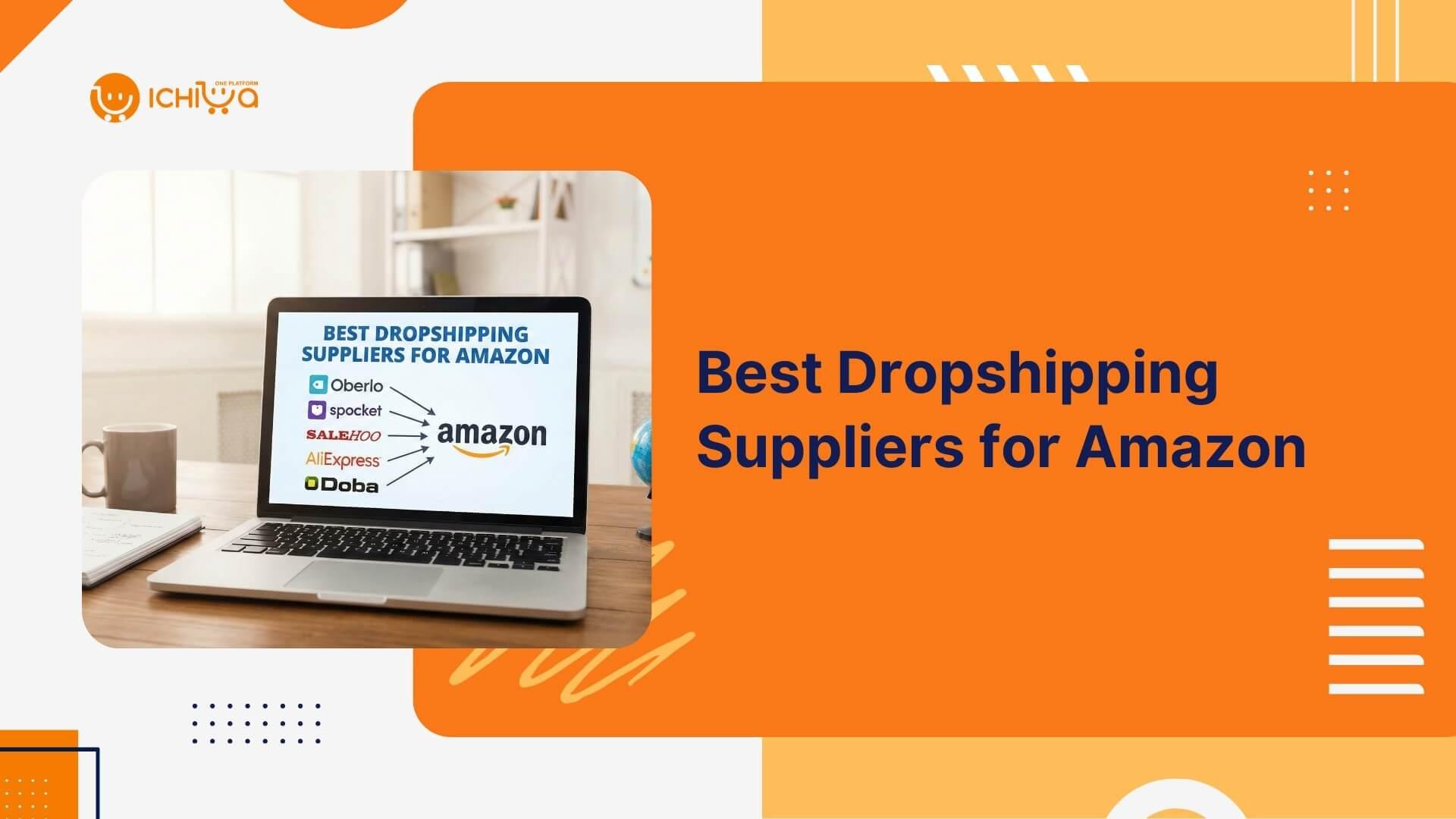
Finding the right dropshipping suppliers for Amazon is one of the most important decisions that determines whether your Amazon dropshipping business will succeed or fail. Many new sellers assume that any dropshipping supplier will work on Amazon. In reality, Amazon dropshipping suppliers must meet higher standards around shipping speed, packaging, inventory accuracy, and compliance.
As competition increases, sellers are actively searching for best Amazon dropshipping suppliers, dropshipping suppliers USA for Amazon, and even free dropshipping suppliers for Amazon to protect margins while staying compliant. At the same time, Amazon referral fees, return handling costs, and strict performance metrics make it essential to work with suppliers who truly understand Amazon operations.
Whether you are looking for dropshipping companies for Amazon, comparing the best supplier for Amazon dropshipping, or planning your long-term Amazon strategy, this article will help you make informed supplier decisions that support sustainable growth.
When selling on Amazon, your supplier is not just a fulfillment partner. They directly affect your account health, customer experience, and long-term business survival. Unlike other platforms, Amazon evaluates sellers based on strict performance metrics, and any supplier mistake is ultimately your responsibility.
If a supplier includes third-party branding, invoices, or pricing slips from another marketplace, your account can be flagged for violating Amazon dropshipping policies. This is why experienced sellers prioritize dropshipping suppliers for Amazon that understand Amazon requirements and can ship orders without external branding.
Amazon customers expect fast and reliable delivery, especially for FBM orders. Slow fulfillment often leads to late shipment rates, order defect rate increases, and negative seller feedback. This is why many sellers actively search for dropshipping suppliers in the USA for Amazon, as US suppliers can offer shorter delivery times and more predictable logistics.
Inventory accuracy also plays a major role in Amazon's performance. When suppliers fail to update stock levels in real time, sellers risk overselling products that are out of stock. This results in order cancellations, account warnings, and lost Buy Box opportunities. The best Amazon dropshipping suppliers provide stable inventory feeds and can handle order volume as your store scales.
Profitability is another reason supplier choice matters. Even when a product sells well, hidden costs such as high unit prices, return handling fees, or expensive shipping can quickly erode margins. Smart sellers compare the best suppliers for Amazon dropshipping not only on product cost, but also on total fulfillment expenses and return policies.
Ultimately, Amazon does not distinguish between seller errors and supplier errors. If a supplier fails to meet Amazon standards, your account bears the consequences. This is why choosing the right suppliers for Amazon dropshipping is not optional. It is the foundation of a sustainable and scalable Amazon business.
Dropshipping on Amazon follows a different operational logic compared to most e-commerce platforms. While sellers do not hold inventory, they are still fully responsible for the customer experience, order fulfillment, and policy compliance. Understanding how the process works in practice is essential before choosing any dropshipping suppliers for Amazon.
Seller of record requirement
The first rule is the seller of record requirement. Your business name must appear on all packing slips, invoices, and external communication with the customer. Any indication that another retailer or marketplace is involved can result in immediate policy violations.
No third-party branding or invoices
Second, Amazon prohibits third-party branding or invoices. Suppliers must not include logos, promotional materials, or documentation from other platforms such as eBay, Walmart, or AliExpress. This is why working with experienced Amazon dropshipping suppliers is critical.
Supplier must ship blind (no logos, no pricing slips)
Third, suppliers must ship blind. This means no logos, no pricing slips, and no marketing inserts inside the package. Neutral packaging is mandatory for compliant Amazon dropshipping.
Tracking uploaded on time
Tracking information must also be uploaded on time. Late or invalid tracking negatively impacts seller metrics and can quickly lead to account health warnings. Reliable dropshipping suppliers for Amazon understand the importance of timely tracking updates.
Many sellers transition to Amazon after running Shopify stores, but the two models operate very differently.
On Amazon, the platform controls the customer relationship, while sellers do not own customer data and cannot remarket freely. Communication is limited and closely monitored by Amazon.
Fulfillment metrics on Amazon are far stricter. Late shipment rates, order defect rates, and customer feedback directly impact listing visibility and Buy Box eligibility. This makes supplier reliability far more important than in Shopify dropshipping.
Branding freedom is also limited on Amazon, which means sellers cannot customize packaging or include marketing materials. However, Amazon compensates for this with higher buyer intent and massive organic traffic, which is why many sellers focus on finding the best dropshipping suppliers for Amazon rather than building independent stores.
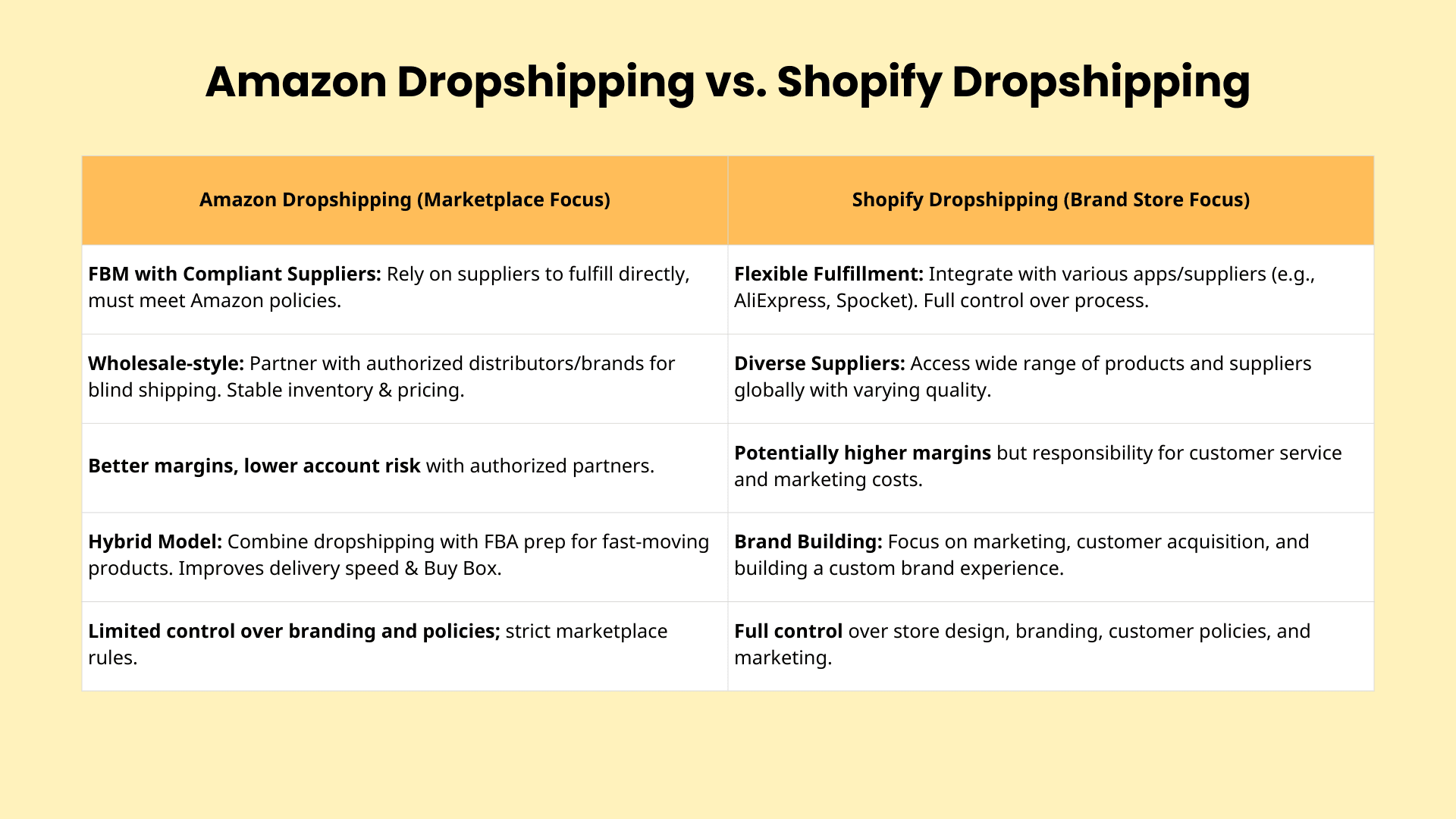
Successful Amazon sellers use several fulfillment models depending on their growth stage and supplier capabilities.
The most common approach is FBM with compliant suppliers, in which sellers rely on Amazon-compliant dropshipping suppliers to fulfill orders directly to customers while meeting all policy requirements.
Another model is wholesale-style dropshipping, in which sellers partner with authorized distributors or brands that allow blind shipping and provide stable inventory and pricing. This approach often offers better margins and lower account risk.
More advanced sellers use a hybrid model that combines dropshipping with FBA prep. Fast-moving products are shipped in bulk to a prep center or Amazon fulfillment center, while slower products remain in dropshipping mode. This strategy allows sellers to scale safely while improving delivery speed and Buy Box performance.
A supplier that works well for Shopify or other platforms can easily put your Amazon account at risk if they do not meet Amazon standards. This is why successful sellers evaluate dropshipping suppliers for Amazon using a clear set of criteria focused on compliance, reliability, and scalability.
Amazon compliance is the first and non-negotiable requirement because even a single violation can result in account suspension, regardless of your sales volume.
Suppliers must use neutral packaging at all times, which means plain boxes with no logos, no marketing inserts, and no references to other marketplaces. Any visible branding from platforms like eBay, Walmart, or AliExpress can trigger immediate policy issues.
Another critical factor is the ability to customize packing slips, like attaching brand-name cards with the orders. The best Amazon dropshipping suppliers understand this requirement and can adjust documentation to match Amazon policies.
As Amazon customers expect fast delivery, many sellers prioritize dropshipping suppliers in the USA for Amazon. US suppliers typically offer shorter delivery times, more predictable logistics, and fewer customs-related delays.
Reliability is just as important as speed. Suppliers must process orders consistently, provide valid tracking numbers, and meet promised handling times. Unreliable shipping leads to late shipment rate increases and negative feedback, which are difficult to recover from on Amazon.
Accurate inventory data is essential for avoiding overselling. Suppliers that fail to update stock levels in real time expose sellers to order cancellations and performance warnings.
The best suppliers for Amazon dropshipping provide real-time inventory sync. This becomes even more important as order volume increases.
Scalability also plays an important role, especially when it comes to the peak seasons. A supplier should be able to handle bulk orders without fulfillment delays. Sellers planning to grow should verify supplier capacity early to avoid operational bottlenecks later.
Competitive pricing alone is not enough; sellers must evaluate total costs to understand true profitability.
Unit cost should be compared against Amazon referral fees, shipping costs, and payment processing fees. Some suppliers offer low product prices but charge high shipping or handling fees that reduce margins.
Return handling is another hidden cost, so suppliers should have clear return policies and reasonable fees for damaged or undeliverable packages. The best supplier for Amazon dropshipping supports efficient return processing with minimal additional charges.
Strong communication becomes critical when issues arise. Supplier response time can directly affect customer satisfaction and Amazon's case resolution.
Reliable suppliers respond quickly to inquiries, provide clear shipment updates, and assist with damage or lost package claims. Poor communication often leads to delayed resolutions and negative customer feedback.
For long-term success, sellers should treat suppliers as strategic partners rather than just order processors. Working with responsive dropshipping companies for Amazon significantly reduces operational stress and account risk.
Choosing the right supplier is not about finding the cheapest option. It is about working with suppliers who understand Amazon rules, ship reliably, and can support long-term growth. Below are some of the most commonly used dropshipping suppliers for Amazon, categorized by location and operational strength.
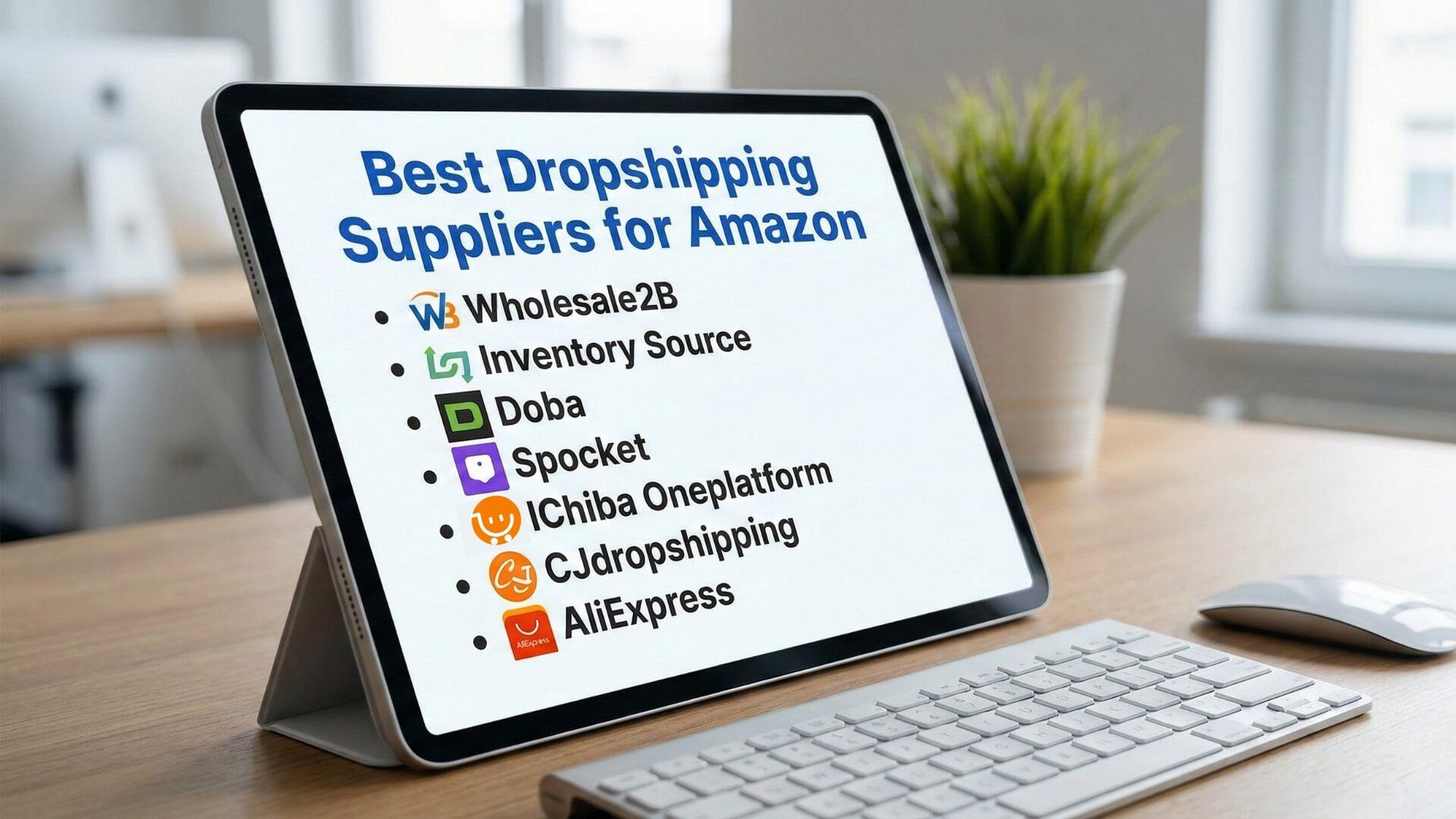
Wholesale2B
Wholesale2B connects sellers to a large network of US suppliers across multiple product categories. The platform supports Amazon integration and allows sellers to automate order forwarding while remaining the seller of record. Many suppliers within Wholesale2B are familiar with blind shipping requirements, which helps reduce policy risk. However, sellers should still test packaging because compliance can vary between individual suppliers. Wholesale2B is best suited for sellers managing multiple SKUs and categories.
Pros
Reliable US shipping options
Amazon friendly fulfillment setup
Large supplier network
Cons
Monthly subscription fee
Product quality varies by supplier
Inventory Source
Inventory Source is primarily an automation and inventory management platform rather than a traditional supplier. It integrates with verified US suppliers and focuses heavily on real-time inventory synchronization, which helps prevent overselling on Amazon. The platform routes orders automatically and updates tracking information efficiently. This makes it suitable for scaling sellers who prioritize operational stability. The main drawback is the higher monthly cost compared to basic sourcing platforms.
Pros
Strong inventory sync
Automation friendly
Suitable for scaling sellers
Cons
Higher software cost
Limited control over individual supplier policies
Doba
Doba provides access to a curated catalog of suppliers through a single dashboard. It simplifies product discovery and order management, which makes it attractive for beginners entering Amazon dropshipping. Some suppliers offer US shipping and Amazon-compliant fulfillment, but shipping performance can vary depending on the supplier selected. Sellers should review handling times carefully before listing products. Doba works best for early-stage sellers who want a centralized sourcing solution.
Pros
Centralized product catalog
Simplified supplier management
Good for beginners
Cons
Subscription required
Shipping speed depends on the supplier's location
Spocket (US suppliers only)
Spocket focuses on connecting sellers with US suppliers that offer faster domestic shipping. This significantly improves delivery speed and customer satisfaction on Amazon FBM listings. Many Spocket suppliers use cleaner and more neutral packaging compared to overseas sources. However, product selection for Amazon is more limited, and unit costs are generally higher. Spocket is ideal for sellers prioritizing shipping speed over maximum margins.
Pros
Fast domestic shipping
Cleaner packaging compared to overseas suppliers
Easy product selection
Cons
Limited product range for Amazon
Higher product costs
IChiba Oneplatform
IChiba Oneplatform is designed for sellers who prioritize compliance and controlled fulfillment workflows. The platform supports blind shipping, customized packing slips, and supplier coordination aligned with Amazon policies. It is particularly suitable for sellers working with cross-border supply chains that require higher operational discipline. While it may not offer the lowest product costs, it reduces account risk significantly. IChiba Oneplatform fits sellers building a long-term Amazon business rather than short-term testing.
Pros
Strong compliance focus
Stable fulfillment processes
Suitable for long-term Amazon strategy
Cons
Not ideal for ultra-low cost products
Requires an onboarding process
CJdropshipping (Amazon-compliant setup)
CJdropshipping offers global sourcing with access to multiple warehouses, including US fulfillment options. When configured correctly, it supports blind shipping and Amazon-compliant order processing. Sellers can source private products and work with dedicated agents to improve fulfillment consistency. Shipping speed depends heavily on warehouse location and product availability. CJdropshipping is suitable for sellers balancing cost efficiency with moderate compliance control.
Pros
Global warehouse network
Flexible sourcing options
Amazon is compatible when properly set
Cons
Requires careful setup
Shipping speed varies by warehouse
AliExpress (advanced filtering + blind shipping only)
AliExpress remains one of the most widely used sourcing platforms, but it carries a higher risk for Amazon dropshipping. Only a small percentage of suppliers can ship blind and meet Amazon documentation requirements. Sellers must carefully filter suppliers, confirm neutral packaging, and test orders before listing products. Shipping times are typically longer, which limits Buy Box competitiveness. AliExpress is best used for product research and validation rather than large-scale Amazon operations.
Pros
Large product selection
Low unit costs
Good for product testing
Cons
High compliance risk if misused
Longer shipping times
Many suppliers are not Amazon-friendly
Supplier | Location | Shipping Speed | Best For | Fee |
Wholesale2B | USA | Fast | Multi-category sellers | Monthly |
Inventory Source | USA | Fast | Automation-focused sellers | Monthly |
Doba | USA and Global | Medium | Beginners | Monthly |
Spocket | USA | Fast | US market FBM | Subscription |
IChiba Oneplatform | USA and Japan | Fast | Compliance-driven sellers | Custom |
CJdropshipping | Global | Medium | Cost-focused sellers | Free plus shipping |
AliExpress | Global | Slow to Medium | Product testing | Free |
Connecting dropshipping suppliers to Amazon requires more than just listing products and forwarding orders. Sellers must choose a fulfillment workflow that ensures compliance, accurate inventory updates, and timely tracking uploads. There are two main approaches used by Amazon dropshippers: manual fulfillment and automated fulfillment.
Manual fulfillment is the most common starting point for new sellers. In this model, sellers list products on Amazon and manually place orders with suppliers after receiving customer orders. The seller then uploads tracking information to Amazon once the supplier ships the product.
This approach offers full control over supplier communication and order review. It allows sellers to verify packaging instructions, confirm blind shipping, and catch potential issues before fulfillment. However, manual fulfillment becomes time-consuming as order volume increases and is more prone to human error. It is best suited for beginners testing products or working with a small number of orders per day.
Automation tools are used by sellers who want to scale operations while reducing manual workload. These tools sync products, inventory levels, and orders between Amazon and approved dropshipping suppliers. Once configured, orders are automatically forwarded, and tracking details are pushed back to Amazon.
Automation helps maintain inventory accuracy and improves on-time shipment performance. It also reduces the risk of overselling and delayed tracking uploads. However, sellers must ensure that automation settings align with Amazon policies and that suppliers remain compliant. Automation works best with reliable dropshipping suppliers for Amazon that provide stable inventory feeds and consistent fulfillment.
Scaling on Amazon is not just about increasing product listings or order volume. It requires a structured approach to suppliers, fulfillment, and risk management. Sellers who scale too fast with unstable suppliers often face account warnings or suspensions that can shut down their business overnight.

Many sellers start with entry-level suppliers to test products and validate demand. Once consistent sales appear, it becomes necessary to upgrade to more reliable dropshipping suppliers for Amazon.
Signs that it is time to switch include frequent stock issues, delayed shipments, inconsistent tracking, or repeated customer complaints. Higher volume sellers should prioritize suppliers that offer stable inventory, faster processing times, and stronger communication. Moving to better suppliers may reduce short term margins, but it significantly improves account stability and long term profitability.
As sellers scale, working with private suppliers or US agents becomes a major advantage. These partners often provide faster fulfillment, better packaging control, and more flexible communication compared to public marketplaces.
Private suppliers are more likely to support blind shipping, customized packing slips, and bulk order handling. US agents also help sellers reduce shipping times and improve Buy Box competitiveness. For serious sellers, private sourcing is often the transition point from short-term dropshipping to a sustainable Amazon business.
Successful sellers treat dropshipping as a foundation rather than a permanent end goal. Over time, top-performing products are often moved into wholesale or FBA models to improve margins and delivery speed.
A hybrid approach allows sellers to keep testing new products through dropshipping while scaling proven products with better fulfillment methods. This strategy reduces dependency on any single supplier and protects the account from sudden operational disruptions.
Scaling safely on Amazon means aligning growth with compliance, supplier quality, and operational discipline. Sellers who focus on long-term strategy rather than quick wins are far more likely to build a stable and profitable Amazon business.
Is dropshipping allowed on Amazon?
Yes, dropshipping is allowed on Amazon if sellers follow all platform rules. The seller must always be the seller of record and take full responsibility for customer communication and fulfillment. Suppliers cannot appear on packaging, invoices, or order documentation. As long as these conditions are met, working with compliant dropshipping suppliers for Amazon is permitted.
Can I use AliExpress for Amazon dropshipping?
AliExpress can be used, but it carries a higher risk compared to other options. Most AliExpress suppliers are not familiar with Amazon compliance and may include third-party branding or slow shipping. Sellers must carefully filter suppliers, confirm blind shipping, and test orders before listing products. AliExpress is better suited for product research rather than scaling an Amazon business.
Are there free Amazon dropshipping suppliers?
Some platforms allow free access to suppliers, but most reliable dropshipping suppliers for Amazon charge either subscription or fulfillment fees. Free suppliers often come with limitations such as slower shipping, limited support, or inconsistent inventory updates. Sellers should evaluate total cost and reliability rather than focusing only on free access. In many cases, paid suppliers reduce account risk and operational issues.
What shipping speed is required for Amazon FBM?
Amazon expects FBM sellers to meet delivery promises shown on product listings. For US customers, shipping times of three to five business days are generally considered competitive. Slower delivery increases the risk of negative feedback and lower Buy Box eligibility. This is why many sellers prefer dropshipping suppliers USA for Amazon.
Which supplier is best for beginners on Amazon?
For beginners, the best suppliers for dropshipping on Amazon are those that offer compliance support, stable inventory, and simple order management. Platforms like Doba or Wholesale2B can help new sellers get started with lower operational complexity. However, beginners should still test packaging and shipping performance before scaling. Starting with compliant suppliers helps avoid early account issues.
Choosing the right dropshipping suppliers for Amazon is the foundation of a successful and sustainable business. Unlike other ecommerce platforms, Amazon places full responsibility on the seller, which makes supplier compliance, shipping reliability, and inventory accuracy non-negotiable.
Ultimately, success in Amazon dropshipping comes from building a system that aligns suppliers, fulfillment, and Amazon policies. Sellers who invest time in selecting the best suppliers for Amazon dropshipping are far more likely to protect their accounts, maintain strong performance metrics, and build a profitable business over time.

Work with us
Our solutions
Address:
 〒136-0082, Japan, Tokyo, Koto-ku, Shinkiba 3-5-6, 5F
Connect us:


Japan
〒136-0082, Japan, Tokyo, Koto-ku, Shinkiba 3-5-6, 5F
Texas, USA
1606 Audrey Dr, Garland, TX 75040, United States
California, USA
1316 John Reed Ct, City of Industry, CA 91745, United States