

News
Ichiba OnePlatform Team - 12/06/2026
In this article
Rakuten Japan is one of the most important marketplaces for global sellers who want to enter the Japanese ecommerce market. Unlike platforms built mainly around standardized product listings, Rakuten Ichiba works more like an online shopping mall. Each seller can build a branded storefront, explain product value, run campaigns, and create a deeper shopping experience for Japanese customers.
That makes Rakuten a strong option for sellers who want to build brand presence in Japan, not just compete on price. However, to sell on Rakuten successfully, sellers need to understand more than account registration. They need to prepare for seller requirements, fees, Japanese localization, storefront design, logistics, customer service, and campaign planning.
Rakuten Group reported that Domestic E-Commerce GMS reached 6.35 trillion yen in FY2025, up 3.9% year over year. Rakuten also reported that its Internet Services segment reached 1.37 trillion yen in revenue in FY2025, supported by core businesses such as Rakuten Ichiba and Rakuten Travel.
Rakuten is also expanding its international seller network. In a 2025 announcement, Rakuten said Rakuten Ichiba had more than 1,000 overseas-affiliated merchants, and these sellers can reach over 100 million registered member accounts in Japan.
This guide explains how to sell on Rakuten Japan as a global seller, covering requirements, fees, Rakuten Ichiba setup, storefront localization, marketing campaigns, fulfillment options, and Japan-focused ecommerce operations.
Rakuten Ichiba is one of Japan’s major ecommerce marketplaces, but its selling model is different from Amazon Japan.
On Amazon, buyers often search for a product, compare prices, check reviews, look for fast delivery, and make a quick decision. On Rakuten, the purchase journey is more connected to the store, brand, campaign, points, and product content. Sellers are not limited to a single product listing. They can build a storefront with banners, category pages, campaign pages, product stories, and loyalty-driven offers.
This is why selling on Rakuten should be treated as a brand and store-building strategy, not only a product upload task. Rakuten is not always the fastest marketplace to enter, but it gives sellers more room to shape how customers experience their brand.
For products that need explanation, trust, comparison, lifestyle positioning, or repeat purchase, Rakuten can be a strong fit. This includes beauty, fashion, food, lifestyle goods, niche premium products, branded goods, and products with a clear story or use case.
Rakuten Ichiba is part of a broader Rakuten ecosystem that includes ecommerce, fintech, mobile, travel, content, payment, advertising, and loyalty services. This ecosystem matters because Rakuten shoppers are not only searching for products. Many shoppers also interact with Rakuten through points, cards, travel, mobile services, and other Rakuten services.
Rakuten Points are one of the biggest differences. Japanese shoppers can earn and use points across the Rakuten ecosystem, which helps create repeat purchase behavior and loyalty. For sellers, this means Rakuten is not only a search-based marketplace. It is also a campaign and loyalty-driven marketplace.
A seller who wants to sell on Rakuten Japan should understand how storefronts, points campaigns, seasonal promotions, email marketing, and repeat purchase behavior work together. A product page can bring the first order, but the store experience and campaign strategy can help bring the customer back.
Rakuten can be especially useful for products where customers need more information before buying. A skincare buyer may want ingredients, usage instructions, origin, and safety details. A fashion buyer may need size information, styling photos, and return clarity. A food buyer may check ingredients, packaging, gift use, and delivery timing. Rakuten gives sellers more space to provide that information.
The biggest benefit of selling on Rakuten is brand-building. On many marketplaces, sellers have limited control over how their brand appears. On Rakuten, sellers can use storefront design, category pages, campaign pages, visuals, long-form product content, and points campaigns to create a more complete shopping experience.
Key benefits of selling on Rakuten Japan include:
Strong brand-building opportunities
A loyal Japanese customer base
Full storefront customization
More room for storytelling and product education
Campaign opportunities through Rakuten Super Sale, Shopping Marathon, and seasonal events
Loyalty-driven marketing through Rakuten Points
Better presentation for premium, lifestyle, beauty, fashion, food, and niche products
Rakuten can also support stronger basket-building potential in some brand-led categories. Sellers can create bundles, related product sections, campaign landing pages, cross-sell flows, and points incentives. This can help increase order value when the store is planned well. However, this should be treated as a marketplace strategy insight, not a guarantee that every Rakuten store will have a higher average order value than Amazon Japan.
The tradeoff is preparation. Rakuten gives sellers more control, but it also requires more operational work. Storefront design, Japanese copywriting, product page structure, campaign planning, logistics, returns, and customer support all need to be handled carefully.
Rakuten Japan and Amazon Japan are both important ecommerce channels, but sellers should not use the same strategy on both.
Amazon Japan is often stronger for speed, convenience, standardized product listings, search-driven purchases, and FBA-driven fulfillment. It can be easier for sellers who want to test products quickly, optimize for search, and use Amazon’s fulfillment infrastructure.
Rakuten Japan is stronger for branded storefronts, loyalty campaigns, product storytelling, and customer relationship building. It is not always easier than Amazon Japan, but it gives sellers more control over how their store looks, how products are explained, and how campaigns are built.
In simple terms, Amazon Japan is a better fit if sellers want to move fast with strong listings and fulfillment support. Rakuten Japan is a better fit if sellers want to build a store and long-term brand presence in Japan.
Before choosing to sell on Rakuten, sellers should define their goal. Are they simply adding another marketplace, or are they building a serious Japan ecommerce channel? If the goal is brand presence, repeat purchase, and customer relationship building, Rakuten can be worth the extra setup work.
Yes, foreign sellers can sell on Rakuten Japan. However, the actual route depends on the seller’s country, business setup, product category, and current program eligibility.
Rakuten has expanded access for international sellers. In its 2025 international seller program announcement, Rakuten said merchants from Belgium, Finland, New Zealand, Norway, Sweden, and Switzerland were added to the direct selling program, alongside merchants from Australia, Canada, China, the United States, and selected European countries. Rakuten also stated that international merchants can ship directly from their home countries without local presence in Japan, depending on program conditions and operational capability.
This means global sellers do have a real opportunity to sell on Rakuten Japan. But it does not mean every country, business type, or product category can open a store directly without review. Rakuten has screening, documentation, operational, and language expectations that are higher than many simple marketplace signups.
Before applying, sellers should check the latest eligibility, product rules, logistics requirements, payout method, and Japanese-language operation needs.
Requirements to sell on Rakuten vary depending on the selling route, but sellers should prepare as a serious business, not as a casual individual seller.
Rakuten Marketplace states that businesses need to be incorporated and may be asked to provide a credit file, Creditsafe report score, or Dun & Bradstreet D-U-N-S number during the application process. Rakuten also notes that RMS, its shop management system, is available only in Japanese.
Sellers should prepare business registration, business address, legal representative information, credit files or a D-U-N-S number if required, product catalog, compliance documents, logistics and return plans, Japanese operation capability, and storefront content direction.
Rakuten is not a marketplace where sellers simply create an account and upload products. Sellers need to show that they can operate a reliable store for Japanese customers.
For the direct selling route, a registered business entity is usually required. Sellers should prepare company registration documents, a business address, legal representative information, and any additional corporate verification documents requested during screening.
The exact requirements may vary depending on country, product category, and whether the seller applies directly or through a partner. A seller selling from the United States may not have the same route as a seller from India, Vietnam, or another market. This is why eligibility should be checked before building the full launch plan.
Sellers should not assume that every Rakuten seller must always have a Japanese bank account.
For cross-border sellers, payout methods can depend on the seller program, country, partner, and setup. Rakuten Marketplace FAQ mentions payout by wire transfer or PingPong, an authorized cross-border payment service provider, in some cases.
This means global sellers should check the current payout requirements before applying. Some sellers may be able to use approved cross-border payment solutions, while others may need a local partner, service partner, distributor, or local account arrangement depending on the route.
A local representative is not always presented as a universal requirement for every seller, but local operational support is often important in practice.
Rakuten is a Japanese-first platform. Store operations, product pages, customer support, returns, campaigns, and compliance communication all require strong Japanese capability. If sellers do not have Japanese-speaking staff or a Japan-side operation, working with a local partner, distributor, cross-border ecommerce agency, or operations partner can make the launch more realistic.
For many global sellers, the real challenge is not only opening the store. It is operating the store well enough to meet Japanese customer expectations after the store goes live.
Sellers from India, Vietnam, and other global markets may be able to sell on Rakuten Japan, but the right route depends on eligibility, business setup, product category, and the programs available at the time of application.
Possible routes include:
Applying directly through Rakuten’s international seller program if eligible
Working with a local partner or distributor
Working with a cross-border ecommerce agency
Using a service partner to help open and operate the Rakuten store
Working with a Japan-side fulfillment or operations partner
For sellers from India or Vietnam, the most important things to check early are business documents, product compliance, Japan market fit, logistics into Japan, and Japanese-language customer support.
If direct access is not available or not practical, sellers may still enter Rakuten through a suitable partner. The real question is not only “can I sell on Rakuten from India?” or “can I sell on Rakuten from Vietnam?” The more important question is which route makes the store operationally viable after launch.
Rakuten is a strong opportunity, but it is not the easiest marketplace for global sellers.
Common challenges include Japanese-first merchant operations, natural Japanese copywriting, strict screening, category compliance, customs clearance, returns, delivery timeline planning, higher setup costs, and campaign strategies that require careful margin control.
The hardest part is not only getting approved. The harder part is operating the store well enough to maintain conversion, reviews, and customer trust in Japan. A weak product page, unclear delivery timeline, or slow support response can hurt performance even if the product itself has demand.
To sell on Rakuten Japan, sellers should plan around six core steps: prepare business documents, apply to Rakuten Ichiba, build the storefront, list products, set up payment and logistics, and launch marketing campaigns.
Sellers who want to sell on Rakuten should prepare these steps before the store is approved. Waiting until approval to prepare product pages, logistics, customer support, and campaign plans can delay launch and weaken the first sales push.
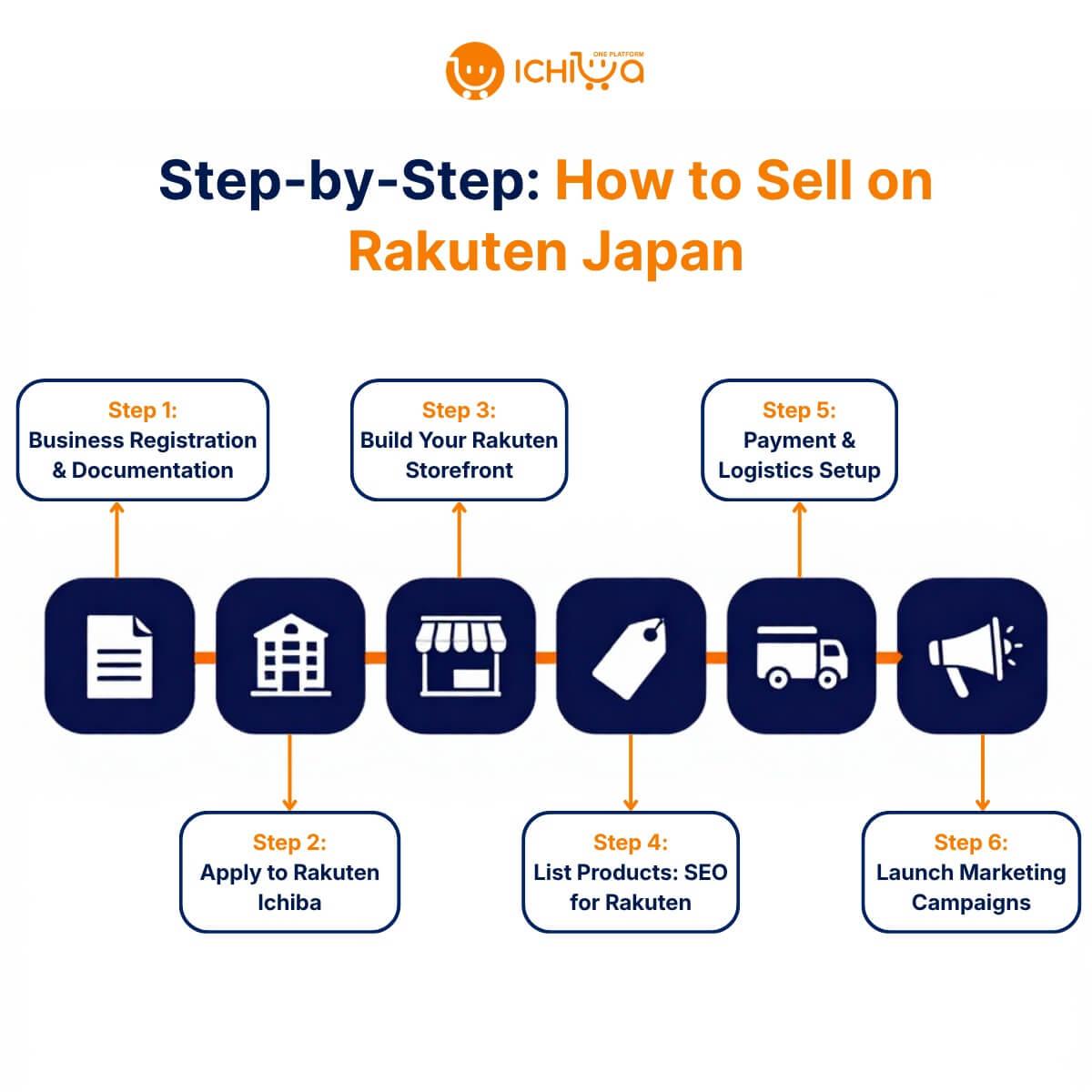
The first step is preparing business documents and product information.
Sellers should prepare:
Company registration
Business address
Legal representative information
Tax documents if needed
Credit file, D-U-N-S number, or equivalent documents if required
Product catalog
Product compliance documents
Shipping and return policy
Customer support workflow
Preparation matters on Rakuten. If documents are incomplete, product information is unclear, or the logistics plan is weak, the application can be delayed.
Sellers should also check product compliance before applying, especially for categories such as cosmetics, supplements, food, electronics, baby products, medical-related products, or products with health-related claims. A product that sells well in another country may not be ready for Japan. Import rules, labeling, safety standards, ingredients, warranty expectations, and claim restrictions should be checked before listing.
After preparing the required documents, sellers can apply to open a store on Rakuten Ichiba.
Rakuten’s screening process is more structured than many simple marketplace signups. This makes sense because sellers are not just uploading products into a standardized listing system. They are opening a branded storefront inside Rakuten Ichiba.
Rakuten Marketplace states that it takes about one and a half months from application submission to shop opening. The application process may take about 2-4 weeks, and store setup may take another 3-4 weeks.
The actual timeline can vary depending on document readiness, product category, store setup, and review requirements. During the review process, sellers should prepare product lists, Japanese product content, category structure, policies, customer support scripts, launch campaigns, and inventory plans.
The storefront is one of Rakuten’s biggest differences.
On Rakuten, sellers need more than product pages. They need a store structure that is easy to navigate, visually clear, consistent with the brand, and strong enough to build trust with Japanese customers.
A Rakuten storefront should include a brand story, category pages, campaign landing pages, product collections, seasonal banners, shipping and return policies, customer FAQs, reviews or trust signals, and a mobile-friendly layout.
For beauty, fashion, food, lifestyle goods, and premium items, the storefront becomes even more important. Customers do not only buy based on price. They also judge the brand, page quality, product presentation, and buying experience.
Custom storefront design helps sellers present their brand better than a standard listing page.
Sellers can use the storefront to explain who they are, where the product comes from, what makes it different, who it is for, and why customers should buy from this store.
However, the store should not only look good. It must also help customers buy more easily. A strong storefront needs clear navigation, clean banners, clear calls to action, visible campaign information, logical product grouping, trust signals, and strong mobile display.
Rakuten works well with campaign landing pages.
Sellers can build landing pages for seasonal promotions, product launches, gift collections, best sellers, new arrivals, or category-specific campaigns. A beauty store can create a skincare routine landing page. A food brand can create a seasonal gift set page. A fashion brand can create a summer collection page.
A good landing page should combine visuals, product education, benefit explanation, social proof, and clear calls to action. It should not be just a long banner with many products placed together.
Sellers should optimize Rakuten storefronts and product pages for mobile.
Many shoppers will view the store on a smartphone. If banners are too small, text inside images is hard to read, product specifications are too long, or calls to action are difficult to find, the shopping experience will suffer.
Mobile-first does not mean removing information. It means presenting information in a way that is easy to read on a smaller screen. Sellers should check titles, images, size charts, calls to action, campaign banners, and shipping or return details on mobile before launch.
Rakuten SEO is not just English-to-Japanese keyword translation.
Sellers need to understand what Japanese buyers actually search for, how they describe their needs, and what information helps them make a purchase decision.
Japanese keyword research should be done before writing product titles and descriptions.
Sellers should research product type, use cases, materials, ingredients, size, color, model, seasonality, gift terms, and problem-solution keywords in Japanese.
A strong Rakuten title is often not too short. It should contain enough information for both the system and the shopper to understand the product, while still sounding natural. A title can include brand, product type, main feature, specification, size, color, model, use case, and target customer when relevant.
Sellers should avoid keyword stuffing. At the same time, they should not write vague titles that include only the brand and product name.
Product descriptions on Rakuten should be more detailed than minimalist marketplace listings.
Japanese buyers often want to understand what the product is, how to use it, who it is for, why it is trustworthy, and what they should check before buying.
A strong product description should include product benefits, usage scenes, size and specification details, ingredients or materials, origin, care instructions, compatibility, warranty, safety notes, and shipping or return notes when relevant.
Storytelling should build trust. It should not become a vague branding copy. Instead of saying “high-quality lifestyle product,” sellers should explain what material it uses, where it fits in daily life, what problem it solves, and what buyers should confirm before purchase.
Rakuten product pages often need many clear images.
Images are not only decoration. They should help buyers understand the product faster. Sellers should prepare main product images, detail shots, size guides, comparison charts, usage examples, packaging images, ingredient or material explanations, campaign banners, and trust badges if available.
For Japan, image content should also be localized. If infographics are still in English, buyers may not understand the details or may feel that the product is not fully prepared for the Japanese market.
Rakuten storefronts should use internal links clearly.
Product pages should connect to category pages, related products, campaign pages, and best-seller collections. This helps buyers continue exploring the store instead of leaving after viewing one product.
For example, a skincare product can link to a full routine set. A food item can link to gift bundles. A fashion item can link to the same seasonal collection. Good internal linking increases page depth, supports discovery, and can improve cross-selling inside the store.
Payment and logistics should be prepared early when selling on Rakuten Japan.
Sellers need to understand how payouts work, how products will be shipped, how customs will be handled, how delivery will be communicated, and how returns will be processed.
Rakuten has its own merchant payment and settlement system.
For cross-border sellers, the payout method can depend on the seller program, country, partner, and setup. Sellers should not assume that every seller must always have a Japanese bank account.
Rakuten Marketplace FAQ mentions that cross-border merchants may be able to use payment solutions such as PingPong in some cases.
Sellers should check current payout requirements before applying, especially if they are selling from India, Vietnam, or another market outside Japan. Sellers should also calculate FX risk if revenue is received in JPY while sourcing, production, or operating costs are in another currency.
Sellers can use domestic fulfillment in Japan or cross-border shipping from outside Japan.
Domestic fulfillment usually offers faster delivery, easier return handling, and stronger trust with Japanese buyers. It is more suitable for sellers with stable demand or long-term brand-building plans in Japan.
Cross-border shipping can work during product testing, for niche products, premium goods, or products not easily available in Japan. However, sellers must clearly manage delivery time, tracking, customs clearance, and returns.
Rakuten Marketplace FAQ states that overseas merchants may dropship directly from an overseas warehouse into Japan if the carrier can ship to Japan and support customs clearance. The FAQ also recommends using a Japanese delivery company such as Yamato because of customer trust.
This means cross-border shipping is possible, but it is not always the easiest option.
Shipping policy should be clear from the beginning.
Sellers should explain delivery time, shipping fees, tracking method, customs and import cost responsibility, return process, damaged or lost parcel policy, customer support contact, and exceptions for remote areas if any.
Japanese customers expect clear information. If delivery time is vague or return policy is hard to understand, buyers may hesitate to purchase or leave negative feedback when problems happen.
After the store and product pages are ready, sellers can start launching through Rakuten campaigns.
Rakuten is not only a search marketplace. Campaigns, points, and CRM play an important role in traffic, conversion, and repeat purchases.
Rakuten Super Sale is one of Rakuten’s major promotional events.
Sellers can use events like Super Sale to increase visibility, drive traffic to the store, and create sales spikes. But major campaigns require preparation.
Before joining a campaign, sellers should check inventory, product page readiness, campaign banners, point rates, discount margins, fulfillment capacity, and customer support readiness. A campaign can bring traffic, but if the store is not ready, that traffic can be wasted.
Shopping Marathon and seasonal campaigns are also important on Rakuten.
Sellers can build campaigns around major Japanese shopping moments, such as New Year, Valentine’s Day, Golden Week, Mother’s Day, summer gifts, Obon, Halloween, Christmas, and year-end shopping.
Each campaign should have its own landing page, clear product selection, relevant banners, and a specific buying message. Rakuten often works better with campaigns that have a concept, points strategy, and clear product grouping instead of generic discounts.
Rakuten Points are an important part of shopping behavior on Rakuten.
Instead of only cutting prices, sellers can use points to create added value. This can fit Rakuten shoppers better, especially during major campaigns.
However, points are still a marketing cost. Sellers must include points in margin calculations. Before running a points campaign, sellers should know current product margin, maximum point rate, campaign goal, inventory status, and follow-up plan.
Rakuten gives sellers more room to build customer relationships than some listing-based marketplaces.
Sellers can use CRM-style email marketing to promote new arrivals, campaign launches, seasonal offers, product education, and repeat purchase reminders.
However, email content should be localized well. Japanese email marketing should be polite, clear, relevant, and not overly pushy. For beauty, food, lifestyle, and fashion sellers, CRM can support repeat purchases if the product cycle is suitable.
Cost is one of the most important things to understand before sellers sell on Rakuten Japan.
Rakuten usually has higher setup and operating costs than some easier marketplaces. This does not mean Rakuten is not worth it. It means sellers need to calculate full operating cost before applying, especially when comparing Rakuten with Amazon Japan or other ecommerce channels.
Rakuten Marketplace lists a Basic Shop Open Plan with a registration fee of ¥60,000 and a monthly fixed fee of ¥65,000. The contract period is listed as one year.
Outside Rakuten’s platform fees, sellers should also calculate practical setup costs, such as Japanese copywriting, storefront design, product page design, product photography, banner design, product compliance preparation, translation, partner or agency fees, and fulfillment setup.
Some sellers may see third-party estimates such as $500-$1,000+ for onboarding or service support, but the safer way to plan is to separate official Rakuten fees from partner costs. If sellers use an agency, service partner, designer, translator, or operations team, the total setup cost can vary widely depending on scope.
Rakuten Marketplace lists system fees for the Basic Shop Open Plan as 2.0%-4.0% for PC and 2.5%-4.5% for mobile. It also lists a Rakuten Super Points fee of 1% of monthly sales and a system enhancement fee of 0.1% of monthly sales.
Sellers should also check fees related to payment, affiliate programs, campaigns, or optional services if they use them.
Rakuten cost is not just one simple commission. Sellers need to look at the full cost structure, including fixed fees, system fees, points fees, marketing, logistics, and store operation.

Marketing on Rakuten is closely connected to points, campaigns, and storefront activity.
Sellers should budget for Rakuten Points campaigns, internal ads inside the Rakuten ecosystem, campaign participation, banner design, seasonal landing pages, email and CRM content, coupons, bundle offers, product photography, and visual updates.
If sellers open a store but do not budget for marketing, the store may struggle to gain traction. If they spend heavily on campaigns without calculating margin, sales may increase while profit stays weak.
Before applying to Rakuten, sellers should build a cost sheet.
Cost item | What to calculate |
Registration fee | Initial store opening fee |
Monthly fixed fee | Monthly store maintenance cost |
System/commission fees | Revenue-based fees |
Points cost | Loyalty and campaign cost |
Storefront setup | Design, banners, landing pages |
Localization | Japanese copywriting, translation, content review |
Product photography | Product images, infographics, campaign visuals |
Fulfillment | Warehouse, pick-pack, domestic shipping |
Returns | Return handling, damaged goods, refund buffer |
Marketing | Ads, campaigns, CRM |
FX risk | Currency risk when costs and revenue use different currencies |
If the margin only works in the best-case scenario, sellers should reconsider the product or launch plan. Rakuten is better for sellers with a serious operating plan, not sellers who only want a very low-cost quick test.
Selling on Rakuten Japan requires a clear strategy for localization, SEO, points, trust-building, and campaign execution.
Localization on Rakuten goes deeper than translation.
Sellers need to localize product copy, banners, page layout, campaign messages, customer support, return policy, and tone of voice. Japanese buyers often expect clear, polite, detailed, and trustworthy communication. A short claim like “best quality, best price” is not enough if it does not include specifications, material, origin, usage notes, and support information.
Sellers should localize product titles, descriptions, banners, landing pages, size charts, ingredients, materials, usage instructions, FAQs, shipping and return policy, and customer service templates.
Cultural adaptation is not only about language. It also affects how product benefits are explained, how claims are written, how visuals are designed, and how trust is built.
Japanese product pages often need more detail around size, material, origin, safety, usage, and care instructions. A claim that works in another market may feel too vague or too aggressive in Japan.
Sellers should avoid direct translations that sound unnatural. The content should feel like it was written for Japanese buyers from the start.
Japanese copywriting should be polite, detailed, and specific.
Sellers should avoid vague lines like “premium quality” or “best product.” Instead, explain why the product is reliable, how it is used, what problem it solves, and what the buyer should check before purchase.
This tone is especially important for beauty, food, supplements, baby products, lifestyle goods, and premium categories, where trust directly affects conversion.
Rakuten SEO depends on Japanese keywords, title structure, product details, and storefront navigation.
Sellers should research keywords in Japanese, not only translate English keywords. Areas to optimize include product title, product description, category page, campaign page, store navigation, related product links, image text, and product specifications.
Rakuten gives sellers more content space than many minimalist marketplaces, so sellers can cover keywords naturally through detailed content. The goal is not keyword stuffing. The goal is to help both the system and the buyer understand the product clearly.
Keyword placement in titles matters because the title helps both Rakuten search and shoppers understand the product.
A good title should include product type, brand, main feature, key specification, size, color, model, and use case when relevant.
However, sellers should not add keywords only for search volume. If the title becomes hard to read, buyer trust can drop. The best titles are keyword-rich but still natural.
Internal linking inside the Rakuten storefront helps shoppers discover more products.
Sellers can link product pages to related products, campaign pages, category pages, best-seller sections, and bundles. This is useful for categories with repeat-purchase or cross-sell potential.
For example, a skincare product can link to a full routine set. A food item can link to gift bundles. A fashion item can link to the same seasonal collection.
Rakuten pages can support more detailed keyword coverage than many listing-based marketplaces.
Sellers can use product descriptions, category pages, image text, FAQs, and campaign pages to cover more Japanese search terms naturally. This is useful for products where buyers search by material, use case, season, size, color, ingredient, or gift occasion.
The goal is not to repeat the same keyword unnaturally. The goal is to cover the way real Japanese buyers search and compare products.
Rakuten Points can help sellers improve conversion and repeat purchase behavior.
Instead of only reducing prices, sellers can use points to create perceived value. This fits shoppers who are already used to earning and spending points inside the Rakuten ecosystem.
A points strategy should be controlled. Sellers can use points during major campaigns, increase points for products that need conversion support, combine points with seasonal offers, use points to encourage repeat purchases, and avoid point rates that destroy margin.
Discounting can reduce brand value if overused. Points can sometimes be a better tool because they give shoppers extra value without always lowering the displayed product price.
This can be useful for premium products, branded items, gift products, and repeat-purchase categories. However, points are not free. Sellers must treat them as marketing cost and calculate them before joining campaigns.
Rakuten’s ecosystem supports loyalty-driven marketing because shoppers are already familiar with earning and using points.
Sellers can use points, CRM, seasonal campaigns, and repeat-purchase reminders to bring customers back. This is especially useful for consumable or replenishable products such as beauty, food, wellness, household items, and lifestyle goods.
Trust is essential on Rakuten.
A new store needs to give customers a reason to believe in the seller. This is especially important for foreign sellers because buyers may not know the brand, may not understand the product, and may worry about delivery or returns.
Sellers should focus on Japanese customer support, fast response time, clear return policy, detailed product pages, transparent shipping timeline, authenticity signals, product certifications if available, reviews, packaging quality, and after-sales communication.
Japanese customers often expect timely and polite replies.
Slow responses can create distrust, especially if the product is expensive, imported, or unfamiliar. Sellers should prepare response templates in Japanese and have a clear workflow for shipping questions, return requests, damaged items, and product inquiries.
Return policy should not be hidden at the bottom of the store.
Sellers should clearly explain the return window, eligible conditions, customer steps, damaged item process, refund timeline, and contact method. Clear return policies reduce hesitation before purchase and reduce conflict after purchase.
Detailed product pages help reduce uncertainty.
Sellers should include size, material, specs, origin, ingredients, compatibility, care instructions, warranty details, shipping notes, and FAQs when relevant. The more specific the product, the more important these details become.
Rakuten events can bring meaningful traffic if sellers are prepared.
Important campaigns include Rakuten Super Sale, Shopping Marathon, New Year campaigns, Golden Week, Mother’s Day, summer gifts, Obon, Halloween, Christmas, and year-end shopping.
Sellers should plan the campaign calendar months ahead. Each campaign needs product selection, pricing, point rate, banners, landing pages, inventory planning, and fulfillment planning.
Rakuten Super Sale can drive visibility and traffic, but sellers should prepare early.
Before joining, check whether product pages are ready, banners are clear, inventory is enough, point rates are profitable, and fulfillment can handle a sales spike.
Shopping Marathon can be useful for sellers that understand Rakuten’s points-driven shopper behavior.
It is especially relevant for stores with multiple products, bundles, and repeat-purchase opportunities. Sellers should prepare cross-sell flows and internal links so shoppers can browse more than one product.
Seasonal campaigns are important in Japan.
Sellers can plan around New Year, Valentine’s Day, Golden Week, Mother’s Day, summer gifts, Obon, Halloween, Christmas, and year-end shopping. Each campaign should have a clear theme, product selection, landing page, and fulfillment plan.
Logistics can decide whether a Rakuten store can operate sustainably.
Rakuten shoppers expect clear delivery timelines, reliable tracking, good packaging, and a transparent return process. If fulfillment is weak, the store can lose trust even when the product is good.
Domestic fulfillment is a strong option for sellers who want to build long-term presence in Japan.
Benefits include faster delivery, easier return handling, stronger trust with Japanese buyers, better packaging control, better fit for repeat-purchase categories, and lower risk of customs delays on each order.
If sellers have already validated demand or want to invest seriously in Rakuten, Japan-side fulfillment is often worth considering.
Sellers do not always need to build their own warehouse in Japan. They can use a 3PL warehouse or fulfillment partner to store products and deliver domestic orders.
Ezbuy can support sellers that need fulfillment, warehousing, and logistics in Japan, especially when they do not yet have a local operations team.
Relevant use cases include Japan-side warehousing, receiving goods, storage, pick and pack, domestic shipping coordination, return handling support, and operational support for sellers entering Japan.
For sellers that want to sell on Rakuten but do not have a local warehouse, a 3PL partner can help shorten delivery time, handle returns more smoothly, and create a more reliable customer experience than shipping every order from overseas.
Cross-border shipping can still work in selected cases.
Examples include niche products, premium goods, low-volume testing, products not yet widely available in Japan, and sellers validating demand before importing inventory into Japan.
However, cross-border shipping has challenges: higher shipping cost, slower delivery, more complex customs clearance, stronger tracking requirements, difficult return handling, and lower customer trust compared with domestic shipping.
If sellers use cross-border shipping, delivery time, customs, shipping fees, and return policy must be clear. Buyers should not discover extra cost or delay only after placing an order.
A safer approach is to use cross-border shipping for validation, then move to domestic fulfillment after demand becomes stable.
For sellers that want to sell in Japan across multiple channels, Rakuten is only one part of the operation.
Global sellers may start with Rakuten, but they may later need to manage product data, orders, inventory, fulfillment workflows, and other marketplaces. If everything is handled manually, operations can become messy as SKU count and order volume grow.
IChiba OnePlatform can support global sellers that need multichannel ecommerce operations in Japan.
As a multichannel commerce operation platform, IChiba OnePlatform can help sellers manage product and catalog data, order management, multichannel selling, inventory synchronization, fulfillment workflow coordination, cross-border ecommerce operations, and Japan-focused seller operations.
IChiba OnePlatform does not replace a Rakuten strategy. Sellers still need a strong storefront, good content, a campaign plan, and reliable fulfillment.
Its role is to reduce manual work, centralize operational data, and help sellers prepare for expansion across multiple ecommerce channels in Japan.

It depends on the seller’s strategy.
Rakuten is often a better fit for sellers that want brand-building, custom storefronts, loyalty marketing, campaigns, and product storytelling. Amazon Japan is often easier for sellers that want faster setup, standardized listings, and FBA-driven fulfillment.
If sellers have a clear brand, products that need detailed presentation, and the ability to invest in localization, Rakuten can be a strong option. If sellers want to test quickly with a simpler operational model, Amazon Japan may be easier to start with.
Rakuten Marketplace lists the Basic Shop Open Plan with a ¥60,000 registration fee, ¥65,000 monthly fixed fee, PC system fees of 2.0%-4.0%, mobile system fees of 2.5%-4.5%, Rakuten Super Points fee of 1% of monthly sales, and system enhancement fee of 0.1% of monthly sales.
Sellers also need to calculate localization, storefront design, product photography, logistics, returns, ads, campaigns, points cost, and service partner fees if used.
Yes. Foreign sellers can sell on Rakuten Japan through supported direct programs, service partners, local distributors, or cross-border ecommerce agencies.
The exact requirements depend on country, business setup, product category, and selling route. Sellers should check the latest eligibility before applying.
Possibly, but sellers from India should check the right route first.
If the business qualifies for a direct international seller program, it can apply according to Rakuten’s requirements. If direct access is not practical, sellers may work with a local partner, distributor, cross-border ecommerce agency, or Japan-side operations partner.
The key is not only whether it is possible to sell on Rakuten from India. Sellers also need to check business documents, compliance, Japanese operations, logistics, and customer support.
Sellers do not always need to speak Japanese personally, but Japanese operation capability is highly recommended.
Rakuten is a Japanese-first platform. Storefronts, product pages, campaign content, customer support, and return communication should be written in natural, polite, and clear Japanese.
If sellers do not have Japanese-speaking staff, they should work with bilingual staff, localization specialists, or operations partners.
Rakuten Marketplace states that it takes about one and a half months from application submission to shop opening. The application process may take about 2-4 weeks, and store setup may take about 3-4 weeks.
The actual timeline can vary depending on document readiness, category, screening, and storefront setup.
Categories worth researching on Rakuten include beauty, fashion, food, lifestyle goods, niche premium products, branded products, and repeat-purchase products.
However, these are not automatic winners.
Large categories are often competitive. Sellers still need to check demand, competitors, pricing, compliance, shipping cost, return risk, and margin before choosing products.
Rakuten often works best for products with a brand story, strong visuals, detailed product information, repeat purchase potential, or the ability to use points and campaigns to bring customers back.
Selling on Rakuten Japan can be a strong opportunity for global sellers that want to build brand presence in Japan. But Rakuten is not a marketplace to enter casually.
Sellers need more than a selling account. They need business documents, product compliance, Japanese content, storefront design, Rakuten SEO, a points strategy, campaign planning, logistics, and customer support.
Rakuten fits sellers that are serious about Japan, can localize deeply, and want to build long-term customer relationships.
A safe approach is to start with a focused product range, check eligibility, calculate fees carefully, prepare a strong storefront, launch campaigns with controlled margin, and choose the right fulfillment model.
For sellers without local operations in Japan, Ezbuy can support fulfillment, warehousing, and logistics. For sellers that want to expand across multiple ecommerce channels in Japan, IChiba OnePlatform can support product data, orders, inventory, and fulfillment workflow management.
The goal is not only to sell on Rakuten. The goal is to build an operation that can sell in Japan sustainably, protect customer experience, and keep profit margin healthy while scaling.

Work with us
Our solutions
Address:
 〒136-0082, Japan, Tokyo, Koto-ku, Shinkiba 3-5-6, 5F
Connect us:


Japan
〒136-0082, Japan, Tokyo, Koto-ku, Shinkiba 3-5-6, 5F
Texas, USA
1606 Audrey Dr, Garland, TX 75040, United States
California, USA
1316 John Reed Ct, City of Industry, CA 91745, United States