

News
Ichiba OnePlatform Team - 26/05/2026

In this article
Choosing the right products for dropshipping is one of the most important decisions you can make as an online seller, especially when targeting the highly competitive U.S. market. With thousands of stores selling similar items, the difference between slow sales and a winning store often comes down to identifying the best dropshipping products at the right time. U.S. consumers are trend-driven, value convenience, and increasingly expect fast shipping, which means you need products to dropship that are not only in demand but also easy to fulfill and profitable.
In this guide, we break down the best dropshipping items for 2025, explain why they perform well in the U.S., and help you understand what makes a product a strong candidate for your store. Whether you’re launching your first shop or scaling your existing brand, this list will help you find the best products for dropshipping and build a catalog with real sales potential.

Not every trending product is a good fit for dropshipping, especially in the U.S. market, where customer expectations are high and competition is intense. To consistently find the best products for dropshipping, you need to evaluate each item based on a few essential criteria.
First, the product must have a strong demand. This doesn’t always mean it has to be viral; instead, you should look for items with steady search volume, proven interest on platforms like Amazon, TikTok, or Google, and real purchase intent. High-demand products are easier to market and require less effort to validate.
Second, the best dropshipping items offer healthy profit margins. Because sellers often rely on paid ads, there must be enough room after product cost, shipping fees, and advertising spend to ensure a sustainable profit. Lightweight, compact products usually work best because they reduce shipping and return costs.
Third, consider competition and market saturation. A product with too many identical listings may be harder to differentiate, while niche or problem-solving items often convert better. The best item to dropship is one that solves a specific problem or delivers noticeable value.
Finally, the product should be reliable to source and easy to fulfill. U.S. buyers expect fast shipping, so your suppliers must offer stable stock, reasonable delivery times, and consistent quality. Products with low defect rates and minimal returns also help protect your store from disputes and chargebacks.
By focusing on demand, margins, competition, and fulfillment reliability, you’ll be able to identify the best dropshipping products, items that are not only trending but also realistically profitable for the U.S. market.
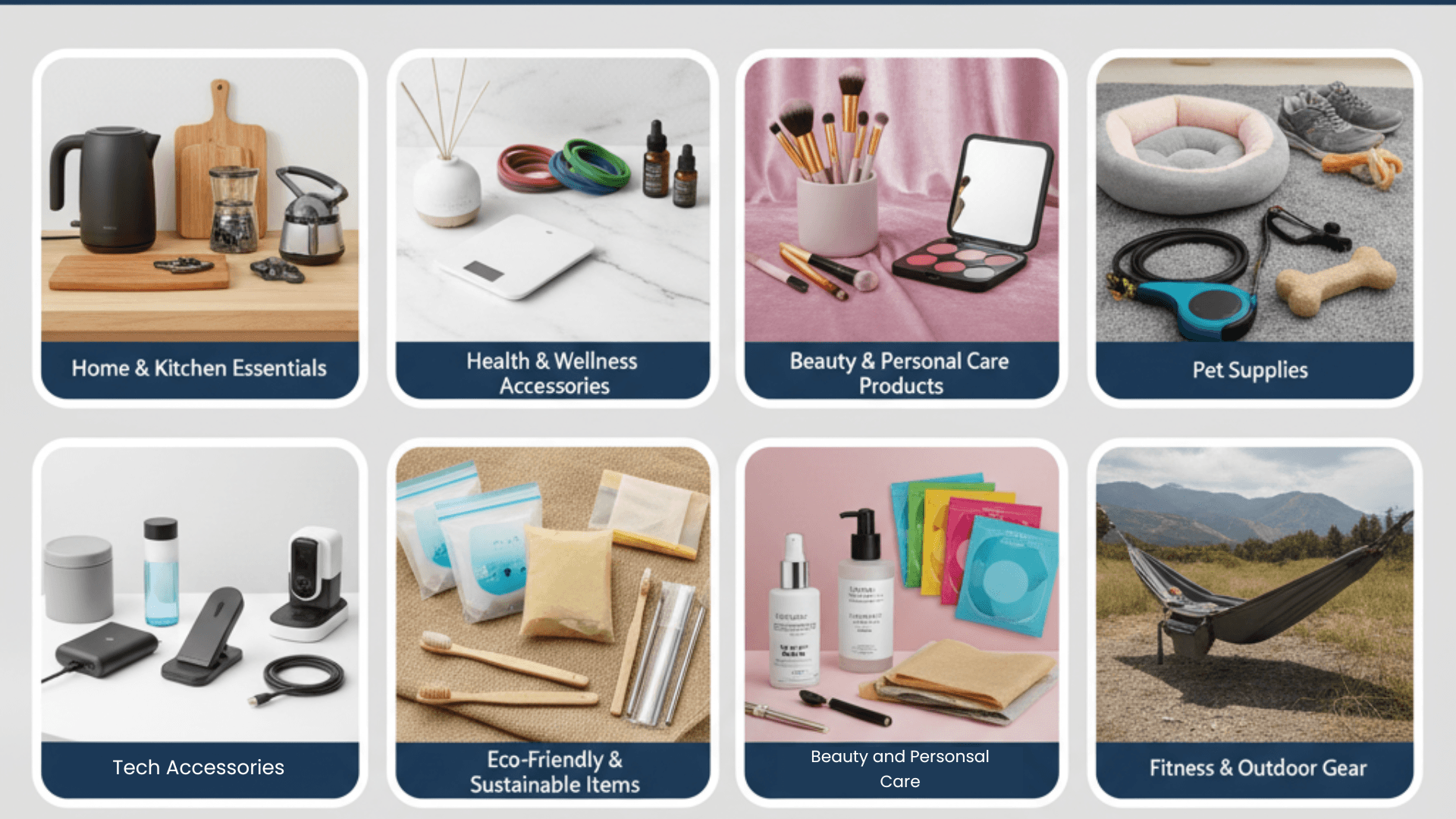
The U.S. e‑commerce market is projected to reach $1.17 trillion in 2025, with nearly 92% of Americans shopping online (Statista, 2025). This massive audience creates excellent opportunities for dropshipping sellers who select the best products for dropshipping. Based on market trends, consumer behavior, and profitability, here are ten product categories poised for success.
Small, practical items like smart organizers, eco-friendly storage solutions, and compact kitchen gadgets continue to be popular. U.S. consumers value convenience, and lightweight items like these are ideal for dropshipping due to low shipping costs and minimal returns. With online sales growing steadily, home and kitchen products remain a high-demand category.
Products such as posture correctors, massage tools, and personal care devices are in strong demand. The U.S. home fitness equipment market was valued at $5.09 billion in 2023 and is projected to grow to $8.50 billion by 2030 (Fortune Business Insights, 2023). This growth shows the potential of health and wellness products for dropshipping sellers.
Skincare tools, hair styling gadgets, and trending K-beauty/J-beauty items continue to perform well. The American beauty market remains robust, with consumers willing to pay for innovative, high-value products. High perceived value allows for attractive profit margins, making beauty items among the best dropshipping products for U.S. buyers.
Interactive toys, grooming tools, and travel accessories for pets are a booming niche. Americans spend heavily on pet care, and lightweight, easy-to-ship items have low return rates. With e-commerce adoption at over 91% (Statista, 2025), online pet supply sales continue to grow.
Portable gym equipment, hiking accessories, and reusable water bottles remain popular. The North American dropshipping market is expected to reach $109.2 billion in 2025 (Mordor Intelligence, 2025), and fitness-related products are a significant contributor. These products align with current consumer trends and generate high engagement on social media.
Wireless chargers, phone stands, and smart device add-ons are in constant demand. Technology evolves rapidly, creating opportunities to find best items to dropship with strong margins.
Reusable household products, biodegradable bags, and bamboo alternatives appeal to environmentally conscious U.S. consumers. Sustainability is increasingly important, and eco-friendly items trend well online.
Small organizers, LED lights, and smart gadgets for vehicles continue to sell well. Practical, affordable, and lightweight products reduce shipping costs and return rates, making them ideal for dropshipping.
Non-electric toys, organizers, and travel essentials for babies remain steady sellers. Parents prioritize convenience and safety, and online shopping facilitates access to a wide variety of products.
Craft kits, painting tools, and beginner-friendly hobby sets cater to Americans looking for at-home entertainment. The continued growth of e-commerce revenue (projected $1.17 trillion in 2025, Statista, 2025) and social media-driven trends makes visual, interactive products highly engaging and profitable for dropshipping.

Finding the best products for dropshipping is just the first step. To maximize your chances of success, you need to validate each product before listing it in your store. Here are key strategies:
Before adding any item to your dropshipping catalog, you need to understand whether U.S. consumers are actually searching for it. Market demand is the strongest indicator of a product’s long-term potential. Tools like Google Trends, Amazon Best Sellers, and eBay Trending allow you to measure search interest, keyword growth, and consumer buying patterns over time. Google Trends helps you identify whether a product keyword is rising, stable, or declining, while Amazon and eBay reveal what customers are actively purchasing in real time. These data sources are especially valuable for sellers targeting the U.S. market, where trends shift quickly and competition is intense.
When you find a product with high and stable search volume, it means shoppers are already looking for it, reducing the educational effort required in your marketing. Steady demand also increases the likelihood of repeat purchases and evergreen sales, which is crucial for building a sustainable dropshipping business. By relying on data rather than guesswork, you increase your chances of selecting products with real market traction in the U.S. and avoid wasting time and advertising budget on items that won’t sell.
Once you’ve identified a product with strong market demand, the next step is to examine how competitive the landscape is. Competition analysis helps you understand whether you can realistically enter the market and generate sales, or whether the space is too saturated to be profitable. The best places to start include major U.S. marketplaces such as Amazon, eBay, and Walmart, where millions of American shoppers make purchasing decisions every day. By searching for your target product on these platforms, you can quickly assess the number of existing listings, the level of seller activity, and how differentiated current offerings are.
When reviewing competition, pay close attention to the variety of sellers and price ranges. If you see thousands of nearly identical listings, it’s a sign that the product may be oversaturated. Competing in such categories often requires significant ad spend and aggressive pricing strategies, challenges that make it hard for new dropshipping sellers to gain traction. On the other hand, products with moderate competition and strong demand tend to be more profitable. They indicate a healthy market with active buyers, but not so much saturation that your listings get buried instantly. This balance is ideal for dropshipping, especially when targeting the U.S. market, where consumer preferences are diverse and fast-changing.
After evaluating demand and competition, the next critical step is determining whether the product can generate healthy profits. Profitability is the foundation of every successful dropshipping business, without strong margins, even high-demand products can lead to losses once marketing and fulfillment costs are factored in. To properly assess profitability, you should calculate the total landed cost of each item. This includes the product’s base price from your supplier, shipping fees, transaction fees, packaging costs, and your estimated advertising spend. Only when you have a complete view of these expenses can you determine if the product can support a sustainable profit margin.
It’s important to remember that paid advertising, especially to U.S. audiences, can be one of your largest expenses. Platforms like Facebook, TikTok, and Google Ads often require testing multiple creatives before finding a winning combination. This means your product must have enough markup potential to absorb these costs. Many experienced dropshippers aim for margins of 20-40% after ad spend, depending on the niche and product type. If your margins fall below this range, it becomes extremely difficult to scale while maintaining profitability.
Even the best dropshipping product can fail if your supplier is unreliable. Supplier reliability directly impacts every part of your business, from shipping speed and product quality to customer satisfaction and refund rates. Before listing any product in your store, you need to evaluate whether the supplier can provide consistent stock availability, meet delivery expectations for U.S. customers, and maintain a stable level of product quality. Unreliable suppliers often cause long shipping delays, mismatched product descriptions, or sudden stock shortages, all of which can damage your store’s reputation and increase chargebacks or negative reviews.
Platforms like Spocket, CJDropshipping, and Ichiba have become popular among U.S.-focused dropshipping sellers because they offer U.S.-ready fulfillment solutions. These platforms often work with local or regional warehouses, meaning your products can be shipped directly from within the United States rather than from overseas. This dramatically reduces delivery times, often to as little as 2–5 days, making your store more competitive in a market where customers increasingly expect fast shipping. Faster fulfillment also leads to higher customer satisfaction, lower return rates, and improved conversion rates, especially for impulse-purchase items.
Before committing significant resources to a new product, it’s essential to validate whether real customers in the U.S. market are willing to buy it. Testing with small batches allows you to gather reliable data without taking on unnecessary financial risk. Instead of ordering large quantities of inventory upfront, you can launch products using print-on-demand or dropshipping suppliers, or by purchasing a very limited number of units. This lean approach is especially effective for new dropshipping sellers, as it minimizes inventory costs while still giving you access to real market feedback.
The primary goal of small-batch testing is to measure how the product performs in real customer interactions. Start by driving a manageable amount of targeted traffic through social ads, TikTok content, influencer shoutouts, or SEO-optimized product pages, and then monitor how visitors respond.
Customer feedback is another crucial component of the testing process. Pay close attention to comments, questions, reviews, and direct messages related to the product. These insights help you identify potential improvements, such as updating product descriptions, enhancing images or videos, or addressing customer concerns before scaling.
Conclusion
Choosing the right products for dropshipping is the key to success in the competitive U.S. e-commerce market. With projected online sales reaching $1.17 trillion in 2025 and over 91% of Americans shopping online, the potential for profitable dropshipping is immense. However, success depends on careful product selection, data-driven validation, and reliable fulfillment.
The 10 product categories highlighted in this guide, from home & kitchen essentials and health & wellness accessories to eco-friendly products and hobby kits, reflect current U.S. consumer trends and proven market demand. By analyzing search trends, assessing competition, calculating profit margins, and testing small batches, sellers can confidently identify the best products to dropship in 2025.
Dropshipping in the U.S. also benefits from a rapidly growing market: the North American dropshipping market alone is expected to reach $109.2 billion in 2025, with a projected CAGR of 20.86% through 2030. Leveraging these insights and focusing on high-demand, profitable, and easy-to-fulfill products allows sellers to build a scalable, sustainable business.
In summary, the most successful dropshipping stores combine trend analysis, market data, and strategic testing. By selecting the right products, monitoring consumer behavior, and using reliable suppliers, U.S. sellers can maximize profits and thrive in a growing e-commerce landscape.

Work with us
Our solutions
Address:
 〒136-0082, Japan, Tokyo, Koto-ku, Shinkiba 3-5-6, 5F
Connect us:


Japan
〒136-0082, Japan, Tokyo, Koto-ku, Shinkiba 3-5-6, 5F
Texas, USA
1606 Audrey Dr, Garland, TX 75040, United States
California, USA
1316 John Reed Ct, City of Industry, CA 91745, United States