

News
Ichiba OnePlatform Team - 27/05/2026

In this article
In the early days of scaling a dropshipping business, platforms like Spocket often feel like a safe and reliable starting point because they offer US and EU suppliers, faster shipping, and smooth integrations with Shopify.
However, as stores grow, ad costs increase, and competition intensifies, many sellers begin to realize that Spocket is not always built for long-term profitability or aggressive scaling. Thin margins, limited product differentiation, and unstable supplier inventory have pushed experienced sellers to actively search for a stronger Spocket alternative that can support higher order volumes and better branding control.
Spocket is a dropshipping platform that connects online sellers with suppliers primarily based in the US and Europe, positioning itself as a solution for faster delivery and higher perceived product quality. For many Shopify and WooCommerce store owners, Spocket serves as an entry point into domestic dropshipping, especially for sellers targeting customers who expect short shipping times and local return addresses.
While Spocket emphasizes reliability and supplier verification, its model is best suited for stores that prioritize speed over product uniqueness. Understanding both the strengths and the limitations of Spocket is essential before deciding whether to stay or move to one of the many Spocket alternatives available today.
One of Spocket’s strongest advantages is its focus on US and EU suppliers, which allows sellers to offer significantly faster delivery compared to traditional cross-border dropshipping. For customers in North America and Europe, domestic shipping times typically range from two to five business days, helping stores reduce delivery complaints and charge premium pricing more confidently.
Spocket also integrates smoothly with major ecommerce platforms, particularly Shopify and WooCommerce, making it easy for sellers to import products, sync inventory, and automate order processing. Once an order is placed, fulfillment workflows are largely hands-off, which reduces manual errors and saves time for solo sellers or small teams.
Another area where Spocket performs well is basic supplier screening. Most suppliers on the platform are wholesalers or distributors rather than unknown individuals, which adds a layer of trust and consistency compared to open marketplaces. For beginners or stores that do not require deep customization, this structure offers a relatively low-risk environment to launch and test products.
As stores begin to scale, many sellers report that Spocket’s biggest limitation is profitability. Because most suppliers are intermediaries rather than factories, product costs are often high, leaving little room to absorb rising advertising expenses or offer competitive promotions. Over time, these thin margins make it difficult for scaling stores to reinvest in marketing and brand development.
Another frequent complaint is the lack of meaningful product customization. Spocket offers limited options for private labeling, custom packaging, or branded inserts, which makes it challenging for sellers to differentiate their stores in crowded niches. For businesses aiming to build a long-term brand rather than run short-term product tests, this limitation becomes a major growth barrier.
Sellers also point to restricted access to trending or ad-friendly products. Many Spocket catalogs focus on generic household or lifestyle items that are already widely distributed, reducing the chance of finding unique winning products. In addition, supplier stock levels can fluctuate without real-time transparency, leading to unexpected out-of-stock situations that disrupt active ad campaigns and customer experience.
These challenges explain why an increasing number of experienced sellers are actively searching for sites like Spocket that offer better control over margins, branding, and inventory stability while still maintaining fast and reliable fulfillment.
Choosing the right Spocket alternative is not just about finding another supplier directory with fast shipping. For growing dropshipping stores, the platform you use directly impacts profit margins, customer satisfaction, and how efficiently your business can scale. A strong alternative should solve the limitations sellers commonly face with Spocket while providing more flexibility in sourcing, fulfillment, and automation.
Instead of focusing only on where suppliers are located, experienced sellers in 2026 evaluate platforms based on supplier reliability, logistics performance, and how well the system integrates into their existing workflows. The following criteria reflect what dropshipping stores should prioritize when comparing alternatives to Spocket.
A reliable Spocket alternative should work with verified suppliers such as factories and established wholesalers rather than multiple layers of middlemen. Direct access to these suppliers helps reduce product costs, stabilize inventory, and improve communication when issues arise. For scaling stores, consistent SKU availability is critical, especially when running paid ads or seasonal campaigns that depend on predictable stock levels.
Product flexibility is another key factor. Sellers increasingly look for private label or white label options that allow them to customize packaging, add branded inserts, or create exclusive variants. Without these options, it becomes difficult to stand out in saturated niches or justify premium pricing. Platforms that support deeper product customization give sellers more control over brand positioning and long-term value.
Shipping performance remains one of the most important decision points when evaluating sites like Spocket. For domestic fulfillment in the US or Europe, competitive platforms should consistently deliver within two to five business days. For cross-border fulfillment, delivery times in the range of six to ten days are now considered acceptable for most markets, provided tracking is accurate and transparent.
Beyond speed, tracking reliability plays a major role in customer trust and support workload. A good Spocket alternative should offer real-time tracking updates that sync directly with your store and customer notifications. Equally important is return address support, particularly for US and EU markets, as local return options significantly reduce disputes, refunds, and chargebacks.
Modern dropshipping operations rely heavily on automation to handle volume without increasing headcount. A strong alternative to Spocket should offer native Shopify integrations rather than relying on unstable third-party connectors. Order syncing should be automatic and reliable, ensuring that customer details, variants, and shipping methods are processed without manual intervention.
As order volume grows, bulk order handling becomes essential. Platforms that support batch processing, automatic supplier routing, and pricing rule automation allow sellers to maintain consistent margins even as costs fluctuate. These features are especially valuable for stores managing multiple suppliers, running flash sales, or scaling across several product lines.
As more sellers move beyond basic domestic dropshipping, the market has seen a rise in platforms that position themselves as serious Spocket alternatives. These solutions differ significantly in terms of supplier access, automation depth, branding support, and scalability. Instead of looking for a one-size-fits-all replacement, it is more effective to evaluate alternatives based on specific use cases such as Shopify scaling, product research, or cost-efficient fulfillment.
Below is a detailed comparison of the most relevant sites like Spocket in 2026, grouped by their core strengths and ideal user profiles.
Zendrop is often mentioned as a direct Spocket alternative for Shopify sellers who want faster fulfillment and cleaner automation. The platform focuses heavily on US fulfillment, making it suitable for stores targeting American customers who expect quick delivery. Zendrop also offers private labeling and custom packaging options on higher plans, which gives sellers more branding flexibility than Spocket.
However, Zendrop’s catalog is still relatively curated and limited, which can restrict product discovery for sellers looking to test aggressively. Pricing can also increase quickly as order volume grows, making it better suited for mid-stage stores rather than beginners.
AutoDS positions itself as both a supplier marketplace and an automation engine. Unlike Spocket, which mainly focuses on supplier access, AutoDS emphasizes end-to-end operational automation, including price monitoring, stock syncing, and automatic order placement across multiple suppliers.
For sellers managing several stores or testing products at scale, AutoDS provides strong operational control. The tradeoff is that supplier quality and shipping speed can vary depending on the source marketplace used, so sellers need to actively manage supplier selection rather than relying on a single curated ecosystem.
Dropship.io is not a fulfillment platform in the traditional sense, but it plays a critical role in product validation. Many sellers use it alongside Spocket or other fulfillment tools to analyze competitor stores, ad creatives, and trending products. For sellers who feel limited by Spocket’s product catalog, Dropship.io helps identify winning SKUs before committing to suppliers.
That said, Dropship.io does not solve fulfillment or supplier management, which is why many sellers search for alternatives to Dropship.io that combine research with execution.
Sell The Trend attempts to bridge the gap between research and sourcing by offering trend analysis, product discovery, and supplier links in one platform. It is useful for early-stage validation and niche exploration, especially for sellers running paid ads. Compared to Spocket, it offers broader visibility into trending products but less control over fulfillment quality and branding.
DSers remains one of the most popular budget-friendly Spocket dropshipping alternatives, especially for beginners. As the official AliExpress solution, it offers strong order automation, bulk processing, and supplier mapping features. For sellers who prioritize low product costs and wide selection, DSers provides flexibility that Spocket cannot match.
The main limitation lies in shipping speed and branding, as most fulfillment remains cross-border unless sellers work directly with private agents or warehouses.
CJ Dropshipping appeals to sellers who want a balance between sourcing, fulfillment, and basic customization. Compared to Spocket, CJ offers a wider product range, better pricing, and access to global warehouses. It also supports custom packaging and branding for certain products, making it more attractive for sellers transitioning toward brand building.
However, catalog consistency and product quality can vary, which means sellers need to invest time in supplier communication and sampling.
IChiba OnePlatform stands out as a more advanced Spocket alternative designed for sellers who want full control over sourcing, fulfillment, and cross-border operations rather than just faster shipping. Unlike traditional supplier directories, IChiba operates as an integrated ecosystem that connects sellers directly with verified suppliers and factories in China, Vietnam and Japan, while providing fulfillment infrastructure in key markets such as the US.
Instead of relying on generic wholesalers, IChiba focuses on long-term supplier partnerships with consistent SKU availability. This is particularly valuable for sellers running high-volume campaigns or building branded product lines, as inventory volatility is significantly reduced compared to Spocket.
From a fulfillment perspective, IChiba OnePlatform supports both domestic US, UK, and Japan fulfillment and optimized cross-border shipping. Tracking reliability and return address support are built into the system, which helps sellers reduce customer support load and refund rates.
Automation is another area where IChiba differentiates itself from most sites like Spocket. The platform offers native Shopify integration, automatic order syncing, bulk order handling, and pricing rule automation designed specifically for scaling sellers. These features allow stores to manage growth without constantly adjusting operations or adding manual workflows.
Switching from Spocket to a new platform can unlock better margins and stronger operational control, but a poorly planned migration can disrupt fulfillment, hurt customer experience, and damage ad performance.
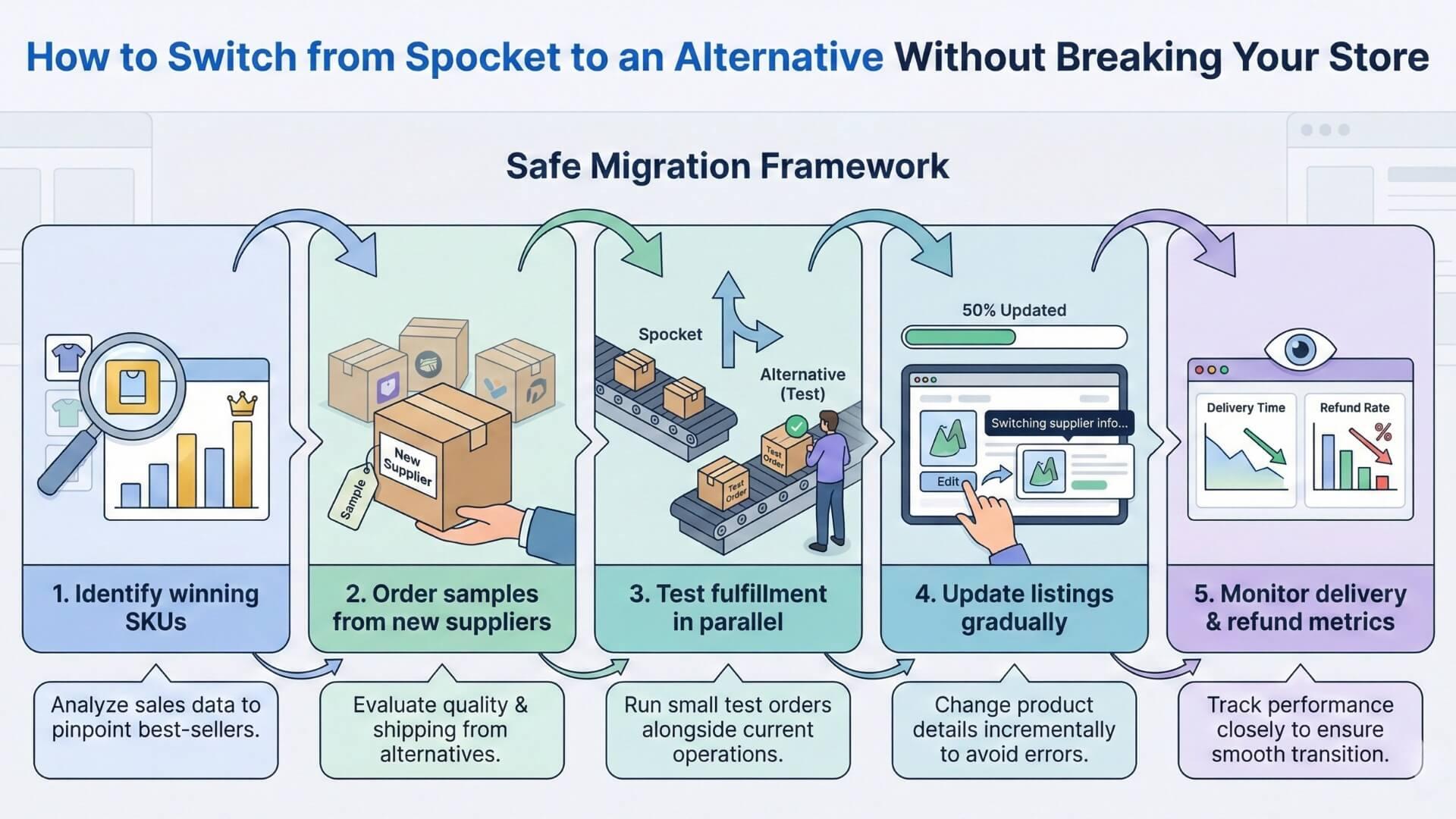
For scaling dropshipping stores, the goal is not to replace Spocket overnight, but to transition in a controlled way that protects revenue while validating the new system. A structured migration framework helps sellers minimize risk and maintain store stability throughout the process.
The first step is to identify your winning SKUs rather than attempting to migrate your entire catalog at once. Focus on products that already generate consistent orders and predictable demand, as these items will provide the most accurate performance data when tested with a new supplier or platform.
Once potential replacements are identified, ordering samples from new suppliers is critical. This allows you to verify product quality, packaging standards, and shipping speed before exposing customers to the new fulfillment flow. Many sellers skip this step to save time, only to face higher refund rates later due to quality mismatches.
Running fulfillment in parallel is a proven risk reduction strategy. Instead of shutting down Spocket immediately, route a portion of orders to the new platform while keeping the rest on Spocket. This approach helps you compare delivery times, tracking accuracy, and customer feedback in real conditions without fully committing.
Finally, update product listings gradually. Changes in shipping times, return addresses, or packaging should be reflected carefully in your store content and customer notifications. Gradual updates reduce confusion and help maintain trust during the transition.
One common issue during platform switching is variant mismatches. Differences in size, color naming, or SKU structure between suppliers can lead to incorrect orders if mappings are not double-checked. Careful variant testing is essential before scaling order volume.
Supplier inventory sync delays can also create problems, particularly when running paid ads. If stock levels are not updated in real time, sellers may continue selling products that are no longer available, leading to cancellations and negative customer experiences.
Customer experience inconsistencies are another hidden risk. Differences in packaging quality, shipping carriers, or tracking formats can confuse repeat buyers who expect a consistent experience. Maintaining brand standards across platforms helps reduce this friction.
After migrating away from Spocket, performance should be evaluated using clear operational metrics rather than assumptions. Shipping time is one of the most immediate indicators, as delays often lead directly to increased support tickets and refund requests.
Refund rate is another critical KPI, reflecting both product quality and fulfillment reliability. A rising refund rate often signals issues with supplier consistency or customer expectation mismatches.
Customer support tickets provide valuable qualitative insight. An increase in delivery related questions, tracking confusion, or return requests can indicate gaps in communication or logistics that need to be addressed quickly.
By monitoring these KPIs closely during and after the transition, sellers can move from Spocket to a more capable alternative without sacrificing store performance, customer trust, or long term growth potential.
Are there free alternatives to Spocket?
There are no truly free Spocket alternatives that offer the same level of automation, supplier verification, and fulfillment support. However, some platforms provide free plans or trials with limited functionality.
DSers, for example, offers a free tier that allows basic order automation with AliExpress suppliers, making it suitable for beginners testing the dropshipping model. The tradeoff is slower shipping and minimal branding control compared to paid platforms.
Is Zendrop better than Spocket?
Zendrop can be a better option than Spocket for Shopify sellers who prioritize US fulfillment and want more private labeling options. It generally offers stronger automation and faster domestic shipping.
That said, Zendrop still relies on a curated catalog and can become expensive as order volume increases. For sellers focused on margin optimization or sourcing, more advanced Spocket alternatives may be a better fit.
Which Spocket alternative has the fastest US shipping?
Platforms with dedicated US fulfillment infrastructure typically offer the fastest delivery. Zendrop and AutoDS, when paired with US suppliers, can achieve two to five-day shipping within the United States. IChiba OnePlatform also competes strongly in this area by combining US fulfillment with optimized sourcing, allowing sellers to maintain fast delivery while improving margins and inventory stability.
Spocket remains a familiar name in dropshipping, especially for sellers who value US and EU suppliers and faster delivery times. However, as the market matures and competition intensifies, its limitations around profit margins, product differentiation, and supplier flexibility have become increasingly clear.
Choosing the right Spocket alternative ultimately depends on your growth stage and long-term goals. Sellers focused on short-term testing may prioritize speed and simplicity, while those building serious ecommerce brands should look for platforms that support stable inventory, customization, and operational scalability.

Work with us
Our solutions
Address:
 〒136-0082, Japan, Tokyo, Koto-ku, Shinkiba 3-5-6, 5F
Connect us:


Japan
〒136-0082, Japan, Tokyo, Koto-ku, Shinkiba 3-5-6, 5F
Texas, USA
1606 Audrey Dr, Garland, TX 75040, United States
California, USA
1316 John Reed Ct, City of Industry, CA 91745, United States