

News
Ichiba OnePlatform Team - 20/05/2026
In this article
For sellers doing dropshipping from China to the UK, the upside is obvious. China offers deep catalog depth and fast testing, so new products can be validated quickly. The UK is also the market that punishes messy operations fast - usually through fee surprises at delivery, stalled tracking, and parcels held at the border.
UK buyers do not ask for perfection. They ask for a predictable experience. When VAT messaging, customs data, and tracking behavior match what buyers saw at checkout, even “normal products” sell fine. When one layer slips, buyers do not want a long explanation. They refund.
This guide breaks down how the flow works, how the £135 threshold impacts VAT experience, which shipping methods tend to keep tracking clean, how to vet suppliers for UK-bound orders, and how to set up a store that avoids repeatable disputes.
The order flow is simple. A UK buyer orders on the store. The supplier in China fulfills. The parcel enters UK import processing. Last-mile delivery is handled by Royal Mail or a courier partner, depending on the shipping line.
Most UK problems are not caused by “slow shipping.” They come from inconsistency between three layers.
Checkout expectation. What the buyer believes they paid for, including whether VAT and fees are handled.
Invoice proof. What the seller can show if a charge is questioned.
Customs data. What the border actually sees on declarations.
When those do not align, the outcome is predictable. A parcel can be on schedule and still turn into a refund because the import experience feels messy.
Checkout clarity is usually the first weak spot. UK buyers hate “extra charges later.” If fees may apply, sellers need to say it before payment, not inside support tickets.
Tracking behavior is the second weak spot. If tracking sits on “label created” for days, buyers assume the parcel is not moving and start pushing for refunds.
Customs consistency is the third weak spot. Random descriptions and values increase holds, and they increase the chance of buyers being asked to pay at delivery.
Last-mile handoff is the final weak spot. A messy handoff creates “stuck tracking” complaints that turn into reviews.
Yes. Dropshipping is legal. The risk comes from how sellers handle VAT, customs declarations, and compliance claims.
The common “we did it to ourselves” problems look like this.
VAT messaging is unclear, so buyers feel tricked at delivery.
Declarations do not match checkout, so parcels get held or buyers get charged twice.
Undervaluation becomes a selling point, which creates long-term risk.
Tracking gets messy, with delayed scans or recycled numbers.
CE/UKCA claims get used casually, without proof for the product category.
If you’re still building your China supplier setup, start here: Chinese supplier setup that doesn’t break at scale - Why Use Chinese Dropshipping Suppliers in 2026?
£135 is the line that decides “VAT now” vs “VAT later” for many cross-border consumer parcels into Great Britain. For consignments at £135 or less sold directly to customers in Great Britain (not via an online marketplace), UK supply VAT is charged at the point of sale.
That sentence matters because the UK experience is all about avoiding fee surprises at the door.
The rule sellers miss: the £135 limit applies to the total consignment value, not each item inside the parcel. Bundles can push an order over the line without anyone noticing until the buyer gets charged at delivery.
When sellers run china to uk dropshipping, VAT collection depends on the selling channel and consignment value.
For direct sales (no online marketplace) and £135 or less, HMRC guidance treats VAT as charged at the point of sale for Great Britain. That is why sellers need checkout, invoice, and customs data to match.
For online marketplace sales, HMRC guidance generally makes the online marketplace liable for VAT on overseas goods in consignments of £135 or less, and the £135 test is based on total consignment value.
For orders over £135, “normal import VAT and customs rules” apply. That is the zone where courier collection at delivery becomes common, and where sellers must warn buyers clearly before payment.
(This is not legal advice. It is operational guidance. Sellers should confirm how their exact channel and route handles VAT and fees.)
Scenario 1: Direct sale, ≤ £135. The cleanest experience is VAT handled upfront and messaging consistent everywhere. Sellers get burned when checkout says one thing and paperwork says another.
Scenario 2: Direct sale, > £135. Fees may show up at delivery. Sellers get burned when buyers feel baited because “fees may apply” was not clear before payment.
Scenario 3: Marketplace sale. VAT follows channel policy. Sellers get burned when they assume they collect VAT while the marketplace is the VAT party (or the reverse).
Scenario 4: Courier collects at delivery. This can work, but only when the store warns buyers clearly on product page, checkout, and confirmation email. Otherwise buyers refuse delivery and disputes spike.
Ignoring VAT sometimes looks “fine” early because a few parcels slip through without friction. Then volume grows and the same pattern repeats.
Parcels get held, tracking stalls, and refund pressure rises.
Buyers get charged at delivery, refuse parcels, and disputes increase.
Payment processors see dispute spikes, and reserves or holds become more likely.
In the UK, this is not about luck. It is about whether VAT messaging, invoices, and customs data stay aligned at scale.

UK buyers do not need “two days like Amazon.” They need predictable delivery ranges, early tracking scans, and a clean handoff into UK last-mile.
That’s why shipping choice is not just a cost lever. It is a dispute lever.
AliExpress Standard Shipping and Cainiao can work for testing because costs are manageable and the pipeline is widely used. The risk is inconsistency by seller and season. When tracking sits on “label created,” buyers assume the parcel is stuck.
Commercial lines like YunExpress or 4PX are common in dropshipping china to uk because they often show earlier scans and clearer updates. The reliability still depends on lane selection and how disciplined the supplier is with dispatch and declarations.
ePacket is often treated as a legacy option. Some sellers still use it, but many treat it as a test lane, not a scaling lane, because consistency can swing.
Private lines and UK-bound channels are usually the “scale” path. They are often more stable for tracking and last-mile handoff, but they require a supplier or agent who can run the workflow properly and keep customs data consistent.
What this means for conversion: UK stores that last are boring in a good way. Early scans. Steady ETAs. No fee surprises. Buyers reward predictability.
If you want a delivery-speed benchmark mindset by region, see 17 Fastest Dropshipping Suppliers for 2026 (Fast Shipping Options for U.S, EU, China, Japan)
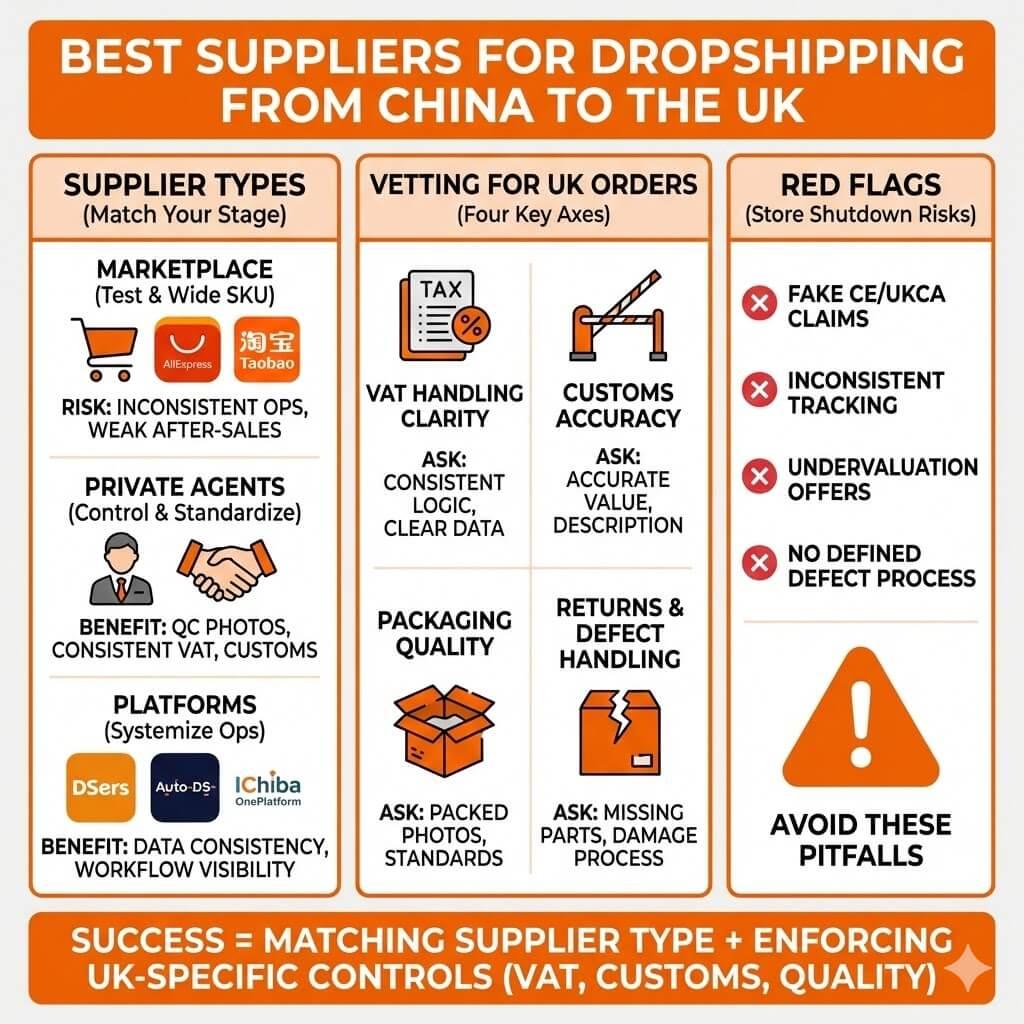
Most sellers lose time building a “big list.” UK success is simpler. Pick the supplier route that fits the stage, then lock UK controls: VAT messaging, declarations, tracking behavior, and packing standards.
Marketplace suppliers (AliExpress, 1688, Taobao).
Great for fast testing and wide SKU access. The UK risk is operational inconsistency. Declarations vary order to order. Packaging drifts. After-sales is weak. Tracking can be delayed or reused.
Private agents.
Best once winners are proven and control matters. Agents can standardize packaging, request pre-ship photos, and tighten declaration consistency. The trade-off is relationship management. Agent quality varies, so SOPs matter.
Dropshipping platforms and workflow layers (DSers, AutoDS, IChiba OnePlatform, and similar).
Useful when sellers want fewer moving parts. Cleaner product data reduces listing mistakes. Order sync reduces manual chaos. Tracking visibility improves support speed. In the UK, less chaos usually means fewer disputes.
Dropshipping platforms (DSers, AutoDS, IChiba OnePlatform, etc.)
If you’re scaling and want fewer moving parts:
cleaner product data
order sync and clearer tracking visibility
clearer issue workflows
The UK is where “less manual chaos” directly reduces disputes.
If you vet only on cheap pricing and generic reviews, you can survive in the UK, but scaling will be painful. If you want a broader supplier evaluation framework, see Top 14 Reliable Dropshipping Suppliers Every Seller Should Know.
1) VAT handling clarity
Ask how they handle VAT logic for low-value UK consignments and what data appears on labels and invoices. You want consistency, not “we ship worldwide.”
2) Customs declaration accuracy
Undervaluing parcels or using inaccurate descriptions increases holds and long-term risk. Even when parcels pass, inconsistent declarations create buyer fee surprises later.
3) Packaging quality
The UK has a lot of gift purchases. A crushed box can earn a bad review even when the product is fine. Ask for packed-box photos and define minimum packing standards.
4) Returns and defect handling
Don’t ask “Do you accept returns?” Ask operational questions:
What happens if parts are missing
What happens if the parcel arrives damaged
Replacement timeline expectations
Whether return shipping is required, or if you can run returnless solutions for low-value items
CE/UKCA claims without proof for the category
Inconsistent or recycled tracking numbers
“We can undervalue” offered as a selling point
No defined defect process beyond apologies
The products that scale with fewer disputes tend to share the same traits. They are light, durable, low-compliance, and clearly useful.
Home and lifestyle items often work because they solve small daily annoyances. Simple kitchen accessories and organization tools can convert well without complicated compliance claims.
Car accessories can work when they are easy to describe and unlikely to break. UK buyers like “practical” products, as long as delivery is clean.
Pet products can work because demand is emotional and repeatable. Basic grooming tools and hygiene accessories tend to create fewer disputes than complex electronics.
Problem-solving niche items can scale when claims stay realistic. The UK punishes exaggerated promises because disputes move fast.
Products to avoid are usually the ones that create compliance and expectation traps. Electronics without clear compliance proof are risky. Health and beauty often have claim risk. Heavy items get crushed on shipping costs and damage rates. Bulky products trigger “local delivery” expectations sellers cannot meet.
Pricing in the UK is a trust lever.
GBP anchors like £19.99, £24.99, and £29.99 feel normal. Odd conversions feel accidental and reduce confidence.
VAT messaging is where stores win or lose trust. UK buyers do not mind paying VAT. They mind being surprised. If VAT is handled at checkout, sellers should say it clearly. If fees may apply at delivery, sellers should say that clearly too, before payment. HMRC’s guidance around ≤£135 direct consignments into Great Britain is a good reference point for why clarity matters.
Free shipping can convert well when ETAs are stable. When timelines swing by season, transparent shipping paired with honest delivery ranges often creates fewer disputes.
UK stores survive by being predictable.
Sellers should start with low-compliance, low-claim product categories so support does not explode on day one. Then sellers should lock VAT messaging early so checkout and paperwork do not drift apart as volume grows.
A two-tier shipping setup usually works best. One lane for testing at acceptable cost. One lane for scaling with stable tracking and cleaner last-mile handoff.
Expectations should be set on the product page, not buried inside support replies. UK buyers decide “wait or refund” fast, so the store should publish realistic delivery ranges and explain what tracking looks like in the first few days.
Finally, sellers should prepare an issue workflow before problems hit. Late delivery templates, damage claim templates, and VAT/fee confusion templates reduce response time. In the UK, speed of support often matters as much as speed of shipping.
If you want a broader view of supplier evaluation structure, see Top 14 Reliable Dropshipping Suppliers Every Seller Should Know

It can be profitable. Durable profit usually comes from low disputes and stable delivery, not from tricks.
It depends on the line and season. The win is consistent delivery ranges and early tracking scans.
Yes for testing. For scaling, sellers usually need tighter control over VAT consistency, customs data, packaging standards, and tracking quality.
The UK is more sensitive to the VAT and import experience. It is not impossible. It is less forgiving of inconsistency.
Dropshipping from China to the UK still works for APAC sellers, but it only works when the system is clean. VAT clarity, consistent customs declarations, solid packaging, and readable tracking reduce disputes more than any “winning product” does.
Start with low-risk products. Lock consistency early. Upgrade shipping lines and supplier workflows as volume grows.
If sellers want more operating checklists, dispute templates, and supplier workflow updates, join the community and follow IChiba channels for new resources.

Work with us
Our solutions
Address:
 〒136-0082, Japan, Tokyo, Koto-ku, Shinkiba 3-5-6, 5F
Connect us:


Japan
〒136-0082, Japan, Tokyo, Koto-ku, Shinkiba 3-5-6, 5F
Texas, USA
1606 Audrey Dr, Garland, TX 75040, United States
California, USA
1316 John Reed Ct, City of Industry, CA 91745, United States