

News
Ichiba OnePlatform Team - 20/05/2026
In this article
Dropshipping anime figures can be highly profitable, but it is also one of the easiest niches to get shut down in-usually because of counterfeit products, risky “official” claims, or copyrighted images used in listings and ads. If you plan to expand into other dropshipping anime products later (apparel, posters, accessories), you still need the same compliance mindset from day one.
Unlike many beginner niches, anime figure buyers (especially in the US and EU) care about the collecting experience: box condition, paint quality, small parts, and tracking clarity. That means your real job is not “finding a cool product.” Your job is building a system that controls IP risk, quality risk, and shipping damage.
If you are new to dropshipping, read Dropshipping How to Start: Easy Guide for Beginners first. This guide focuses on what makes dropshipping anime figures different and how to execute it safely.
Dropshipping anime figures means you sell figures without holding inventory. When an order comes in, your supplier packs and ships the item to your customer.
The difference from “normal” dropshipping is simple: higher scrutiny and higher consequences. Customers notice dents, paint flaws, missing parts, and mismatched photos. Minor issues become refunds. And IP complaints happen faster because many products sit close to protected franchises.
Not everything “anime-related” is a figure. These are the most common product types you will see when dropshipping anime figures:
PVC figures are the most beginner-friendly. They are widely available, easier to ship, and typically less fragile than premium collectibles. If you’re starting out, this is usually the cleanest category to learn supplier vetting and expectation setting.
Action figures have joints and accessories, so QC matters more. Loose joints, scratches, missing parts, or poor paint alignment can trigger complaints quickly. If you sell action figures, your product pages must be more detailed and photo-heavy.
Chibi / Nendoroid-style items sell well because they are cute and giftable, but they are also a hotspot for lookalikes and replicas. This is the category where “it looked like the photo” disputes are most common, so your vetting process matters a lot.
Resin statues are usually the worst starter category. They are heavy, fragile, expensive to return cross-border, and often come with “authenticity” disputes. Even if the margins look attractive, damage claims and return costs can erase profit fast.

Anime figures are different from general dropshipping anime products like shirts, posters, or stickers.
Figures can deliver higher AOV and stronger margins, but they come with higher legal risk (replicas, misleading “official” claims), higher customer expectations (box + paint quality), and higher operational risk (shipping damage and returns). Generic anime products can be easier to ship, but competition is tougher, and IP risk still exists if you use copyrighted artwork or franchise names.
If your goal is stability, you want products that can be described honestly, shipped safely, and supported by suppliers that can handle after-sales.
Collectors care about authenticity, details, accessories, and box condition. They refund quickly if the product fails expectations.
Casual fans buy for a character they like or because the figure looks good on a desk. They still want clear photos, honest descriptions, and predictable delivery.
Gift buyers care most about “arriving safely and on time.” For US/EU buyers, vague delivery timelines are a top complaint trigger.
This is not legal advice, but here is the practical risk reality.
Many anime franchises are protected by copyright and trademark. IP owners and licensors (for example, companies like Bandai, Toei Animation, and Shueisha) can request takedowns when sellers use copyrighted images, trademarked names, or misleading claims.
Two common mistakes:
assuming “fan-made” is automatically safe to sell commercially
using official posters, screenshots, or Google images for listings and ads
Licensed products usually flow through an authorized distribution chain, which lowers counterfeit risk and reduces takedown risk.
Unlicensed or bootleg products increase the chance of listing removals, ad account restrictions, refunds, and chargebacks-especially when customers suspect the item is fake.
You cannot remove risk, but you can reduce it:
Prioritize original “anime-style” figures that are not tied to a franchise
Avoid “official/authentic” language unless you can prove it
Keep ads and product naming away from trademark-heavy phrasing
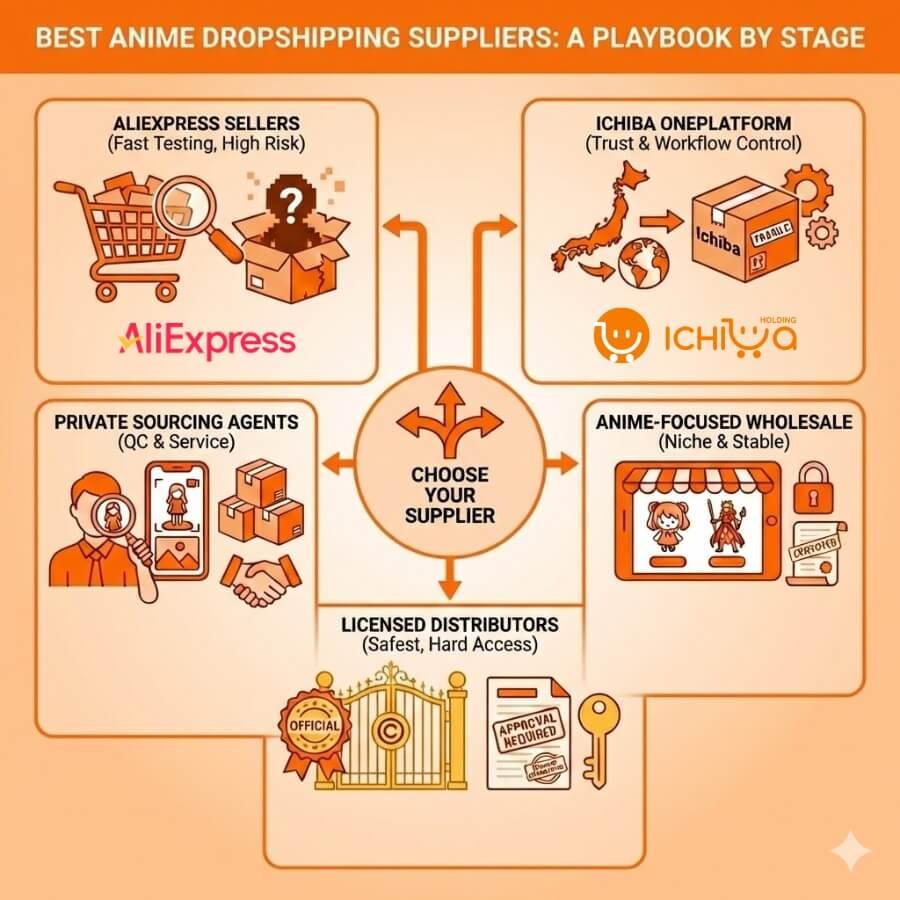
There is no perfect supplier type. Your choice depends on whether you are testing or building a long-term store. Below are the main anime dropshipping suppliers you will see, with realistic pros and cons. Treat this as a playbook for choosing anime dropshipping suppliers by stage, not a single “best list.”
AliExpress works for fast testing: huge catalog, low friction, low commitment. But it carries the highest bootleg risk and inconsistent packaging/QC. Treat it as a testing channel and be strict with vetting.
If you need the basics, see How to Start AliExpress Dropshipping (Step-by-Step for Beginners). The key point for this niche: do not scale until you have proven quality, packaging, and tracking consistency.
IChiba OnePlatform sourcing can improve buyer trust because expectations around product handling and packaging are higher. The bigger value is workflow control: clearer order visibility, more consistent fulfillment steps, and fewer “random surprises” that create refund spikes.
IChiba OnePlatform is built to support cross-border operations from sourcing to fulfillment, which is useful when you operate from Asia but sell to US/EU buyers. If you want to understand Japan routes and supplier evaluation.
>> Read more:
Dropshipping From Japan: Trends, Opportunities & Suppliers
Suppliers from Japan: How to Find Reliable Japanese Suppliers
These platforms can offer tighter niche selection and sometimes stronger compliance. The trade-off is access and price: some catalogs are limited, and pricing can be higher than marketplaces. This route is best when you already know your positioning (for example, “cute desk collectibles” or “fantasy-inspired figures”) and want more stability.
A good agent can provide QC photos/videos, improve packaging, and help resolve issues. The downside is variability: quality depends on the agent, and agents usually make more sense once you have repeat volume. If you choose this route, audit the agent like a supplier: proof, process, and accountability.
This is the safest route for compliance and trust, but often the hardest to access. Many distributors require approvals, documents, and minimum commitments, so this is usually a later-stage option.
Sellers don’t need a 30-point spreadsheet to start. They need a few hard gates that prevent predictable disasters.
Here is a short checklist sellers can use before listing any figure:
Authenticity signals and clear product identifiers
Real photos from the supplier or buyers, not stock-only
Packaging standard confirmed in writing
Refund and replacement policy clear before first order
Shipping consistency and tracking reliability proven
Counterfeit risk usually shows patterns. Sellers should treat these as warning signals:
Price is too low to be true compared to similar listings
“No box” for boxed products, especially collector lines
Blurry photos or inconsistent angles across the listing
Misspelled brand names or strange logo edits
If multiple red flags show up together, sellers should assume higher risk and avoid scaling.
Sellers often ask, “What sells?” The better question is, “What sells without killing the store?”
The best dropshipping anime products balance demand, safety, and claim risk. That usually means products that don’t rely on 1:1 replicas or “official” claims.
Anime-inspired figures with original characters
These can convert well when the design quality is strong. They reduce franchise-linked IP pressure.
Generic chibi-style characters
Chibi sells because it is cute and giftable. Generic chibi-style collectibles can work without leaning on protected character names.
Generic fantasy figures with anime aesthetics
Dark fantasy, monster themes, and RPG aesthetics often overlap with anime audiences. Sellers can market the vibe without tying to a franchise.
Genre-driven demand
Shonen, isekai, and dark fantasy aesthetics drive ongoing attention. Sellers can target genre interest without building product pages around trademarked franchise terms.
Seasonal spikes
New releases and seasonal gifting periods create spikes. The risk is when sellers use hype content that includes copyrighted visuals or implies licensing.
Limited-edition trends
Collectors chase scarcity. Sellers should be careful here because limited-edition language can create authenticity disputes if the supply chain is unclear.
1:1 replicas
This is where IP complaints and counterfeit disputes stack up fast.
Premium resin statues
Damage rates and return costs are brutal when shipping cross-border.
“Official” claims without proof
If the seller cannot support it with documentation, the claim becomes a liability.
Anime buyers are more demanding because they often buy as collectors. That creates a stricter standard than generic dropshipping.
Box condition matters
Collectors treat packaging as part of the product value. A crushed corner can trigger refunds even when the figure is intact.
Paint quality is scrutinized
Small defects look big when the buyer expects display quality.
Collector mindset escalates disputes
If a buyer believes the product is fake or mishandled, the complaint becomes emotional and fast.
Sellers don’t need fancy packaging. They need consistent packaging.
Double boxing prevents crushing.
Fillers prevent movement inside the box.
Corner guards reduce dents for collector packaging.
If sellers scale figures without a packaging standard, they scale damage claims.
The shipping method also matters. Standard lines can work for low-ticket testing. Premium lines reduce uncertainty and can protect reviews. Insurance can help on fragile or higher-value items, but sellers should treat it as part of a broader dispute system, not a magic fix.
If you need a benchmark for delivery expectations, see 17 Fastest Dropshipping Suppliers for 2026 (Fast Shipping Options for U.S, EU, China, Japan).
Sellers should choose a policy that is clear and cost-controlled.
If a figure arrives broken, a slow back-and-forth usually ends in a chargeback. A simple workflow reduces damage:
Photo proof first.
Replacement when cost-effective.
Partial refunds for minor issues.
Returnless refunds when return shipping is irrational.
The goal is to protect margin while preventing escalation.

In this niche, trust converts. Hype does not protect a store.
Real photos and short videos
Supplier photos can work if they reflect the real product. Customer UGC can work even better because it reduces “fake anxiety.”
Honest descriptions
Materials, size, and “what’s included” should be explicit. If sellers hide details, buyers assume the worst.
Clear delivery timelines
US and EU buyers expect realistic windows. If the operation runs from APAC, sellers should set ranges they can consistently hit, not wishful estimates.
Sellers often sabotage themselves by naming the store like a fan page.
Store names should avoid franchise names. Category naming should lean on descriptive terms such as “anime-style collectibles” or “collectible figures,” rather than trademark-heavy phrasing.
Safe SEO usage is about intent keywords, not franchise bait. Sellers can target “dropshipping anime figures” while keeping product naming conservative.
This niche rewards the community.
UGC from buyers builds trust and reduces disputes. Discord and Instagram can support repeat buyers and give sellers a stream of content that does not rely on copyrighted visuals. Micro-creators can also help, especially when the content focuses on unboxing, packaging quality, and product details.
Most failures follow the same pattern.
Sellers scale copyrighted or replica-like products without permission.
They run ads using anime characters or copyrighted images.
They overpromise authenticity without proof.
They ignore customer service speed until refunds become chargebacks.
If sellers fix these four areas, the store becomes harder to kill.
It depends on what is sold and how it is marketed. The biggest risks come from protected IP usage, unsupported “official” claims, and copyrighted visuals in ads and listings.
Sellers can test on marketplaces, then upgrade to more stable supplier types such as wholesale platforms, vetted agents, or licensed distributors when scaling requires consistency.
They can be profitable because demand is strong and AOV can be high. Profit depends on refund rates, damage rates, and how well sellers control authenticity disputes.
Avoid copyrighted images and trademark-heavy naming unless sellers have valid rights. Focus on original anime-style designs and conservative product naming that does not imply official affiliation.
Generic anime-inspired figures, non-franchise chibi-style collectibles, and fantasy figures with anime aesthetics are often safer than 1:1 replicas tied to known franchises.
Using trademarked character names can increase enforcement risk when sellers cannot support licensing or rights. Conservative naming and accurate claims reduce exposure.
Dropshipping anime figures is not a beginner “easy mode” niche, but it can work if you treat it as a system: control IP risk, vet anime dropshipping suppliers, and protect the collecting experience with strong packaging.
Start with safer products, set clear delivery expectations for US/EU buyers, and prioritize supplier reliability over “cheap listings.” If you want more checklists and updates, join the community and follow our channels.

Work with us
Our solutions
Address:
 〒136-0082, Japan, Tokyo, Koto-ku, Shinkiba 3-5-6, 5F
Connect us:


Japan
〒136-0082, Japan, Tokyo, Koto-ku, Shinkiba 3-5-6, 5F
Texas, USA
1606 Audrey Dr, Garland, TX 75040, United States
California, USA
1316 John Reed Ct, City of Industry, CA 91745, United States