

News
Ichiba OnePlatform Team - 20/05/2026
In this article
Dropshipping has lowered the barrier to entry for e-commerce sellers worldwide, but long-term success rarely depends on product selection alone. As stores begin to scale, the real challenge quickly shifts toward how efficiently orders are processed, shipped, and supported after purchase. This is where dropshipping order fulfillment becomes a critical factor that directly impacts customer satisfaction, profit margins, and brand reputation.
This guide helps dropshipping sellers understand how dropshipping ecommerce fulfillment actually works behind the scenes, from order placement to delivery and after-sales support.
In a dropshipping business model, sellers do not store or ship products themselves, yet they remain fully responsible for the customer experience after a purchase is made. Because of this, understanding how dropshipping order fulfillment works is essential for anyone building a sustainable ecommerce operation.
Dropshipping fulfillment is the operational process that begins the moment a customer places an order and ends when that order is successfully delivered and supported after delivery. While the supplier physically handles inventory and shipping, the seller manages order accuracy, speed, communication, and issue resolution.
To better understand this concept, it is important to clarify the differences between several commonly confused terms.
A dropshipping order refers only to the transaction itself, including the product selected, payment captured, and customer information. It represents a single sale, not the operational steps that follow.
Dropshipping fulfillment, on the other hand, includes everything that happens after the order is placed. This covers order forwarding, supplier confirmation, packaging, shipping, tracking updates, and customer service related to that order.
When comparing dropshipping fulfillment to traditional fulfillment, the key difference lies in inventory ownership and control. In traditional fulfillment models, such as in-house warehousing or third-party logistics, sellers purchase inventory upfront and manage stock levels. With dropshipping fulfillment, inventory remains with the supplier, which reduces upfront costs but increases dependency on external partners for speed and reliability.

Although suppliers handle shipping, the seller remains the central coordinator of the entire dropshipping order process. Each order must move through a defined sequence of steps to ensure accuracy and customer satisfaction.
The core dropshipping order process starts when a customer completes checkout, and payment is successfully captured on the ecommerce platform. The order data is then sent to the supplier, either manually or through an automated system, where product availability and shipping details are confirmed.
Once the supplier processes the order, the product is packed and shipped directly to the customer using the selected carrier. Tracking information is generated and passed back to the seller, who is responsible for updating the customer and handling any delivery questions.
Even after delivery, the fulfillment process continues. Returns, refunds, replacements, and chargeback management are all part of fulfilling dropshipping orders properly. Sellers who understand this full lifecycle are better positioned to build trust, reduce disputes, and scale their business efficiently.
While dropshipping allows sellers to operate without holding inventory, a successful business still depends on a well-structured fulfillment workflow. Each step in the dropshipping order fulfillment process plays a direct role in delivery speed, order accuracy, and overall customer satisfaction. When any stage is delayed or mismanaged, the entire experience can quickly break down.
Below is a breakdown of how fulfilling dropshipping orders typically works in practice, from the moment a customer places an order to post-delivery support.
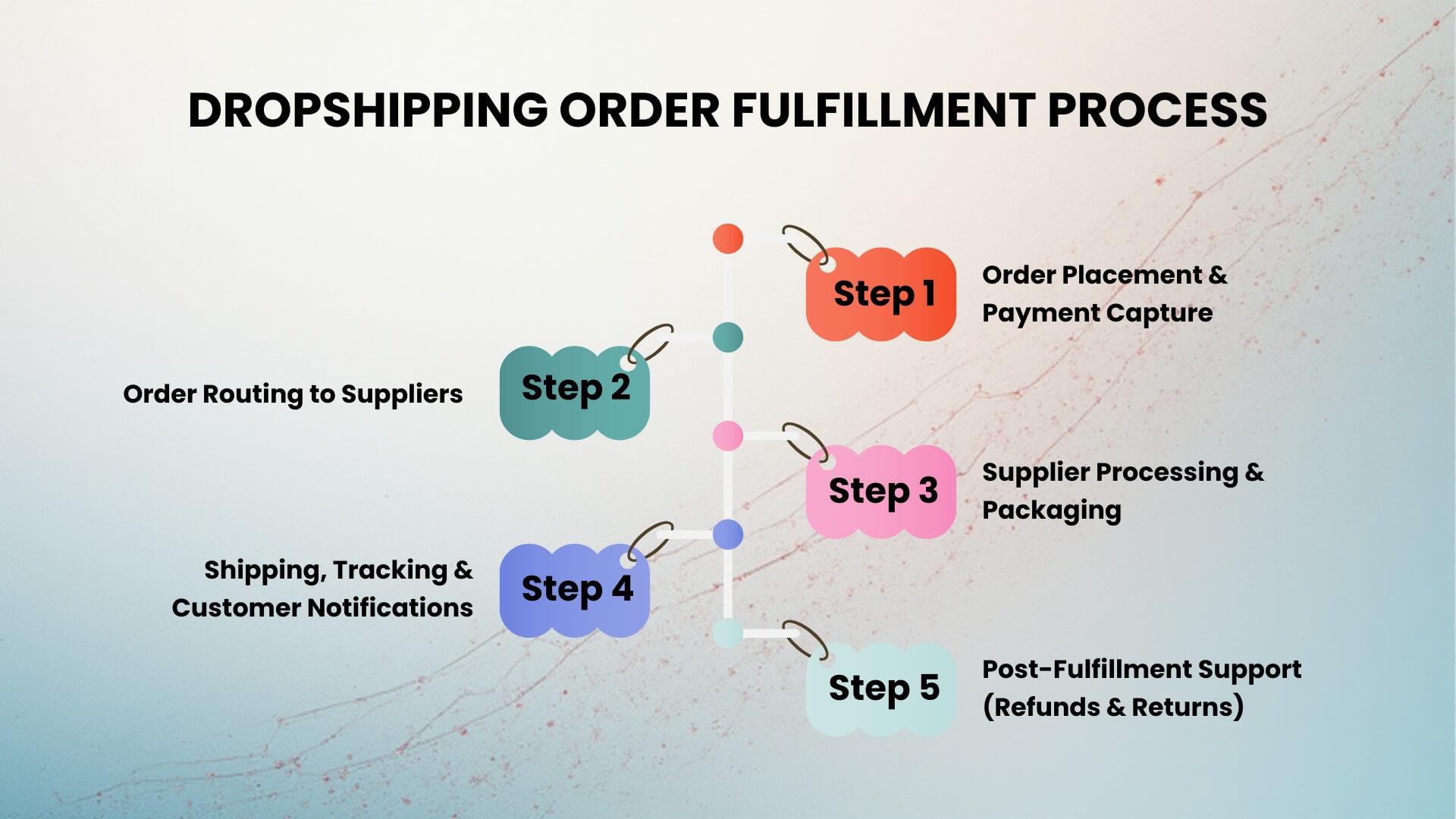
Once a customer completes checkout on your store, the system records the dropshipping order and captures payment through the selected payment gateway. At this stage, order data such as product details, quantity, shipping address, and customer contact information must be accurate.
Errors in this first step often lead to fulfillment issues later, including incorrect shipments or failed deliveries. This is why many sellers rely on ecommerce platforms and apps that automatically validate address formats and payment status before moving the order forward.
After payment is confirmed, the order must be transmitted to the supplier responsible for fulfillment. In manual workflows, sellers log into the supplier platform and place the order one by one. In more advanced setups, dropshipping auto fulfillment tools automatically sync orders in real time.
Accurate order routing is critical, especially when working with multiple suppliers or offering products that ship from different locations. A reliable dropshipping fulfillment system ensures that each order reaches the correct supplier with the correct product variant and shipping method.
Once the supplier receives the order, they verify product availability and begin processing. This stage includes picking the item from inventory, quality checking, and packaging it for shipment.
For brand-focused sellers, packaging quality and branding consistency play an important role in customer perception. While many suppliers use generic packaging, some private agents and sourcing partners offer custom inserts, branded labels, or neutral packaging to support long-term brand building within a dropshipping ecommerce fulfillment model.
After the order is shipped, the supplier generates a tracking number and hands the package over to the carrier. This information must be sent back to the seller and then shared with the customer in a timely manner.
Delayed or missing tracking updates are one of the most common dropshipping fulfillment problems. Automated systems that sync tracking numbers and trigger customer notifications help reduce support tickets and improve trust, especially for international orders with longer transit times.
Fulfillment does not end when the package is delivered. Customers may request refunds, exchanges, or report damaged or missing items. Handling these situations efficiently is a core part of fulfilling dropshipping orders at scale.
Sellers must coordinate with suppliers to approve returns or replacements, while also complying with payment processor policies to minimize chargebacks. A clear post-fulfillment workflow helps protect both customer satisfaction and profit margins as order volume increases.
As order volume increases, the way sellers handle fulfillment becomes a deciding factor between steady growth and operational overload. While many beginners start with manual workflows, scaling a dropshipping business often requires a shift toward automation to maintain speed, accuracy, and customer satisfaction.
Understanding the differences between manual fulfillment and dropshipping auto fulfillment helps sellers choose the right approach based on their current stage and growth goals.
Manual fulfillment refers to a process where sellers place and manage each dropshipping order by hand. After receiving an order, the seller logs into the supplier platform, reenters customer information, selects shipping options, and later updates tracking details manually in the store.
Pros:
Full control over each dropshipping order before it is sent to the supplier
Easier to test new suppliers and products with low order volume
No additional software or automation costs at the beginning
Allows manual verification of stock availability and shipping options
Cons:
Time-consuming order processing that does not scale well
High risk of human error in addresses, product variants, and shipping methods
Slower fulfillment speed, especially during peak sales periods
Difficult to manage multiple suppliers and sales channels efficiently
Dropshipping auto fulfillment uses software tools and integrations to automatically transmit orders from the ecommerce store to suppliers, sync tracking numbers, and update order statuses without manual input. This approach connects storefronts, suppliers, and customer communication into a single system.
Pros:
Automatically syncs orders between the store and suppliers in real time
Faster and more consistent dropshipping order fulfillment
Reduces manual workload and operational stress
Scales easily without increasing staff or processing time
Improves tracking updates and customer notifications
Cons:
Requires initial setup and configuration to avoid system errors
Dependent on supplier integrations and data accuracy
Software and app subscription costs may apply
Automation can amplify mistakes if rules are misconfigured
Transitioning from manual to automated fulfillment should be done strategically rather than all at once. Sellers typically begin by integrating their ecommerce platform with fulfillment apps that support order syncing and tracking updates.
The next step involves testing automation with a limited number of products or suppliers to confirm order accuracy and delivery performance. Once confidence is established, sellers can expand automation across their catalog and gradually build a more scalable fulfillment dropshipping system.
When implemented correctly, dropshipping auto fulfillment allows sellers to handle higher order volumes without increasing headcount, making it a key foundation for long term growth and profitability.
>> See more: Best automated dropshipping software
As a dropshipping business grows, fulfillment decisions become more strategic rather than purely operational. Different fulfillment methods offer different levels of control, speed, cost efficiency, and scalability. Choosing the right dropshipping fulfillment method depends on product type, target market, order volume, and long-term business goals.
Understanding the strengths and limitations of each option allows sellers to build a fulfillment dropshipping setup that supports growth instead of creating friction.
AliExpress and similar marketplaces are often the starting point for many dropshipping sellers. These platforms provide easy access to a wide product catalog, low upfront costs, and simple order placement.
This fulfillment method works well for beginners who want to validate product demand before investing in deeper supplier relationships. However, sellers often face challenges such as long shipping times, inconsistent tracking updates, and limited control over packaging. As order volume increases, relying solely on marketplace fulfillment can negatively impact customer satisfaction and brand credibility.
Private agents and sourcing companies act as intermediaries between sellers and factories or wholesalers. Instead of placing orders on public marketplaces, sellers work directly with dedicated partners who manage product sourcing, quality checks, and fulfillment.
This approach provides better communication, faster processing times, and more flexible shipping options. Many agents also support branded packaging and customized fulfillment workflows, which makes this method suitable for sellers focused on long-term brand building and repeat customers. The main trade-off is higher minimum order requirements or service fees compared to basic marketplace fulfillment.
A hybrid fulfillment model combines dropshipping with third-party logistics services. In this setup, sellers may continue to dropship some products while storing fast-moving inventory in regional warehouses managed by a 3PL provider.
This method offers faster delivery times, especially for key markets such as the US or Europe, while still maintaining the flexibility of dropshipping for product testing. Although this approach requires upfront inventory investment and more operational planning, it allows sellers to optimize dropshipping ecommerce fulfillment for scale and customer experience.
>> See more: Best automated dropshipping software
As dropshipping businesses scale, fulfillment issues tend to surface more frequently. Many of these problems are not caused by a lack of sales but by weak operational systems and overreliance on suppliers. Understanding common dropshipping fulfillment problems allows sellers to anticipate risks and build processes that protect customer satisfaction and revenue.
Long delivery times remain one of the most common challenges in dropshipping order fulfillment, especially when sourcing products from overseas suppliers. Customers today expect clear delivery estimates and timely updates, even when shipping internationally.
When shipping times are unpredictable, sellers often experience higher refund requests and negative reviews. This issue becomes more severe when sellers do not proactively communicate shipping expectations or fail to choose suppliers with reliable logistics partners.
Because sellers do not control inventory directly, stock availability can change without warning. A supplier may run out of stock, discontinue a product, or delay processing without notifying the seller in advance.
These situations disrupt the dropshipping order process and can lead to canceled orders or forced substitutions. Sellers who rely on a single supplier for high-volume products face greater risk, especially when there is no backup fulfillment option in place.
Tracking delays occur when suppliers ship orders but fail to provide tracking information promptly, or when carriers take time to register tracking numbers in their systems. From the customer's perspective, this often appears as if the order has not shipped at all.
Delayed tracking updates increase support tickets and can trigger payment disputes. Efficient dropshipping fulfillment systems reduce this risk by automatically syncing tracking data and sending proactive notifications to customers.
Handling returns and refunds is one of the most complex aspects of fulfilling dropshipping orders. Different suppliers often have different return policies, which can create confusion and inconsistent customer experiences.
When refunds are delayed or poorly managed, customers may escalate issues into chargebacks. High chargeback rates not only reduce profit margins but can also threaten payment processor accounts. A clear post-fulfillment policy and strong supplier communication are essential to managing this risk effectively.
As a dropshipping business moves beyond the initial growth stage, fulfillment efficiency becomes directly tied to profitability. Scaling without optimizing fulfillment often leads to higher costs, slower delivery, and increased customer complaints. To build a sustainable operation, sellers must treat dropshipping order fulfillment as a system that can be measured, refined, and automated.
Making data-driven decisions allows sellers to identify weaknesses in the fulfillment process before they turn into costly problems. By tracking key performance metrics, sellers gain visibility into how well their dropshipping fulfillment operation is performing.
Important metrics to monitor include:
Order processing time, which measures how long it takes for an order to move from payment confirmation to supplier processing
Shipping time, which tracks the number of days from shipment to delivery
Refund rate, which helps identify product quality or expectation gaps
Chargeback rate, which signals issues with delivery reliability or customer communication
Fulfillment cost per order, which directly impacts profit margins
Regularly reviewing these metrics helps sellers optimize supplier selection, shipping methods, and customer communication strategies. Over time, data analysis becomes a key driver of both scalability and profitability.
Automation plays a critical role in optimizing dropshipping ecommerce fulfillment, especially as order volume increases. By reducing manual tasks, sellers can improve speed, accuracy, and consistency across all fulfillment activities.
Core areas where automation delivers the most impact include order syncing between the store and suppliers, automatic tracking updates, and real-time customer notifications. These systems reduce human error and significantly lower the workload on support teams.
When selecting tools for dropshipping fulfillment, sellers should prioritize platforms that connect order management, supplier coordination, and customer communication into a single workflow. Some of the best dropshipping fulfillment tools on the market today include solutions like DSers and AutoDS, which help automate order routing and tracking so that orders are processed with minimal manual work. DSers is particularly strong for AliExpress sourcing and bulk order processing, while AutoDS offers a comprehensive suite that handles order fulfillment, inventory sync, and even pricing rules across multiple marketplaces.
For sellers looking to simplify fulfillment with global networks and faster shipping options, platforms such as IChiba OnePlatform, Zendrop and CJ Dropshipping provide solid fulfillment support with automated product imports and tracking updates directly to your store. When these tools are able to sync orders, update status, and trigger shipments automatically, sellers can build a scalable dropshipping ecommerce fulfillment system that supports growth without adding unnecessary operational complexity.
How long does dropshipping fulfillment take?
The time required for dropshipping order fulfillment depends largely on the supplier location, shipping method, and order processing speed. In many cases, order processing takes one to three days, followed by shipping times that can range from several days to a few weeks for international deliveries.
Sellers who use local suppliers, private agents, or regional warehouses can significantly shorten fulfillment timelines. Clear delivery estimates and proactive communication help manage customer expectations, even when shipping times are longer.
Can dropshipping be automated?
Dropshipping can be automated to a large extent when sellers use integrated fulfillment tools and reliable suppliers. With the right setup, orders can be automatically forwarded to suppliers, tracking numbers synced back to the store, and customers notified without manual intervention.
While automation improves efficiency, sellers still need to monitor supplier performance, handle exceptions, and manage customer support. Dropshipping auto fulfillment works best when combined with ongoing oversight and data analysis.
What’s the best dropshipping fulfillment method?
There is no single best fulfillment method for all sellers, as the ideal approach depends on business size, target market, and growth strategy. Marketplace fulfillment may work well for beginners, while private agents or hybrid models offer better control and speed for scaling businesses.
Sellers should evaluate fulfillment options based on shipping reliability, cost structure, and the ability to support long-term brand building.
What happens if a supplier fails to ship?
When a supplier fails to ship an order, the seller remains responsible for resolving the issue with the customer. This may involve issuing a refund, offering a replacement, or switching to an alternative supplier.
To reduce risk, sellers should work with multiple suppliers for key products and monitor supplier performance closely. Having backup fulfillment options in place helps protect both revenue and customer trust.
How do I scale fulfillment without hiring staff?
Scaling fulfillment without increasing headcount requires a combination of automation, reliable suppliers, and standardized processes. By automating order syncing, tracking updates, and customer notifications, sellers can handle higher order volumes with minimal manual effort.
As the business grows, investing in better fulfillment tools and supplier relationships allows sellers to scale dropshipping order fulfillment efficiently while keeping operational costs under control.
Building a profitable dropshipping business requires more than finding winning products and driving traffic. As order volume grows, dropshipping order fulfillment becomes the foundation that determines delivery speed, customer satisfaction, and long term scalability. Sellers who treat fulfillment as a structured system rather than a background task are better positioned to compete in an increasingly demanding ecommerce environment.
Throughout the dropshipping order process, every step plays a role in shaping the customer experience. Whether using manual workflows or implementing dropshipping auto fulfillment, the goal remains the same: consistent execution and reliable delivery.
In a competitive market, strong fulfillment is no longer optional. By monitoring performance data and investing in automation, sellers can scale dropshipping ecommerce fulfillment without sacrificing profit margins or customer trust. Sellers who build resilient fulfillment systems today create a long-term advantage that supports growth, brand credibility, and sustainable revenue in the future.

Work with us
Our solutions
Address:
 〒136-0082, Japan, Tokyo, Koto-ku, Shinkiba 3-5-6, 5F
Connect us:


Japan
〒136-0082, Japan, Tokyo, Koto-ku, Shinkiba 3-5-6, 5F
Texas, USA
1606 Audrey Dr, Garland, TX 75040, United States
California, USA
1316 John Reed Ct, City of Industry, CA 91745, United States