

News
08/06/2026
In this article
Dropshipping to Japan can be a strong opportunity for sellers who want to enter a mature ecommerce market with high purchasing power and strong expectations for service quality. Japan is not a market where sellers can simply upload products, run ads, and wait for orders. Buyers often expect clear product information, reliable shipping, polite customer support, and a smooth experience from product page to delivery.
That makes dropshipping in Japan more demanding than in markets where fast product testing and aggressive pricing can carry early sales. At the same time, these higher standards create room for sellers who can build trust properly. If the product is relevant, the listing is clear, and fulfillment is reliable, Japan can become a high-value market rather than just another short-term testing channel.
To build a sustainable dropshipping business in Japan, sellers need to understand how Japanese ecommerce works, what buyers expect, which legal and tax factors matter, how to choose suppliers, and how to manage fulfillment without hurting customer trust.
Dropshipping is an ecommerce model where sellers do not need to hold inventory upfront. When a customer places an order, the seller passes the order to a supplier, warehouse, or fulfillment partner, who then prepares and ships the product.
In Japan, the basic model is the same, but the execution standard is higher. Japanese buyers are less tolerant of vague descriptions, unclear shipping timelines, poor product photos, and weak return policies. For this reason, dropshipping to Japan should not be treated as a “list fast, test fast, switch fast” model. Sellers need a more controlled ecommerce workflow built around product clarity, trust, payment experience, and reliable delivery.
Japan is one of the largest and most mature ecommerce markets in Asia. METI’s latest official ecommerce survey, released in 2025, reported that Japan’s domestic B2C ecommerce market reached 26.1 trillion JPY in 2024, up 5.1% year over year. More recent market reports published in 2026 also place Japan’s ecommerce market well above the $150B mark, with Mordor Intelligence estimating USD 207.33 billion in 2026 and ResearchAndMarkets estimating USD 258.07 billion for B2C ecommerce in 2025. For sellers evaluating dropshipping to Japan, the key takeaway is clear: Japan is not an emerging test market, but a large, mature ecommerce market with strong online shopping behavior.
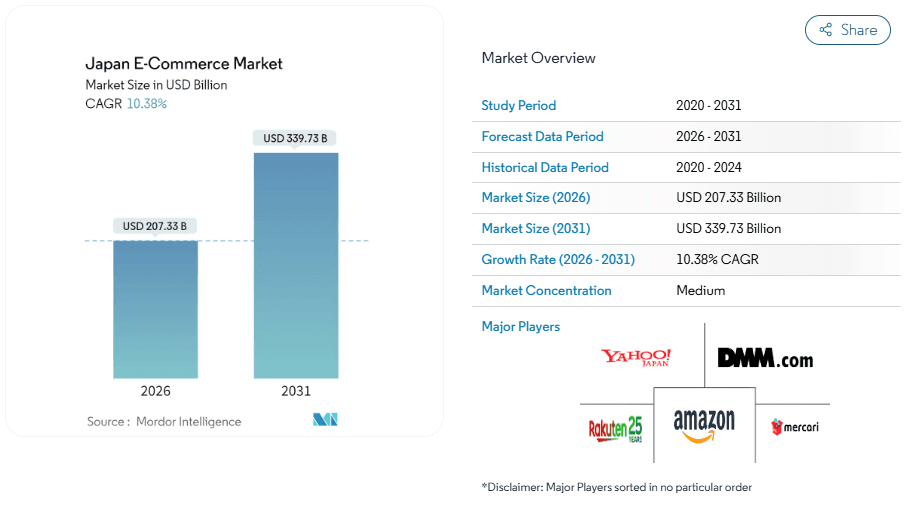
The key point is not only market size. Japan is a market where buyers are already used to high-quality online shopping experiences. Major platforms include Rakuten, Amazon Japan, Yahoo Shopping, Mercari, and category-specific channels. Rakuten is strong in loyalty points and store-based marketplace experiences. Amazon Japan is strong in search intent, convenience, and fast delivery expectations. Yahoo Shopping connects well with users inside the Yahoo/PayPay ecosystem, while Mercari is important for secondhand and C2C behavior.
For foreign sellers, the challenge is not only choosing a channel. The real challenge is building enough trust for Japanese buyers to place an order from a new seller. Customers often check company information, reviews, product images, return policies, shipping timelines, and listing quality before buying. If those areas look weak, demand may exist, but conversion will suffer.
Japanese buyers often make decisions based on clarity, consistency, and trust. A product may have a good price, but if the page lacks information, shipping fees are unclear, or delivery time feels uncertain, buyers may leave before checkout.
Several elements can strongly affect conversion in Japan:
Clear product titles
Real product photos from enough angles
Detailed specifications
Prices shown in JPY
Clear shipping timelines
Easy-to-understand return policy
Reviews or social proof
Transparent seller or company information
Polite, responsive customer support
For this reason, sellers planning dropshipping to Japan should not only ask whether a product is trending. A better question is whether the product has enough information, trust signals, and margin to be sold to Japanese buyers with confidence.
Dropshipping in Japan can be profitable, but not because the market is easy. Profit comes from choosing the right products, controlling costs, and meeting Japanese buyer expectations.
Japan has strong purchasing power, but buyers also have many reliable local options. If a seller competes only with generic products, similar images, and slightly lower prices, the model will be difficult to sustain. A Japanese buyer may prefer a local seller with faster delivery, clearer policies, and stronger reviews.
A product has a better chance of working in Japan when it solves a specific need, has clear quality signals, provides transparent information, and can be fulfilled reliably. Beauty products need ingredient details, origin, and usage instructions. Electronics need specifications, voltage compatibility, warranty information, and usage notes. Hobby or collectible products need condition details, version information, and authenticity signals.
A dropshipping business in Japan needs a full cost breakdown before products go live. If sellers only look at product cost, they can easily misread profitability.
Cost Item | What to Check |
Product sourcing cost | Supplier, wholesaler, or marketplace price |
Domestic shipping | Supplier-to-warehouse or supplier-to-fulfillment cost |
International shipping | Shipping cost into Japan if products come from overseas |
Platform fees | Shopify, Amazon Japan, Rakuten, or marketplace fees |
Payment fees | Gateway fee, processing fee, or currency conversion |
Tax and duties | Consumption tax, import duties, or related charges |
Returns/refunds | Return handling, refund cost, and dispute risk |
Localization/support | Translation, customer service, and post-purchase communication |
Each sales channel has a different fee structure. Rakuten, Amazon Japan, Shopify, and WooCommerce may involve listing fees, transaction fees, payment fees, fulfillment fees, advertising costs, or campaign-related costs. For local marketplaces, sellers may also need to consider loyalty points, promotion budgets, and platform-specific requirements.
Return cost should also be calculated early. For cross-border orders, one returned product can erase the profit from several successful orders. If a product has size risk, fragile packaging, unclear usage, or high defect risk, sellers should add a buffer before scaling.
The first challenge is customer service. Japanese buyers often expect clear, polite, and responsible communication. A machine-translated reply, a vague answer, or a delayed response can reduce trust even if the product itself is good.
The second challenge is language. Japanese ecommerce copy is not just a direct translation from English. Product titles, descriptions, size charts, checkout messages, return policies, and support replies need to sound natural and structured. Many Japanese consumers are not comfortable making purchase decisions in another language, especially when product details, payment, or returns are involved.
The third challenge is fulfillment. Japan has high expectations for delivery and packaging. If a seller promises delivery in 3–5 days but the order takes 12–15 days, the buyer may consider the experience poor even if the product arrives safely. With dropshipping to Japan, delivery timelines should be clear before payment.
Dropshipping is not banned in Japan, but the actual business model may involve requirements around business registration, taxes, imports, product safety, labeling, trademarks, and marketplace policies.
Sellers should not interpret “dropshipping is legal in Japan” as permission to sell any product without checks. Certain categories, such as cosmetics, supplements, food, electronics, batteries, children’s products, medical-related products, and branded goods, may require additional review before selling.
Not every dropshipping to Japan model requires a Japanese company. If a seller runs an overseas website and ships cross-border into Japan, the setup may be different from operating as a local seller on a Japanese marketplace.
However, some local platforms may require stricter seller information, business documents, screening, or local operational details. Rakuten, for example, is known for a more controlled merchant application process. Amazon Japan also has seller registration requirements that vary by account type, category, and fulfillment method.
The safer approach is to define the sales channel before building the full model. Selling through Shopify cross-border, selling on Amazon Japan, applying for Rakuten, or working with a Japan-based fulfillment partner can all create different requirements.
Japan applies a standard consumption tax rate of 10% to most goods and services. Some categories may qualify for a reduced 8% rate, but this depends on product type and transaction details.
If goods are imported into Japan, sellers need to check import duties, customs declarations, product restrictions, and required documentation. For branded products, sellers should avoid trademark issues and marketplace policy violations. For regulated products, labeling, safety standards, instructions, and sales conditions should be checked before scaling.
Product categories that need extra caution include:
Cosmetics and skincare
Food and supplements
Electronics and batteries
Baby and children’s products
Medical or health-related products
Products that touch skin
Branded goods and collectibles
This should be treated as a compliance check, not a minor detail. A product may have strong demand, but if it creates legal or platform risk, it may not be suitable for early-stage dropshipping in Japan.
Payment experience affects conversion. Japanese buyers use credit cards, konbini payments, cash on delivery, digital wallets, bank transfers, and other local payment methods. The latest METI release reported that Japan’s cashless payment ratio reached 42.8% in 2024, exceeding the government’s 40% target.
This does not mean every seller needs to support every payment method from day one. However, sellers targeting Japan seriously should reduce checkout friction. Prices should be shown in JPY, shipping fees should be visible, payment methods should feel familiar, and the checkout flow should not feel risky.
If customers need to convert currency themselves, discover shipping fees too late, or cannot understand when the order will arrive, cart abandonment can increase.

Supplier quality has a direct impact on the customer experience. A cheap supplier with slow processing, poor images, weak communication, or unreliable inventory can damage the entire store. A reliable supplier helps sellers control product quality, delivery timelines, and issue resolution.
When choosing suppliers for dropshipping in Japan, price should not be the only filter. Sellers should also check inventory stability, order processing speed, product information, return policies, document support, authenticity, and fit with Japanese customer expectations.
Sellers can use several Japan-based platforms to research products, compare listings, or build a sourcing workflow:
Platform | Best For | What Sellers Should Check |
Rakuten Japan | Structured listings across beauty, home goods, lifestyle, fashion, hobby products, and consumer goods | Seller credibility, product details, reviews, shipping options |
Yahoo Auctions Japan | Secondhand, collectible, limited, or hard-to-find products | Seller rating, final auction price, product condition, item availability |
Mercari Japan | Individual listings, secondhand products, and unique lower-priced items | Listing quality, seller response, stock availability, condition accuracy |
Janbox Japan | Accessing multiple Japanese platforms, consolidation, warehouse receiving, and international shipping | Service fees, handling process, consolidation options, shipping timeline |
This setup gives sellers a clearer view of which platform fits each use case. Rakuten works better for structured product research, Yahoo Auctions and Mercari are more useful for secondhand or niche products, while Janbox Japan can support sellers who need help with Japan-based buying, package consolidation, and cross-border shipping.
Super Delivery Japan and NETSEA are B2B platforms that may fit sellers looking for wholesale suppliers from Japan or more structured sourcing relationships. Compared with C2C marketplaces, B2B suppliers are often more useful after sellers have validated demand and want a more stable catalog.
Before working with a B2B supplier, sellers should check MOQ, export conditions, warehouse delivery options, product images, return policies, and support for foreign sellers. A good supplier for the Japanese market needs more than product availability. They need clear communication, stable processing, and enough product information for trustworthy listings.
Read more in: Top B2B Dropshipping Suppliers in 2026: Wholesale Platforms to Scale
A Japanese dropshipping platform or cross-border platform can help sellers reduce manual work across sourcing, product management, warehousing, fulfillment, tracking, and reconciliation. This matters because dropshipping to Japan is not only about finding products. The harder part is building a stable operating flow that can meet Japanese customer expectations.
IChiba OnePlatform can be positioned as an all-in-one solution for sellers who want to connect suppliers, fulfillment, and cross-border operations in one workflow. Instead of managing sourcing, warehouse coordination, shipping updates, and order visibility across disconnected tools, sellers can use a centralized platform to make operations easier to control.
This is especially useful for sellers who want to move beyond manual order handling and build a repeatable dropshipping business in Japan. The key value is operational control: clearer supplier coordination, more consistent fulfillment, and better visibility from product selection to delivery.
A supplier for dropshipping in Japan should be evaluated across several layers:
Rating and transaction history
Customer reviews
Product authenticity
Product photos and descriptions
Response speed
Order processing speed
Return and refund policy
Tracking availability
Inventory stability
Ability to support export or warehouse delivery
If a supplier cannot provide clear information, responds slowly, or has repeated complaints about wrong items, sellers should not scale immediately even if the price looks attractive. In Japan, one fulfillment mistake can damage trust more than a small saving from a cheaper supplier.
Read more in: Top Japan dropshipping suppliers in 2026
Starting dropshipping to Japan requires a clearer process than simply choosing a product and opening a store. Sellers should start with market research, choose the right business model, build a reliable sales channel, optimize listings, and then set up fulfillment. This helps avoid a common problem: building a store first, then discovering that the product is difficult to ship, hard to localize, or not suitable for Japanese buyers.
Market research should start with real demand, not a feeling that a product “should sell.” Sellers can use Google Trends, Amazon Japan rankings, Rakuten category pages, Yahoo Shopping, and competitor stores to understand product demand and pricing.
The goal is not only to find what is trending. Sellers need to understand what Japanese buyers care about inside each category. For beauty products, buyers may look for ingredients, safety, origin, and usage instructions. For home goods, they may care about size, material, durability, and storage fit. For hobby products, they may care about version, condition, authenticity, and limited availability.
A product worth testing usually has four signals: clear demand, active sellers, enough price gap to protect margin, and manageable fulfillment risk. If a product has demand but is fragile, regulated, difficult to return, or expensive to ship, it may not be suitable for the first stage.
After selecting a product category, sellers need to choose the operating model. For dropshipping to Japan, this may mean a standalone store, a local marketplace, or a marketplace-plus-fulfillment setup.
Shopify and WooCommerce give sellers more control over branding, content, and checkout. They can work well for testing a niche before investing heavily in marketplace operations. Amazon Japan can help sellers reach search-driven demand, but it comes with seller, listing, category, and fulfillment requirements. Rakuten may require more preparation because it is more store-oriented and built around trust, loyalty, and professional merchant operations.
The right channel is not always the one with the most traffic. It should match the product, budget, customer support capacity, and legal requirements.
A store targeting Japanese buyers should feel clear, trustworthy, and easy to understand. This is different from many dropshipping landing pages that rely heavily on bold claims, urgency, and aggressive discounts. In Japan, clean layout, complete information, polite tone, and clear policies often matter more.
Language is also a major barrier. Many Japanese consumers do not rely heavily on foreign-language product pages when making purchase decisions. They may check product information carefully on a desktop screen to review images, specifications, and seller details, but complete the purchase on mobile because it is more convenient. That means sellers need both detailed product information and a mobile-friendly shopping flow.
If using Shopify, sellers should optimize for mobile speed, clear checkout, and detailed product pages. If using WooCommerce, they should pay attention to page speed, security, SEO structure, and payment plugins. If selling on a marketplace, they need to follow listing formats, image policies, product description rules, and customer support requirements.
A reliable store should include company information, shipping policy, return policy, FAQ, contact methods, and clear product origin. If the product is shipped from overseas into Japan, sellers should explain order processing time, expected delivery time, carrier options, and any possible extra fees.
Product listings are where many foreign sellers lose trust. Translating descriptions into Japanese is not enough. Listings should sound natural, follow a clear structure, and answer common buyer questions before purchase.
A strong product page should include a clear title, real images, detailed specifications, size charts when needed, material details, origin, condition, usage instructions, processing time, shipping timeline, and return policy. For branded products, authenticity should be clear. For secondhand products, condition should be described honestly instead of using vague phrases like “good condition.”
If targeting Japanese buyers, the tone should be polite and precise. Avoid exaggerated claims such as “best ever,” “must-have now,” or “limited today only” unless there is a real reason. In Japan, trust usually comes from clarity rather than pressure.
Fulfillment should be planned before running ads or pushing traffic. A simple workflow may look like this:
The customer places an order.
Seller purchases from the supplier.
Supplier ships to a warehouse or fulfillment partner.
Warehouse checks, consolidates, or repacks the item.
Product ships domestically or internationally.
Tracking is shared with the customer.
If selling to Japan from overseas, sellers need to state order processing time and estimated delivery time clearly. If using a fulfillment partner in Japan, they should check inbound receiving time, order processing time, domestic carrier options, and the return-handling process.
In the Japanese market, fulfillment is not only about getting the product delivered. The package should be clean, accurate, trackable, and consistent with the product page. If delays happen, sellers should notify customers early instead of waiting for complaints.
Shipping is a critical part of dropshipping to Japan. Japanese buyers are used to fast delivery, clear tracking, and careful packaging. If cross-border sellers do not explain delivery timelines clearly, buyers may expect a domestic-level experience and feel disappointed when the order takes longer.
Domestic shipping in Japan is usually fast and reliable. For many domestic orders, 1–2 day delivery is a common expectation, especially in major regions. This sets a high benchmark for foreign sellers. If a seller cannot match local delivery speed, the best solution is transparency: explain where the item ships from, how long delivery takes, and how tracking updates will be shared.
Yamato, Sagawa, Japan Post, and other domestic carriers help shape buyer expectations in Japan. If sellers use a fulfillment partner inside Japan, they may improve delivery speed and customer experience. If products are shipped from overseas into Japan, sellers need to account for customs clearance, processing time, and possible delays.
International shipping is common when sellers ship products from overseas into Japan or use suppliers outside Japan to serve Japanese buyers. In this case, carrier selection should depend on product weight, size, value, and customer expectations.
EMS can work for standard international orders. DHL and FedEx may be better for higher-value or urgent shipments. For sellers who need a Japan-based receiving and dispatch flow, Janbox Express can be positioned as a more practical option when orders require Japan warehouse handling, package consolidation, and international shipping support. This is useful for sellers who want stronger control over products moving through Japan instead of relying only on scattered one-off shipping methods.
Method | Speed | Cost | Best Use Case |
Domestic Japan shipping | Fast | Medium | Local Japan orders |
EMS | Medium to fast | Medium | Standard international shipping |
DHL/FedEx | Fast | High | High-value or urgent orders |
Janbox Express | Medium to fast | Flexible by route | Japan warehouse handling and cross-border shipping |
Consolidated forwarding | Medium | Lower per item | Multi-item or batch orders |
For dropshipping in Japan, the best shipping method is not always the cheapest. It is the method that keeps delivery time, tracking, and margin under control.
The best way to control shipping cost is to design pricing and fulfillment before orders arrive. Sellers should estimate shipping cost by product category, destination, weight, size, and order value.
Free shipping thresholds can help increase AOV, but only if the margin supports them. Bundles can also raise order value without increasing customer acquisition cost too much. For smaller products, shipping multiple items in one order may be more efficient than fulfilling each item separately.
Regional pricing should also be considered. If products come from different countries or suppliers, shipping costs into Japan can vary widely. A single flat shipping rate may make some products unprofitable.
Read more in: 17 Fastest Dropshipping Suppliers for 2026 (Fast Shipping Options for U.S, EU, China, Japan)
Marketing in Japan needs trust more than noise. Some markets respond well to aggressive copy, deep discounts, and constant urgency. Japan often requires a clearer, more structured, and more trust-led approach.
Localization is not only translating a website into Japanese. It includes pricing, measurement units, size charts, date formats, FAQ pages, return policies, post-purchase emails, and customer support.
If sellers target Japanese buyers, product descriptions should be written in natural Japanese. Machine translation can sound stiff, unclear, or impolite. For specification-heavy products, clarity matters more than creativity. Buyers need to understand exactly what they are buying.
Website experience should also be mobile-friendly. Many Japanese customers may compare product information, images, and seller details carefully, then complete the purchase on mobile for convenience. Product pages should therefore be detailed enough for evaluation, but simple enough for mobile checkout. Prices should be shown in JPY to reduce purchase friction.
Trust is the most important conversion factor when selling into Japan. A new seller may not lose because the product is weak. They may lose because the website does not feel reliable enough.
Sellers should show company information, shipping policy, return policy, customer support channels, and product authenticity proof when relevant. If products are imported from overseas, the listing should explain product origin, order processing time, shipping method, delivery estimate, and any possible extra costs.
Real reviews are also important. If a store does not have many reviews yet, it can build trust through buying guides, product comparisons, detailed product photos, and transparent FAQs before investing heavily in paid ads.
Rakuten, Amazon Japan, and Yahoo Shopping can help sellers reach existing demand, but each platform works differently. Rakuten is strong in loyalty points, campaigns, shop identity, and a more store-like marketplace experience. Amazon Japan is strong in search intent, fulfillment expectations, and convenience. Yahoo Shopping can work for buyers familiar with the Yahoo/PayPay ecosystem.
If selling on marketplaces, product titles and descriptions should be optimized with Japanese keywords. Product images should be clear and not overly exaggerated. Promotions can help, but sellers should avoid relying only on deep discounts. In Japan, loyalty points, seasonal campaigns, and bundle value can feel more natural than constant price cuts.
SEO can help sellers build long-term trust in Japan. Content should focus on specific search intent: how to choose a product, how to compare brands, how to read specifications, how to check authenticity, how shipping works, or how to select the right size.
If selling into Japan, keywords should be researched in Japanese, not simply translated from English. Japanese buyers may search by product type, problem, use case, brand name, or specifications differently from US or EU buyers.
Good content should help buyers make decisions, not only fill keywords. A product comparison, size guide, authenticity checklist, or shipping cost guide can support conversion better than a generic category introduction.
Paid ads can help test demand, but they should not be used before the store has enough trust signals. For Japan, creatives should be clean, product-focused, and specific. Google Shopping Ads can work for high-intent buyers, while Facebook and Instagram can be used for niche audiences such as beauty, anime, golf, home goods, or fashion.
Retargeting is also important. Japanese buyers may need several touchpoints before buying from a new seller. Retargeting should highlight trust signals such as shipping timelines, return policy, reviews, authenticity proof, and secure checkout.
Micro-influencers can be effective when the product has a clear niche. YouTube, X, Instagram, and LINE can all play different roles depending on the category. YouTube reviews or short demos can help buyers understand products that need explanation, while Instagram can support lifestyle and visual categories.
The key is authenticity. Japanese buyers may not respond well to overly polished ads or exaggerated claims. A real review, practical demonstration, or honest product experience often feels more trustworthy.
Heavy discounting should not be the main strategy in Japan. Constant deep discounts can reduce perceived quality or train buyers to wait for sales. Instead, sellers can use bundles, loyalty points, seasonal campaigns, or free shipping thresholds.
Pricing should be stable and easy to understand. If there are shipping fees, duties, or extra charges, they should be shown before checkout. A low product price followed by unexpected fees can reduce trust and increase cart abandonment.
Customer experience determines whether a dropshipping business in Japan can last. In this market, the post-purchase experience is as important as the product itself. Customers need to know where the order is, when it will arrive, who to contact if something goes wrong, and how returns are handled.
A good experience should include order confirmation, tracking updates, shipping notifications, clear return instructions, and polite support. Packaging also affects perceived quality. Even if the product is not expensive, clean packaging that matches the product description can build trust.
Retention can come from email marketing, loyalty offers, product recommendations, or post-purchase content. If a customer buys skincare, sellers can send usage tips or complementary product suggestions. If a customer buys anime goods, they can recommend related collections. If a customer buys golf products, they can suggest accessories or products from the same brand.
Dropshipping to Japan can fail not because there is no demand, but because sellers underestimate market standards. Small mistakes that may pass in other markets can have a larger impact in Japan.
Machine translation is easy to spot. Unnatural wording, wrong tone, or unclear product details can make a store look unprofessional. If sellers target Japanese customers, product titles, descriptions, checkout messages, and support replies should be written or reviewed by someone who understands Japanese ecommerce language.
Japanese buyers expect clarity and consistency. If product images look weak, specifications are missing, shipping fees are unclear, or delivery timelines are vague, customers may leave before adding to cart. Trust should be built directly on the product page, not only through customer support after questions appear.
Shipping and returns can destroy margin. If products are shipped cross-border, return costs can be higher than the profit from the order. Sellers should state return policy, processing time, expected carrier, delivery estimate, and tax responsibility before purchase.
Generic products are hard to sell in Japan without a clear advantage. Buyers already have many local options with faster delivery and stronger trust. Sellers should focus on niche, authentic, high-quality products or products with a clear use case.
Each platform has different requirements. Rakuten, Amazon Japan, Yahoo Shopping, and other marketplaces have their own rules for seller registration, listing format, categories, delivery, returns, and customer support. If sellers do not check these rules early, they may build a model that cannot be launched properly.
Dropshipping is not banned in Japan, but sellers must follow relevant rules around taxes, imports, trademarks, product safety, consumer protection, and marketplace policies. Categories such as cosmetics, food, electronics, children’s products, supplements, and medical-related products should be checked carefully before selling.
Yes, foreigners can start a dropshipping business in Japan, but the required setup depends on the sales model. Selling through an overseas website with cross-border shipping is different from opening a store on a Japanese marketplace. Some platforms may require business documents, screening, or local operational details.
Japan can be a good market for dropshipping if sellers understand customer expectations, localization, and fulfillment. It is not ideal for low-effort generic products or vague product pages. However, sellers with quality products, clear information, reliable shipping, and strong support can build a valuable business in Japan.
Not always, but Japanese language support is a major advantage when selling directly to Japanese buyers. Product descriptions, customer support, return policies, and post-purchase emails should sound natural. If sellers do not speak Japanese, they should work with a translator, local partner, or reliable support system.
Common options include Shopify or WooCommerce for independent stores, Amazon Japan for search-driven demand, Rakuten for a trust-focused marketplace experience, Yahoo Shopping for local exposure, and sourcing or fulfillment platforms such as Janbox, Buyee, ZenMarket, or IChiba OnePlatform. The best option depends on product type, budget, support capacity, and the seller’s fulfillment model.
Good products for dropshipping to Japan are usually niche, high-quality, clearly described, and differentiated from generic local options. Potential categories include beauty products, hobby goods, anime collectibles, lifestyle accessories, home goods, fashion items, golf products, and products with a strong brand or use-case story. Regulated categories such as cosmetics, supplements, electronics, and children’s products should be checked carefully before scaling.
Dropshipping to Japan can be profitable, but it does not fit rushed or generic execution. Japan has strong purchasing power, a mature ecommerce ecosystem, and buyers who are used to high-quality online shopping. In return, sellers must handle localization, trust, shipping, returns, and product information carefully.
A safer approach is to start with a clear model: what product to sell, which channel to use, which supplier to work with, and how fulfillment will be handled. Then sellers need to validate demand, calculate the full cost structure, choose reliable suppliers, and build product pages that give Japanese buyers enough confidence to purchase.
Japan is not a low-effort dropshipping market. But for sellers who can localize properly, build trust, and execute fulfillment carefully, it can become a strong cross-border ecommerce opportunity.

Work with us
Our solutions
Address:
 〒136-0082, Japan, Tokyo, Koto-ku, Shinkiba 3-5-6, 5F
Connect us:


Japan
〒136-0082, Japan, Tokyo, Koto-ku, Shinkiba 3-5-6, 5F
Texas, USA
1606 Audrey Dr, Garland, TX 75040, United States
California, USA
1316 John Reed Ct, City of Industry, CA 91745, United States