

News
Ichiba OnePlatform Team - 20/05/2026
In this article
Managing inventory across multiple sales channels has become one of the most significant challenges for modern dropshipping sellers seeking to scale without losing control. When products are listed simultaneously on multiple marketplaces, such as Shopify, Amazon, eBay, and TikTok Shop, even minor inventory inconsistencies can quickly lead to canceled orders, account warnings, and damaged customer trust.
This is where multi-channel ecommerce inventory management becomes not just a technical tool, but a core operational strategy for sustainable growth. In this guide, we will break down how multi-channel inventory management software helps dropshipping businesses centralize stock data, sync inventory accurately across platforms, and protect margins while scaling.
Multi-channel ecommerce inventory management refers to the process of tracking, controlling, and synchronizing product inventory across multiple sales channels from a single system. Instead of managing stock separately on Shopify, Amazon, eBay, or other marketplaces, sellers use one centralized inventory management system to ensure that stock levels, product availability, and order data remain consistent everywhere they sell.
For dropshipping sellers, this concept goes beyond basic stock counting. Inventory is often virtual rather than physically stored, meaning availability depends on supplier feeds, APIs, or data updates rather than warehouse scans. A well-designed multi-channel inventory management system connects these moving parts in real time, helping sellers prevent overselling, reduce manual work, and maintain platform compliance as they expand to more channels.
At its core, multi-channel ecommerce inventory management means having one source of truth for your inventory. When a product sells on one channel, the available quantity is automatically updated across all other connected channels. This ensures that customers only see products that are actually available and that orders can be fulfilled without delays or cancellations.
For beginners in dropshipping, this system acts as a bridge between suppliers and sales platforms. It pulls stock data from suppliers, maps products to the correct SKUs on each marketplace, and pushes updated inventory levels to every store in your selling ecosystem. Instead of manually checking supplier stock or updating listings one by one, sellers rely on automation to keep everything aligned as sales volume increases.
Single-channel inventory tracking focuses on managing stock for just one sales platform. While this approach may work at an early stage, it quickly breaks down when sellers expand to additional channels. Each platform operates in isolation, which increases the risk of mismatched stock levels, delayed updates, and operational blind spots.
Multi-channel inventory management, on the other hand, is built for complexity. It synchronizes inventory across all channels in near real time, taking into account sales velocity, supplier availability, and fulfillment workflows. Instead of reacting to problems after they occur, sellers gain proactive control over inventory flow, which is essential for maintaining account health and customer satisfaction in a multi-platform dropshipping environment.
As dropshipping businesses grow, the difference between single-channel tracking and multi-channel inventory management becomes the difference between manual survival and scalable operations.
Single-Channel | Multi-Channel |
One store only | Multiple marketplaces |
Manual updates | Automated sync |
Low complexity | High operational risk |
As dropshipping sellers expand beyond a single platform, inventory quickly becomes the main operational bottleneck. Multichannel inventory management solves this by creating a unified system that keeps stock data accurate, responsive, and scalable across all sales channels. Instead of reacting to inventory issues after orders fail, sellers can actively control availability, pricing, and fulfillment logic in real time.
For dropshipping businesses in particular, the benefits are not only operational but also strategic. A reliable multi-channel ecommerce inventory management setup directly impacts profitability, platform trust scores, and the ability to scale without increasing headcount.
Dropshipping models face inventory challenges that are fundamentally different from brands holding physical stock. Because sellers do not own or store products, inventory accuracy depends entirely on how well supplier data is tracked and synchronized across channels. This makes multichannel inventory management a necessity rather than an optional optimization.
Supplier stock volatility is one of the biggest risks. Supplier inventory can change multiple times per day, especially for fast-moving products. Without automated synchronization, listings remain active even when suppliers are out of stock, leading to overselling and forced order cancellations. A multi-channel inventory management system continuously monitors these changes and updates all connected stores accordingly.
Lack of physical control over inventory adds another layer of complexity. Dropshippers cannot rely on warehouse scans or manual counts to verify stock. Instead, they must trust external data sources that may be incomplete or delayed. Inventory management software acts as a buffer and control layer, applying safety rules such as stock thresholds or availability limits to protect sellers from supplier errors.
SKU mapping across different supplier catalogs is also a major challenge. The same product may have different SKUs, variants, or naming conventions depending on the supplier or marketplace. Multichannel inventory management software centralizes SKU mapping, ensuring that each sale is correctly linked to the right supplier product, variant, and fulfillment route. This eliminates confusion, reduces order errors, and keeps inventory logic consistent as sellers add more suppliers and sales channels.
Taken together, these benefits explain why dropshipping businesses rely more heavily on structured inventory systems than traditional ecommerce brands. Without a centralized and automated approach, scaling across multiple channels becomes risky, inefficient, and ultimately unsustainable.
For dropshipping sellers, inventory problems rarely appear all at once. They usually start as small inconsistencies and gradually turn into systemic issues that block scaling. Multi-channel ecommerce inventory management systems are designed to eliminate these pain points by creating visibility, automation, and control across all selling channels and suppliers.
Without a centralized system, dropshippers often rely on manual checks, delayed supplier updates, or disconnected tools. This approach may work at low order volume, but it breaks down quickly as product catalogs, suppliers, and marketplaces increase.
Overselling on fast-moving SKUs is one of the most common and costly problems. When the same product is listed on multiple platforms, a spike in sales on one channel can instantly make listings on other channels inaccurate. Without real-time synchronization, sellers continue accepting orders they cannot fulfill, leading to cancellations, refunds, and negative account metrics.
Supplier stock delays not reflected in stores create another critical risk. Many suppliers update inventory feeds only a few times per day, while some rely on manual CSV uploads. During these gaps, products may appear available even when they are not. A multi-channel inventory management system mitigates this by applying buffers, update rules, and fallback logic to prevent listings from going live based on outdated data.
Price mismatches that kill margins are also common in unmanaged setups. Supplier costs can change without notice, especially when working with multiple sources. If prices are not synced automatically across all channels, sellers may continue selling at outdated prices, absorbing losses on every order. Inventory systems help align stock availability with pricing logic, ensuring that margin rules are consistently applied.
Manual order processing errors increase as order volume grows. When orders are downloaded, routed, and fulfilled manually, mistakes such as selecting the wrong supplier, shipping the wrong variant, or missing tracking updates become more frequent. Centralized inventory and order management reduce human error by automating order routing and linking each order to the correct inventory source.
Inventory management issues do not just affect daily operations. They directly influence key business metrics that determine long-term viability and platform trust.
Order cancellation rate
Order cancellation rate is often the first metric to suffer. Frequent cancellations due to stock issues signal unreliability to marketplaces, increasing the risk of account restrictions or listing suppression.
Platform account health
Platform account health is closely tied to inventory accuracy. Marketplaces such as Amazon and eBay actively monitor fulfillment performance, stock availability, and cancellation behavior. Poor inventory control can trigger automated warnings, listing removals, or even account suspensions.
Refund costs
Refund costs increase when inventory issues force sellers to cancel or delay orders. Beyond the direct financial loss, refunds also consume customer support resources and reduce overall profitability.
Customer satisfaction
Customer satisfaction declines when products are out of stock after purchase or orders are delayed due to supplier issues. Over time, this leads to negative reviews, lower repeat purchase rates, and reduced brand credibility across channels.
Not all inventory tools are built for the realities of dropshipping and multi-platform selling. Many systems were originally designed for warehouses and lack the flexibility needed to manage virtual inventory, unstable supplier data, and complex channel logic. Choosing the right multi-channel inventory management software starts with understanding which features are essential for control and which ones enable long-term scaling.
A strong system should reduce manual work, prevent costly mistakes, and give sellers confidence that inventory data is accurate across every channel.
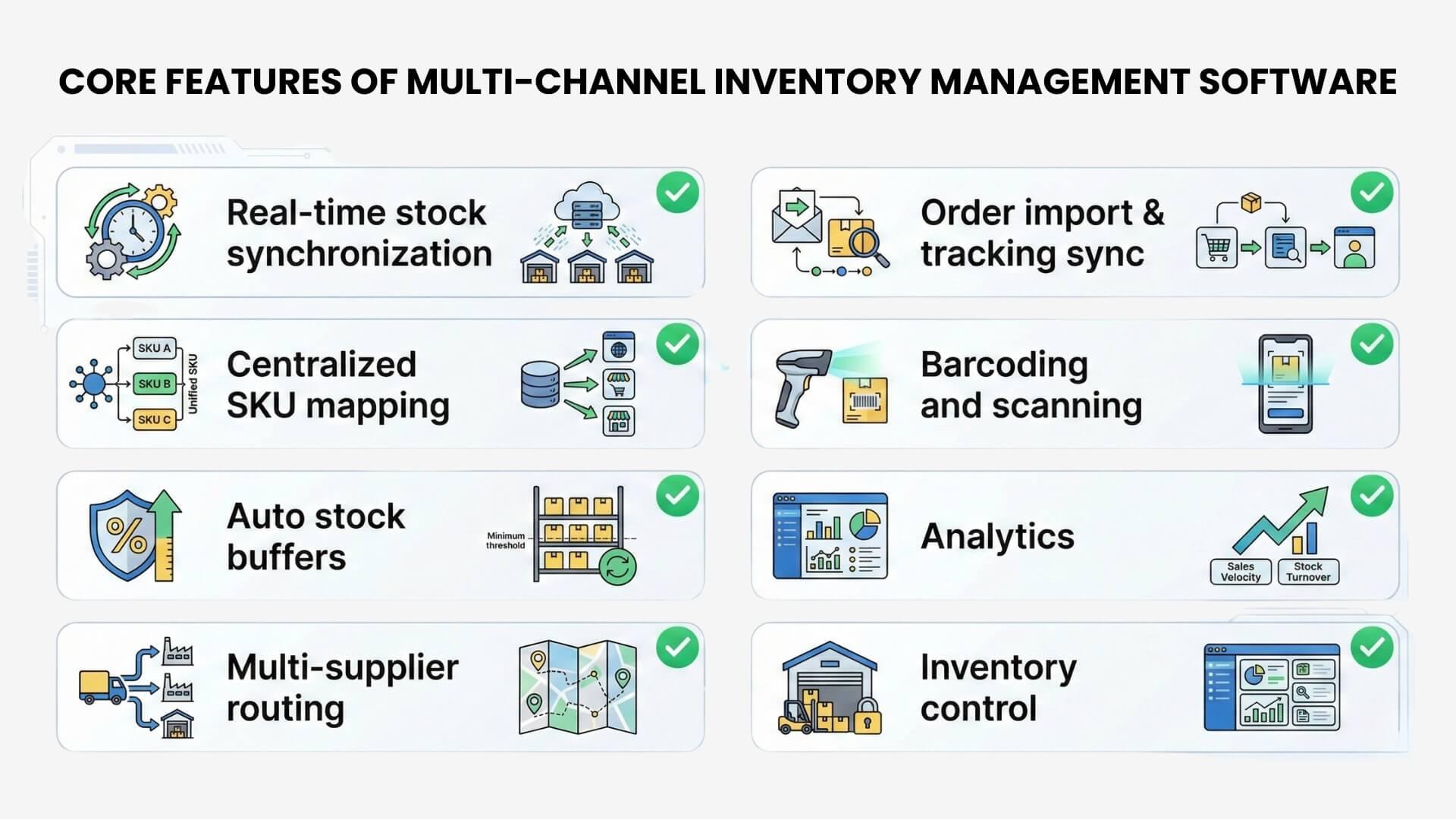
Real-time stock synchronization is the foundation of any multi-channel ecommerce inventory management system. When a sale happens on one channel, inventory levels must be updated everywhere else with minimal delay. This reduces overselling risk and keeps listings aligned with actual availability.
Centralized SKU mapping allows sellers to connect the same product across different marketplaces and supplier catalogs. Since suppliers often use different SKUs and naming structures, this feature ensures that each sale is linked to the correct product and variant, regardless of where the order originates.
Auto stock buffers provide a safety layer between supplier data and storefront listings. By reserving a portion of inventory or limiting available quantities, sellers can protect themselves from delayed supplier updates or sudden stock drops.
Multi-supplier routing ensures that orders are automatically sent to the correct supplier based on predefined rules. This is especially important when multiple suppliers offer the same product or when fallback options are needed to maintain fulfillment continuity.
Order import and tracking synchronization keeps all order data in one place. Orders from every channel are imported automatically, fulfillment status is updated in real time, and tracking numbers are pushed back to each marketplace without manual intervention.
Barcoding and scanning support becomes relevant for hybrid models where sellers use private agents or small warehouses alongside dropshipping suppliers. This feature helps maintain accuracy when physical inventory is introduced into the workflow.
Analytics and reporting give sellers visibility into stock movement, sell-through rates, and supplier performance. With accurate data, inventory decisions become proactive rather than reactive.
Inventory control tools allow sellers to pause listings, set minimum and maximum stock thresholds, and apply availability rules. This level of control is critical for protecting account health across multiple platforms.
Supplier API integrations enable direct and frequent inventory updates from suppliers. Compared to manual uploads, API connections reduce delays and improve data accuracy at scale.
Auto supplier switching allows the system to reroute orders when a primary supplier runs out of stock. This ensures continuity in fulfillment without manual intervention and helps maintain listing uptime.
Warehouse and agent hybrid support is essential for sellers who combine dropshipping with private fulfillment partners. The system should treat each inventory source as part of a unified network rather than separate silos.
Profit margin rules help sellers protect profitability by adjusting availability or pricing based on supplier costs, fees, and channel-specific expenses. This feature becomes increasingly important as catalogs and order volume grow.
Demand forecasting uses historical sales data to predict future inventory needs. While not always perfect in dropshipping, it provides valuable insights for supplier planning and channel prioritization.
Supplier API integrations
Auto supplier switching
Warehouse + agent hybrid support
Profit margin rules
Demand forecasting
Handling virtual inventory is a core requirement for dropshipping-focused systems. Instead of relying on physical stock counts, the software must manage availability based on supplier data, buffers, and fulfillment rules.
Supplier catalog syncing allows sellers to import, update, and maintain large product catalogs without manual data entry. This keeps product information consistent and reduces listing errors across channels.
Product bundling logic supports scenarios where one listing depends on multiple supplier SKUs. The system must accurately calculate availability and prevent sales when any required component is unavailable.
Choosing the right multi-channel inventory management software can be a game-changer for dropshipping sellers. The right solution does more than sync stock, it streamlines orders, protects margins, and helps maintain healthy marketplace accounts. Below are some of the best inventory tools available today, grouped by use case and seller type. Each of these tools supports multichannel syncing, centralized SKU control, and automation tailored to multi-platform selling.
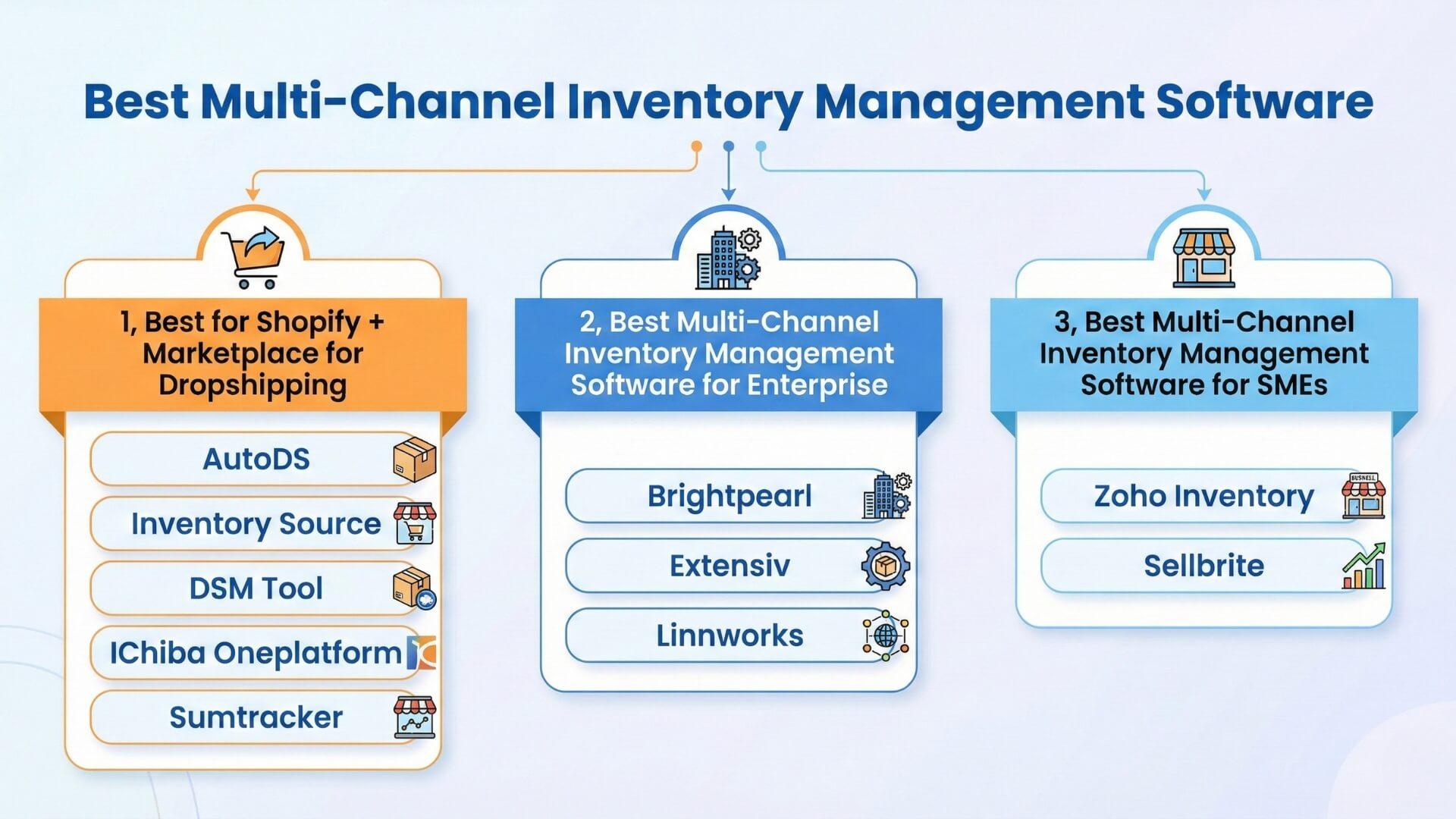
These platforms are particularly popular among dropshippers because they blend strong automation with marketplace and Shopify support.
AutoDS stands out for its deep focus on dropshipping automation. It connects multiple suppliers with Shopify and marketplaces, handles inventory syncing, automates price monitoring, and offers routing for order fulfillment.
Inventory Source focuses on supplier integrations and feed automation. It supports hundreds of suppliers, automatically updates stock and pricing, and simplifies catalog management across platforms.
DSM Tool provides multichannel syncing along with repricing and order automation. It works well for sellers who rely on fast-moving products and need responsive inventory updates across eBay, Shopify, and other channels.
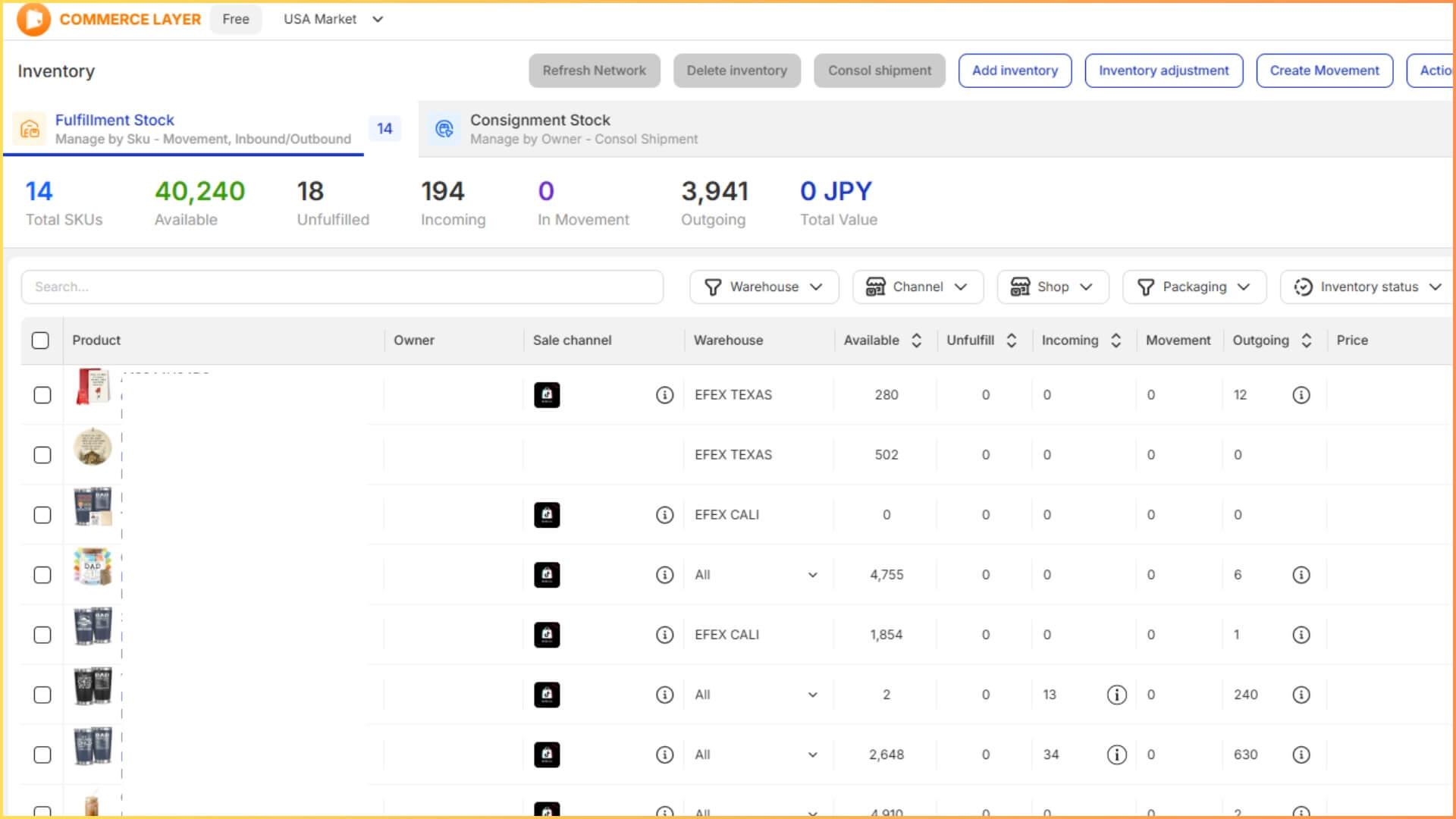
Ichiba OnePlatform’s inventory management features are built not just for tracking stock but for full multichannel orchestration, providing visibility, automation, and integration that help eliminate manual errors and operational bottlenecks common in dropshipping and global ecommerce.
Its focus on real-time synchronization, centralized product data governance, and automated distribution workflows makes it a strong candidate among multi-channel inventory management software options for sellers looking to scale with confidence.
Sumtracker offers real-time inventory updates, multi-supplier control, and easy onboarding for Shopify sellers. It also provides insights and alerts that help protect account health as order volume grows.
Enterprise sellers require advanced features, robust scalability, and extensive integrations. The following systems cater to larger catalogs, complex routing, and multichannel fulfillment.
Brightpearl is a powerful operations platform that combines inventory, order, and financial management. It supports high-volume merchants selling across multiple marketplaces and includes reporting tools that help with forecasting and performance analysis.
Extensiv (formerly eComEngine) focuses on connecting inventory and order workflows across major sales channels. Its suite supports sync automation, SKU normalization, and advanced reporting for enterprise operations.
Linnworks provides a unified commerce platform built for complex inventory environments. It supports configurable rules, supplier API connections, and multi-warehouse logic, giving enterprise sellers the control needed to manage thousands of SKUs.
Smaller sellers and growing brands need inventory tools that are powerful yet affordable, and easy to implement without heavy technical overhead.
Zoho Inventory offers multichannel syncing, order management, and automated workflows in an intuitive interface. It integrates with popular marketplaces, Shopify, and manual supplier feeds, making it a strong choice for small and medium-sized ecommerce sellers.
Sellbrite provides centralized inventory and order management with easy connectivity to major marketplaces and Shopify. Its simple setup and clear dashboards make it ideal for SMEs expanding beyond a single channel.
Choosing the right multi-channel inventory management system can feel overwhelming, especially when dozens of tools promise multichannel syncing, automation, and real-time control. The key is to approach the selection process systematically, aligning the software’s capabilities with your dropshipping business’s current needs and future growth plans. Below are practical criteria and decision points that will help you evaluate options with clarity and confidence.
Not all businesses need the same level of inventory management sophistication. Your stage of growth should influence the features you prioritize and the budget you allocate.
Beginner: 1–2 Channels, Manual Suppliers
At this stage, your primary focus is on preventing overselling and automating basic stock updates. Look for systems that offer real-time inventory syncing across a couple of channels and simple SKU mapping. You don’t yet need enterprise-grade forecasting or complex routing logic, but you do need reliable accuracy and easy onboarding.
Growth: Multiple Suppliers, Automation Needed
Once you connect more suppliers or begin selling on additional marketplaces, manual processes become bottlenecks. Prioritize automation features that remove repetitive work, for example, automatic stock buffers, supplier feed connections, and order import automation. The goal here is to reduce errors and free up time for strategic tasks.
Scale: Private Agents, Bulk Routing, Velocity Rules
At scale, the ideal system must support advanced workflows: rules-based routing, multi-warehouse logic (even if virtual), dynamic margin protections, and demand forecasting. You should also expect integrations with fulfillment partners and APIs for custom automation. The investment here pays off by maintaining accuracy even as your SKU count and order volume explode.
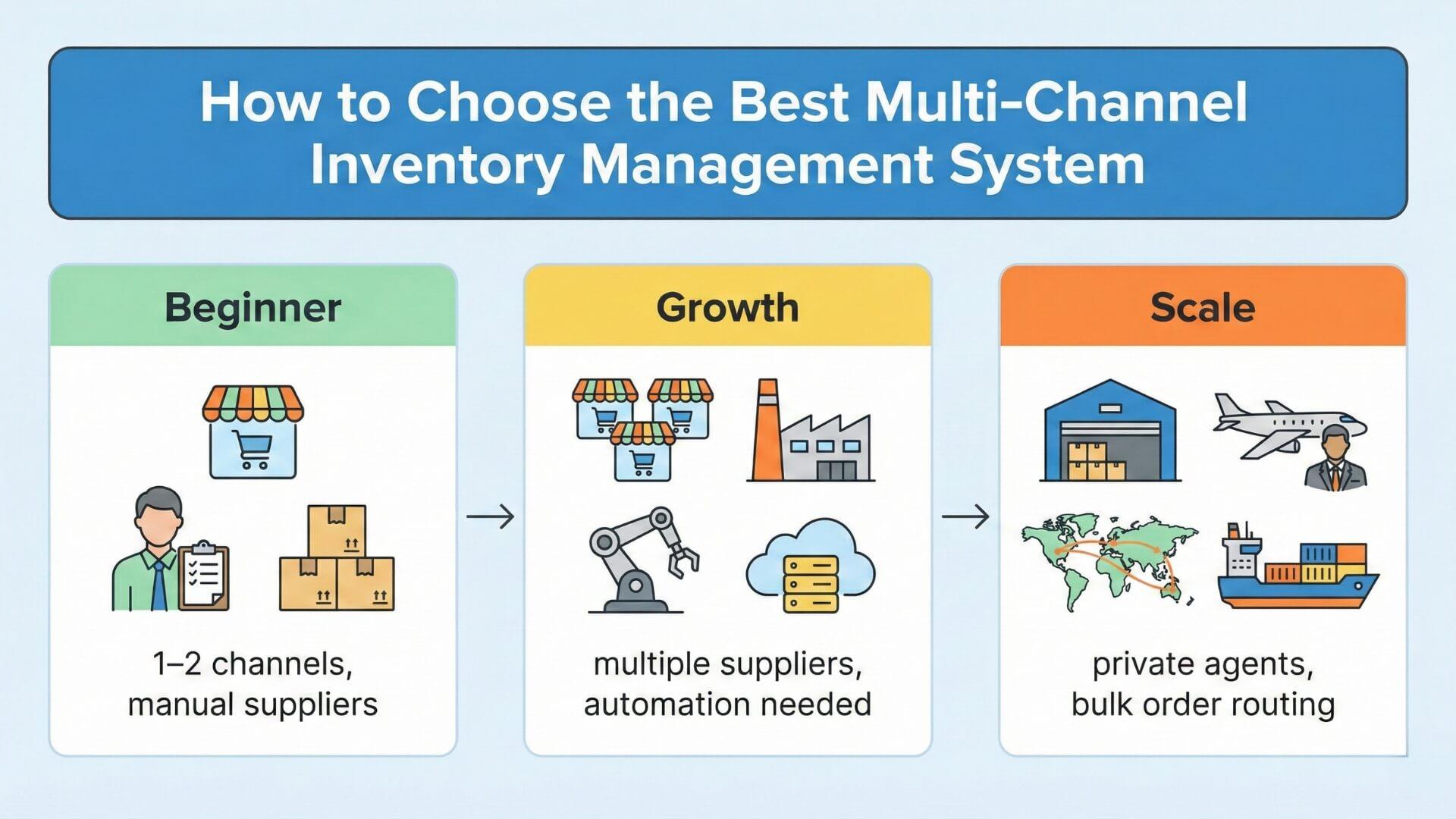
Before committing, clarify how each candidate matches your operational needs by asking targeted questions. Important considerations include:
Does it sync supplier stock automatically?
Manual uploads cause delays and errors. A system that pulls stock in real time or near real time from supplier feeds or APIs will reduce overselling significantly.
Can it map variants across channels accurately?
Different channels and suppliers often use different SKU naming schemes. Your system should let you unify these under centralized SKU logic so inventory updates are consistent everywhere.
How often does inventory refresh?
Some tools sync every few minutes, others only periodically. For dropshippers with fast-selling SKUs, shorter sync intervals reduce stock discrepancy issues.
Does it integrate with your tech stack?
Check compatibility with your marketplaces, Shopify, accounting software, shipping providers, and any ERP or CRM systems you use. Seamless integration reduces manual work and improves data accuracy.
Is the user interface intuitive?
Even powerful systems fail if your team finds them hard to use. A clean interface, good onboarding, and robust documentation reduce training time.
Asking these questions and testing real workflows during a trial helps you avoid common pitfalls like choosing tools that don’t truly sync or lack critical channel support.
Pricing is rarely as simple as the headline monthly fee. Many multi-channel inventory management systems include variable costs that only become visible as your business grows.
Per-order fees are one of the most common hidden expenses. While they may seem small at low volume, they scale directly with revenue and can quickly become a significant cost line.
API request limits can also restrict growth. Systems that rely heavily on supplier APIs may throttle updates or charge extra once request thresholds are exceeded, directly impacting inventory accuracy during peak periods.
Add-on modules are another factor to consider. Features like advanced analytics, forecasting, or barcode support are often sold separately. What looks affordable at first may require multiple upgrades to fully support your workflow.
Choosing the best multi-channel inventory management system is less about chasing the most features and more about selecting a platform that fits your current operations while supporting your next stage of growth. When evaluated through this lens, inventory software becomes a strategic asset rather than just another tool.
Many dropshipping businesses fail to scale, not because of poor marketing or weak products, but because inventory operations collapse under growth. What works at 10 orders per day often breaks completely at 200 orders per day. The following inventory management mistakes are some of the most common reasons why scaling dropshippers lose margins, damage platform accounts, and eventually stall growth.
Understanding these pitfalls early allows sellers to build systems that scale smoothly instead of constantly putting out operational fires.
One of the most damaging operational mistakes is trusting supplier CSV uploads as a reliable source of truth. CSV files are often outdated the moment they are generated, especially for fast-moving products. Relying on these uploads without real-time syncing creates blind spots that lead directly to overselling and order cancellations.
Another common mistake is operating without stock buffers. Many sellers assume that supplier inventory numbers are accurate and immediately usable. In reality, delays, allocation rules, and other sellers competing for the same stock make raw supplier quantities unreliable. Without buffers, even small timing gaps can trigger fulfillment failures.
Lack of SKU normalization also causes serious problems as catalogs grow. When the same product is represented differently across suppliers and channels, inventory logic becomes fragmented. Orders get routed incorrectly, variants are mismatched, and manual intervention becomes unavoidable. A centralized SKU structure is essential for maintaining control.
From a strategic perspective, expanding sales channels before fixing inventory synchronization is a costly error. Adding new marketplaces increases order velocity and complexity, which magnifies existing inventory weaknesses. Sellers often interpret early success as a signal to expand, only to discover that their systems cannot support the increased load.
Choosing inventory tools based only on price is another common mistake. Cheaper tools may lack automation depth, refresh frequency, or supplier integration quality. The hidden cost shows up later through higher cancellation rates, support overhead, and lost accounts rather than on the monthly invoice.
Many sellers also fail to establish data auditing routines. Inventory systems are not set-and-forget tools. Without regular checks on stock accuracy, supplier performance, and sync logs, small issues can quietly grow into major operational failures.
Each marketplace enforces inventory accuracy differently, and ignoring these nuances can be dangerous for scaling dropshippers.
On Amazon, repeated inventory cancellations can trigger automatic listing suppressions or account health warnings. Once trust is lost, recovery becomes slow and resource-intensive.
eBay applies velocity limits and performance thresholds that are sensitive to fulfillment consistency. Sudden spikes in cancellations or delayed shipments often lead to reduced visibility or selling restrictions.
TikTok Shop introduces fulfillment score penalties that directly affect traffic and campaign performance. Inventory inaccuracies that cause late or canceled orders can reduce exposure even if demand remains strong.
These risks highlight why inventory management is not just an internal operations issue. It directly determines how marketplaces treat your business as you scale.
What is multi-channel inventory management?
Multi-channel inventory management is the process of tracking and controlling inventory across multiple sales channels from a single centralized system. Instead of managing stock separately on each platform, sellers use one system to synchronize inventory levels, product availability, and order data across all channels. For dropshipping sellers, this often includes managing virtual inventory sourced from multiple suppliers rather than physical stock.
Do dropshippers really need inventory software?
Yes, inventory software is essential for dropshippers who sell on more than one channel or work with multiple suppliers. Without a dedicated multi-channel inventory management system, sellers are exposed to overselling, delayed fulfillment, margin losses, and platform account risks. As order volume increases, manual tracking becomes unreliable and difficult to scale.
What is the best multi-channel inventory management software for Shopify?
The best multi-channel inventory management software for Shopify depends on the seller’s business model and growth stage. Dropshipping sellers often prefer tools that offer strong supplier integrations, real-time stock syncing, and automation across marketplaces. Platforms such as AutoDS, DSM Tool, Ichiba OnePlatform, and Sumtracker are commonly chosen by Shopify sellers operating in a multi-channel environment.
Can inventory tools work with private suppliers?
Yes, many modern multi-channel inventory management systems support private suppliers and agents. This is typically done through API connections, custom feeds, or manual inventory inputs combined with automation rules. For scaling dropshippers, this flexibility is important when transitioning from public suppliers to private sourcing or hybrid fulfillment models.
Scaling a dropshipping business across multiple platforms is no longer just a marketing challenge. It is an operational one, and inventory sits at the center of it. Without a reliable multi-channel ecommerce inventory management approach, even profitable stores can quickly lose control as order volume, suppliers, and sales channels increase.
The right multi-channel inventory management system does more than sync stock numbers. It creates a single source of truth, protects sellers from supplier volatility, and keeps marketplace accounts healthy as complexity grows. From preventing overselling to safeguarding margins and customer experience, inventory accuracy becomes a competitive advantage rather than a hidden risk.
For dropshipping sellers serious about long-term growth, investing in the right inventory software is not about adding another tool. It is about building a foundation that supports expansion without chaos. When inventory management is treated as a core growth system, scaling becomes predictable, sustainable, and far less stressful.

Work with us
Our solutions
Address:
 〒136-0082, Japan, Tokyo, Koto-ku, Shinkiba 3-5-6, 5F
Connect us:


Japan
〒136-0082, Japan, Tokyo, Koto-ku, Shinkiba 3-5-6, 5F
Texas, USA
1606 Audrey Dr, Garland, TX 75040, United States
California, USA
1316 John Reed Ct, City of Industry, CA 91745, United States