

News
Ichiba OnePlatform Team - 26/05/2026
In this article
Toys can scale faster than most ecommerce categories because demand never stops. But in dropshipping toys, speed is not the main advantage - trust is. Parents and gift buyers assume two things: the product is safe and the box arrives clean. If either fails, refunds, chargebacks, and listing removals show up quickly.
This guide explains what marketplaces usually treat as “toys,” why the category is high-opportunity but high-risk, which safety rules matter when you sell from APAC to U.S./EU buyers, how to choose toys dropshipping suppliers you can rely on, and how to pick the best toys to dropship without drowning in defects.
Dropshipping toys means you sell toys online without holding inventory. When an order comes in, the supplier packs and ships it to your customer.
If you want the full beginner setup (store basics, product research, launch steps), You can start here: Dropshipping How to Start: Easy Guide for Beginners.
Toys are harder than “normal” dropshipping items for three practical reasons.
Safety and labeling are part of the product. Age grading, warnings, and material details can decide whether your listing stays live.
Defects trigger stronger reactions. Missing parts, sharp edges, or a strong chemical smell creates instant distrust.
Packaging impacts conversion. Many toy orders are gifts. A crushed box can turn a happy buyer into a 1-star review.
Not every kid-related item is treated the same by platforms. Classification affects warnings, documentation, and ad eligibility. When you misclassify, platforms may remove listings even if you did nothing “wrong.”
Alphabet boards, basic puzzles, number sets, and logic games. These are often beginner-friendly because there are fewer complex components and fewer “it broke” cases.
Science kits, building sets, mechanical models, and beginner robotics. They can be profitable, but missing parts and unclear instructions drive refunds. Your listing must state exactly what is included.
Plush toys are giftable and convert well, but expectation mismatch is common. Buyers judge stitching, softness, and “looks like the photos.” Real photos and consistent QC matter.
Balls, water-play sets, sand toys, and basic sports items. They may have fewer electronics-related disputes, but shipping cost and box damage risk rises with size.
Some novelty products look like toys but are classified differently. They can be restricted by marketplaces or ad platforms. Treat them as a separate category with separate rules.
A simple mindset: if the product is intended for children’s play, expect child-safety standards. If it is a collectible or novelty item, label and market it carefully.
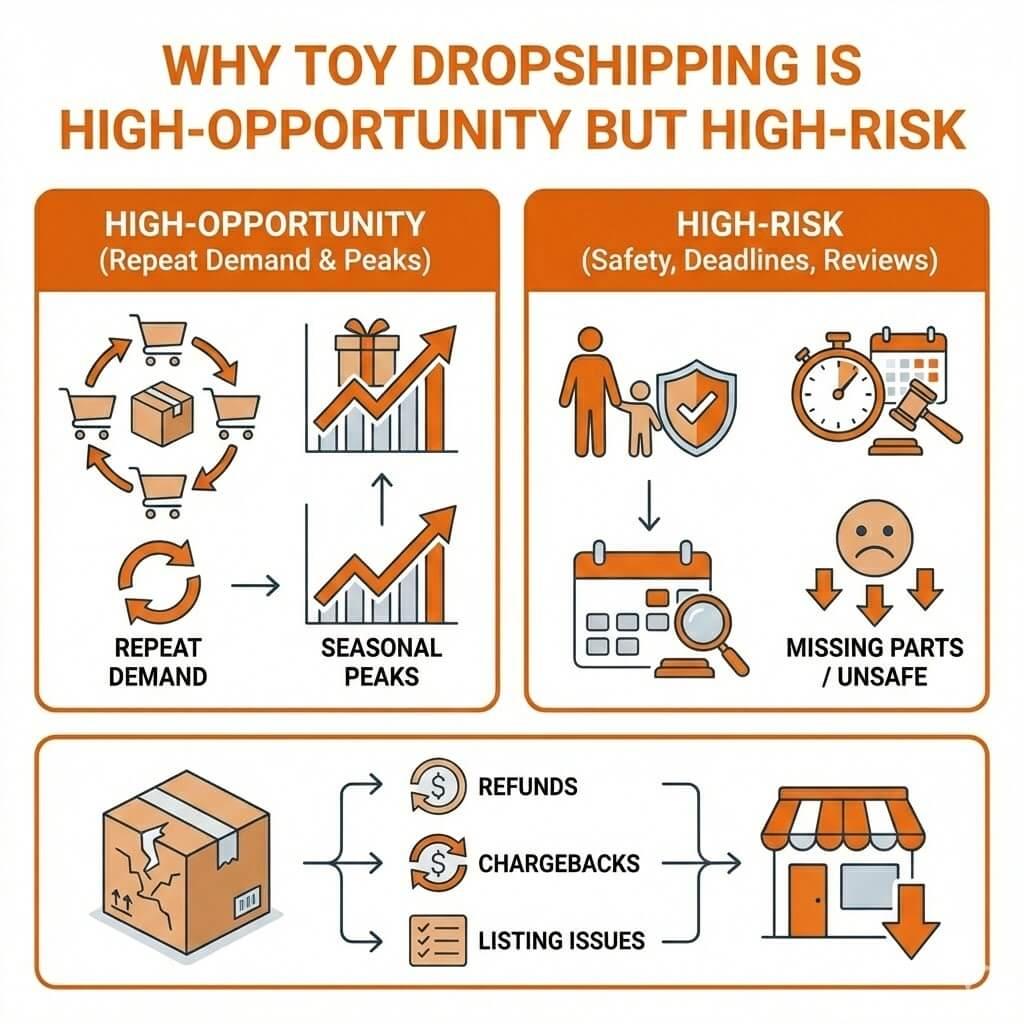
Toys have repeat demand and strong seasonal peaks. But parents buy with safety first, gift buyers buy with deadlines, and marketplaces enforce toy rules more aggressively because children are involved. Reviews also hit harder: a few “missing parts” or “unsafe” reviews can drop conversion across your store.
That is why toy stores can lose money even with good ads-one defect-heavy SKU can create refunds, chargebacks, and listing issues that spread.
Parents want safety proof, age fit, and durability, so they need clear labeling and transparent descriptions.
Gift buyers want presentation and on-time delivery, so box condition matters as much as the toy itself.
Educators want consistent sets and repeatable quality, so they dislike SKU changes and missing pieces.
Seasonal shoppers buy under time pressure, so they increase both sales and customer service. Delivery expectations must be set early when you ship cross-border.
The real question is: can your product meet the destination market’s safety and labeling expectations, and can your supplier back you up when a platform asks?
United States: CPSIA + CPC. Children’s products sold in the U.S. often require safety testing and a Children’s Product Certificate (CPC) that cites applicable rules and identifies the testing lab. Platforms may request documentation during checks or disputes.
United States: ASTM F963 (toy safety standard). CPSC guidance helps sellers understand the toy safety framework and how requirements apply in practice.
(Background: ASTM F963-23 became mandatory in the U.S. via 16 CFR 1250, effective Apr 20, 2024.)
European Union: Toy Safety Directive + CE marking. EU rules apply to products intended for play by children under 14. The Toy Safety Directive is the framework, and toys meeting requirements carry CE marking.
European Union: chemical restrictions (phthalates). Certain phthalates are restricted in toys under REACH Annex XVII.
This is not legal advice. It is a seller reality check: if you sell into the U.S./EU, assume documentation can be requested.
Sellers launch without knowing where certificates come from. When a platform asks, they cannot respond.
Age grading is wrong or missing. Parents treat that as “unsafe,” even if the toy is fine.
Small parts are marketed to the wrong age group. Disputes become emotional and expensive.
Warnings are missing. That looks deceptive and increases platform risk.
Choose dropshipping toy suppliers who can provide documentation when needed. Do not treat compliance as “later.” Stick to age-appropriate toys, especially in your first 50-100 orders, and avoid SKUs that require complex warnings. Create a simple “SKU file” for each product: age grade, materials, warnings, packaging notes, and supplier documents.
If you use Shopify, remember Shopify is a storefront. Compliance demands still come from marketplaces, ads, and destination rules.
The best toys to dropship are the ones you can fulfill with low defect rates, clear labeling, and stable packaging.
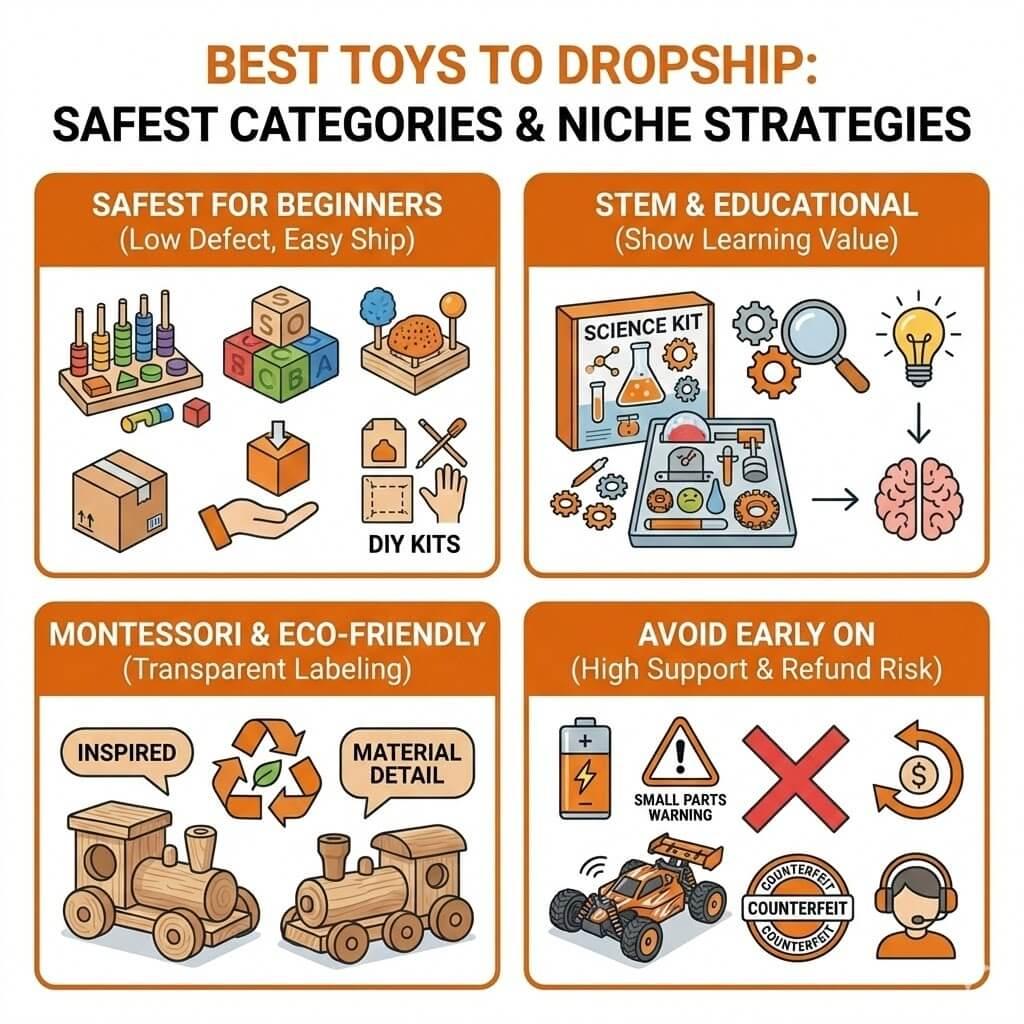
For beginners, the safest starting categories are educational toys, sensory toys, simple DIY kits, and non-electronic toys. They’re easier to explain to buyers, easier to ship without damage, and usually easier to support after purchase.
Higher-margin niches can work too-as long as you manage expectations:
STEM toys can justify a higher price when you clearly show the learning value and list what’s included in the box.
Montessori-inspired toys have demand, but avoid over-claiming. “Inspired” language is safer than “official.”
Outdoor play toys can win seasonally, but they need realistic timelines and stronger box protection.
Eco-friendly toys can convert well when materials are stated clearly. Avoid vague “eco” labels without product detail.
Avoid these toys early on: battery-heavy electronics, small-part toys for under-3 buyers, counterfeit branded toys, and complex RC toys. They create support work and refund risk faster than they create profit.
In toys, a supplier is not just a vendor. They directly shape your defect rate, box condition, and how painful after-sales becomes when parts go missing. That’s why the best toy dropshippers don’t “pick one best supplier.” They build a short list of toys dropshipping suppliers to test, then keep the stable ones.
The fastest way to lose money in this niche is scaling ads before you prove packaging discipline and replacement behavior. One unreliable dropshipping toy supplier can erase weeks of profit through refunds and chargebacks.
Best for fast testing and wide selection. The trade-off is consistency-quality varies by seller, so you must vet each store inside the platform.
AliExpress: huge catalog, easy to test, but you must vet sellers carefully.
CJdropshipping: closer to a managed sourcing + fulfillment flow than a pure marketplace, which helps once orders start coming in.
Doba: a supplier directory/platform that helps you discover and organize sources.
Operator note: if a supplier won’t share packed-box photos or dodges “missing parts” replacement terms, skip them. Toys go refund-first when details are unclear.
If you sell to US/EU buyers, local supply reduces delivery risk, keeps tracking clean, and helps protect gift-box condition-especially during peak season.
Wholesale Central: a US wholesaler directory; more manual work, but strong for local sourcing.
TopDawg: a US-focused dropshipping platform built around domestic suppliers.
Inventory Source with integrated toy suppliers (for example, Big Toys USA): useful if you want feed and inventory sync.
Syncee: connects to brands and wholesalers across the US/UK/EU for faster local delivery options.
Agents make the most sense after you’ve proven a few winners. A good agent can verify parts, check packaging, and send real photos or videos before dispatch. That control often prevents “missing parts” tickets from piling up later.
Choose agents based on four things: real-item photos, packed-box photos, a clear replacement SLA for missing parts, and stable tracking scan times.
IChiba OnePlatform can help sellers standardize product data, tracking visibility, and packaging rules across suppliers - useful when scaling cross-border toys.
If you want a broader supplier evaluation checklist, seeBest Dropshipping Suppliers for the USA Market and Best Dropshipping Suppliers for Shopify (Trusted & Free Options in 2026).
Don’t overthink it. In toys, most problems show up in the same places: documents, labeling, packaging, and replacements. Vet these early and you’ll avoid the refund spiral later.
Start with compliance readiness. If a platform asks for a certificate or test report, can your supplier provide it quickly-or do they go silent?
Next, check age grading and materials. Missing or vague labels are usually a sign the supplier doesn’t control QC tightly.
Then look at the box condition, because toys are often gifts. Ask for packed-box photos and confirm how they protect corners and prevent dents.
After that, test missing parts handling. What qualifies as a defect? How fast do they ship a replacement? Who pays the cost?
Finally, run a small shipping test. Watch scan time, tracking updates, and delivery stability. In toys, a “fast promise” means nothing if tracking is messy.
No age labeling, prices that look too good, blurry photos, no documentation when asked, and vague defect policies. If you see two or three of these together, expect refunds.
Toy margins are controlled by refunds and support time. That is why dropshipping toys is often won in operations, not ads. Low-ticket toys convert fast but leave little buffer for replacements. Mid-ticket learning sets and basic STEM kits often support healthier margins and fewer disputes.
Hidden costs are where new sellers lose money: defect returns, damaged packaging, high support load, and chargebacks driven by “unsafe” perceptions. Build enough margin buffer to survive occasional replacements.
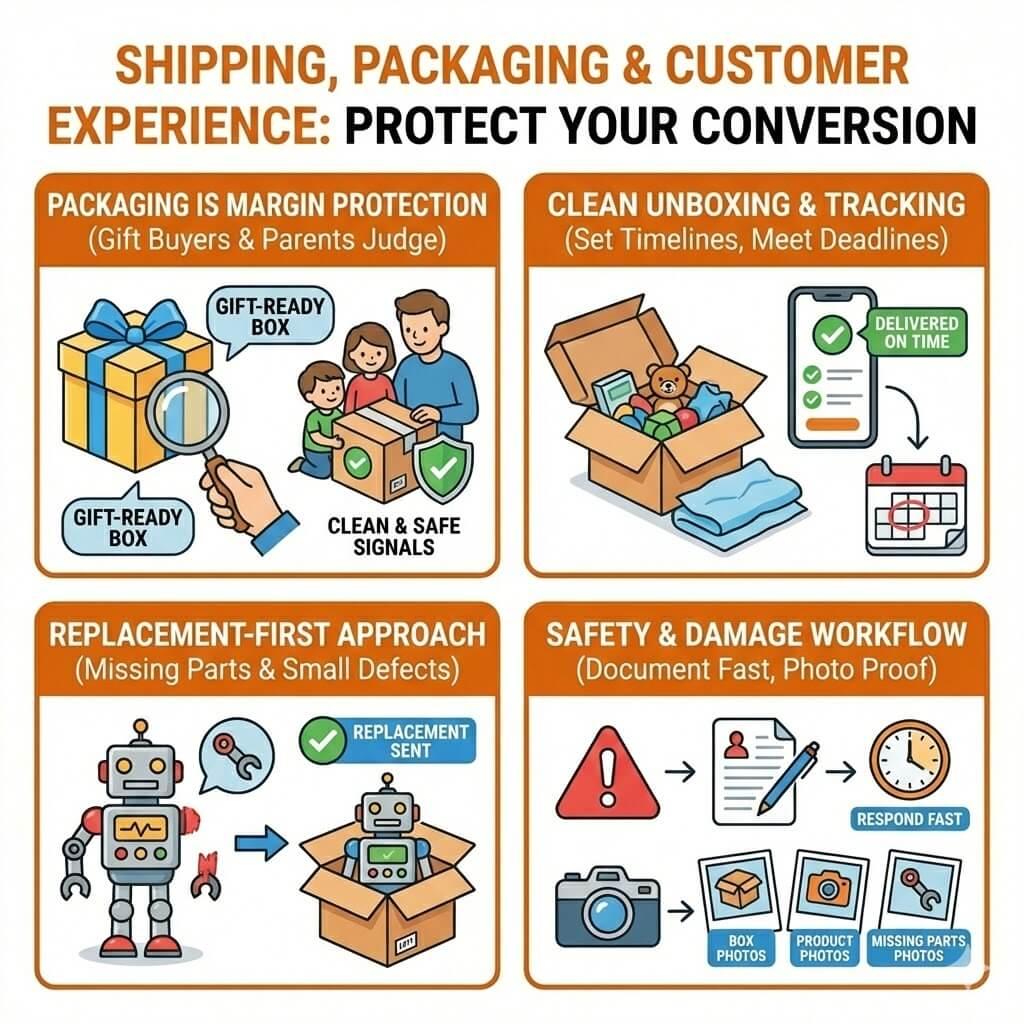
In dropshipping toys, packaging protects your conversion rate. Gift buyers judge the box first, and parents judge cleanliness and safety signals. A clean unboxing experience reduces complaints.
If you ship from APAC into the U.S./EU, set timelines early and keep tracking clean. Holiday deadlines are strict. Late delivery triggers refunds even when the toy is fine. For delivery benchmarking and speed-focused supplier options, see 17 Fastest Dropshipping Suppliers for 2026 (Fast Shipping Options for U.S, EU, China, Japan).
A replacement-first approach works well for missing parts and small defects. For safety-related complaints, respond fast and document everything. For damage claims, use a standard workflow: box photos, product photos, and missing parts photos.
Yes-if you control defects and refunds. Toys can sell fast, but one problem SKU can erase is margin through replacements, returns, and chargebacks. Start with low-defect categories and scale ads only after the first 30–50 orders stay clean.
Begin with toys that are easy to label, easy to ship, and unlikely to break: educational sets, sensory toys, simple DIY kits, plush, and non-electronic toys. Avoid battery-heavy electronics and small-part toys for under-3 buyers until your supplier and packaging are proven.
Sometimes, yes. Requirements depend on the destination market and whether the product is considered a children’s product. The practical rule: choose suppliers who can provide test documents or certificates when requested, and keep a simple SKU file (age grade, materials, warnings, documents).
Yes. Shopify is just the storefront. Your compliance checks come from where you sell and advertise (marketplaces, ad platforms) and from the destination country’s toy rules. Make sure your product pages show age grading and warnings clearly.
Some are, many aren’t-reliability has to be proven. Run small tests, ask for packed-box photos, confirm missing-parts replacement terms, and track delivery stability before you scale.
Toy dropshipping works when compliance, supplier quality, and packaging are managed like a system. Start with safer categories, vet suppliers for documentation and after-sales behavior, and keep SKU files organized. If you sell from APAC into the U.S./EU, set delivery expectations early and avoid fragile SKUs that cannot survive replacements.
Join the community and follow IChiba channels for more cross-border checklists, supplier workflows, and templates for dropshipping toys. The right systems keep dropshipping toys profitable.

Work with us
Our solutions
Address:
 〒136-0082, Japan, Tokyo, Koto-ku, Shinkiba 3-5-6, 5F
Connect us:


Japan
〒136-0082, Japan, Tokyo, Koto-ku, Shinkiba 3-5-6, 5F
Texas, USA
1606 Audrey Dr, Garland, TX 75040, United States
California, USA
1316 John Reed Ct, City of Industry, CA 91745, United States