

News
Ichiba OnePlatform Team - 11/06/2026
In this article
Amazon Japan is a strong marketplace for global sellers who want to enter Japan’s ecommerce market. It already has buyer trust, strong marketplace traffic, and mature fulfillment options.
But to sell on Amazon Japan successfully, sellers need more than an account and a translated listing.
For sellers who want to sell on Amazon Japan, Japan has high expectations for product details, delivery speed, packaging, customer service, and accurate product descriptions. A weak listing, unclear shipping flow, or missing fee calculation can quickly reduce margin.
Japan is also a large enough market to justify serious planning. According to METI’s FY2024 E-Commerce Market Survey, Japan’s domestic B2C ecommerce market reached 26.1 trillion yen in 2024, up 5.1% year over year. (Source: METI, Aug 26, 2025)
This guide explains how to sell on Amazon Japan as a foreign seller. It covers seller requirements, account types, language and localization challenges, product research, listing optimization, launch tactics, fees, and fulfillment options.
Yes, foreign sellers can sell on Amazon Japan if they meet Amazon’s registration and verification requirements.
The better question is not only “can I sell on Amazon Japan?” It is whether the seller can operate the account properly after approval.
Account setup is only the first step. Sellers still need to manage product listings, shipping, tax, customer service, returns, and fulfillment. These areas are often harder than registration itself.
A seller outside Japan can enter the marketplace, but the operation must be reliable enough for Japanese buyers. If delivery is slow, product details are vague, or returns are unclear, conversion and account health may suffer.
Amazon Japan is open to different seller types, including individuals, businesses, non-resident sellers, brands, wholesalers, private label sellers, and selected dropshipping sellers.
Individuals can use Amazon Japan to test a small number of products. This option may fit sellers who want to validate demand before committing to higher fixed costs.
Businesses are usually better suited for long-term selling. A business setup can support larger SKU counts, brand development, supplier relationships, and more structured operations.
Non-resident sellers can sell on Amazon Japan if they complete the required verification and marketplace setup. Living in Japan is not always required, but sellers still need a clear plan for shipping, returns, and customer service.
Brands, wholesalers, and ecommerce operators often have an advantage because they already control products, supply, pricing, or operational data.
Dropshipping sellers need to be more careful. Amazon has specific requirements for drop shipping, including being the seller of record, identifying yourself as the seller on packing slips and invoices, removing third-party supplier information, and accepting customer returns. Sellers who do not follow these rules can risk their selling privileges. (Source: Amazon Japan Fulfillment)
To create an Amazon Japan seller account, sellers usually need to prepare identity, payment, and business information before registration.
Common requirements include:
Passport or government-issued photo ID
Name and address information
Store name
Credit or debit card
Bank account information
Email address and phone number
Address verification document if required
Business registration documents if selling as a company
Amazon Japan’s identity verification page lists documents such as identification documents and company registration documents as part of the verification process. Sellers should check the latest requirements before applying because document requests can vary by account type and verification status. (Source: Amazon Japan Identity Verification)
A Japanese company is not always required to sell on Amazon Japan. However, sellers planning to build a serious operation should prepare proper business documents early.
The most important rule is consistency. Names, addresses, bank details, company records, and uploaded documents should match. Even a small mismatch can delay verification and slow down the start of selling.
Amazon Japan offers two main selling plans: Individual and Professional.
Account type | Fee | Best for | Notes |
Individual | ¥100 per item sold | Low-volume sellers and market testing | Lower fixed cost, but less suitable for scaling |
Professional | ¥4,900/month | Sellers with multiple SKUs or a long-term plan | Better for serious selling and growth |
Amazon Japan states that the Individual plan costs ¥100 per unit sold, while the Professional plan costs ¥4,900 per month. Amazon also charges referral fees by category, with most referral fees between 5% and 15.4%. (Source: Amazon Japan Pricing)
If a seller only wants to test a few products, the Individual plan can be enough. It keeps fixed monthly costs low during the validation stage.
If a seller plans to sell regularly, manage multiple SKUs, or invest in Amazon Ads, the Professional plan is usually more practical. It supports a more serious selling setup and gives sellers a clearer base for long-term planning.
The decision to sell on Amazon Japan should not be based on the monthly fee alone. The account type should not be chosen by monthly fee alone. Sellers should compare expected order volume, referral fees, fulfillment cost, advertising budget, and SKU strategy before deciding.
Language is one of the biggest challenges when sellers enter Amazon Japan. But the issue is bigger than translation.
A listing that works in the US or Europe may not perform well in Japan if the language, structure, product details, and trust signals do not match local buyer expectations.
Japanese buyers often expect clear, accurate, and detailed information before buying. They may check size, material, specifications, usage instructions, product condition, shipping timeline, and return policy more carefully than sellers expect.
A weak Japanese listing often has these problems:
Machine-translated titles
Generic bullet points
Missing product specifications
Unclear size, material, compatibility, or use case
Poor product images
Missing usage notes or safety details
Unclear shipping and return information
This is why localization should be treated as part of a conversion strategy, not only a translation task.
A strong Amazon Japan listing should help buyers understand what the product is, whether it fits their needs, why it is trustworthy, and what happens after purchase.
If sellers do not have in-house Japanese language support, they should consider working with a native reviewer or localization specialist. This can directly affect conversion rate, review quality, and return risk.
This section breaks down how to sell products on Amazon Japan from account setup to launch.
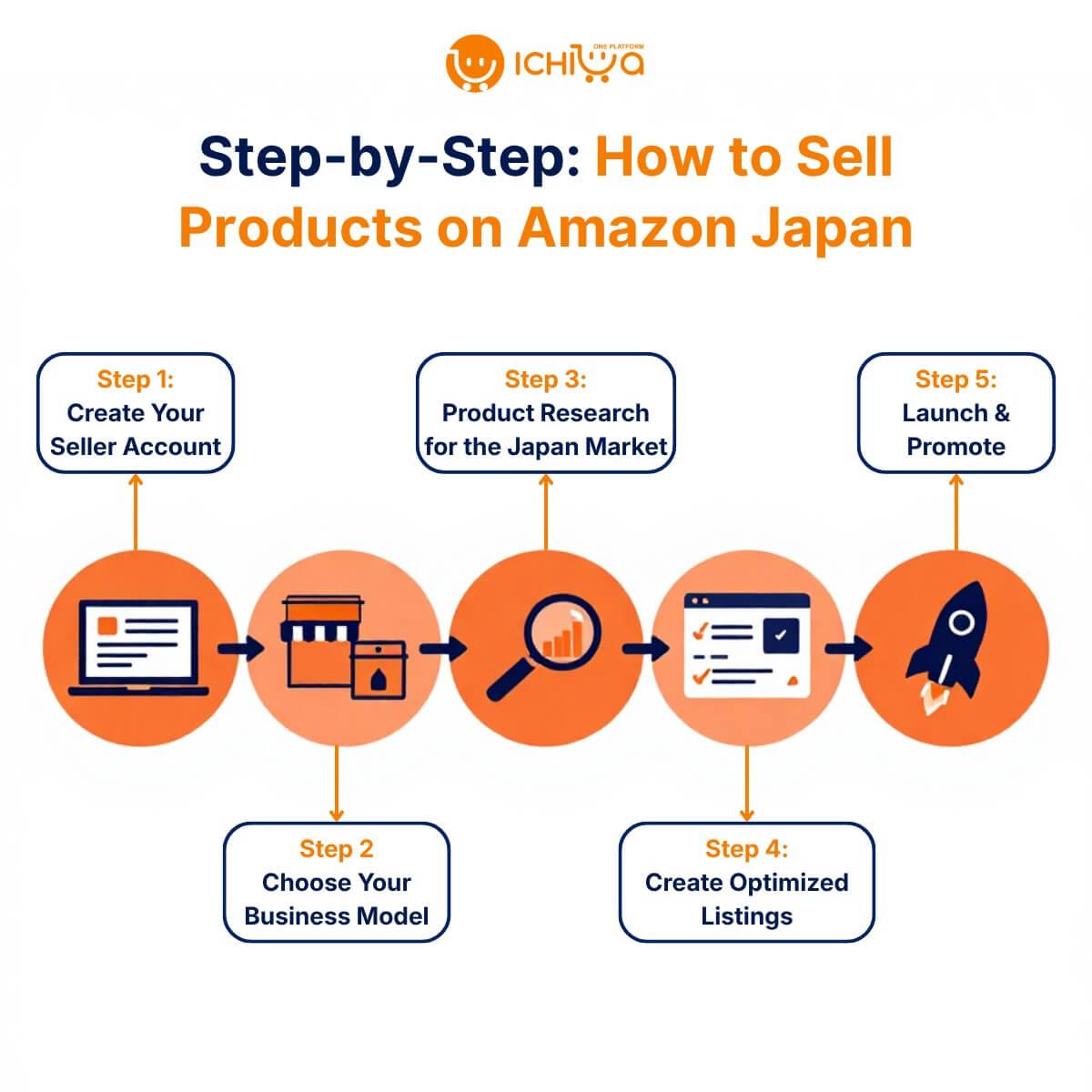
The first step is to create a seller account through Amazon Seller Central Japan.
Before starting, prepare your identity documents, payment information, bank details, store name, and business information if you are registering as a company.
Sellers should carefully check:
Personal or company name
Address
Store name
Credit or debit card details
Bank account information
Email address and phone number
Uploaded verification documents
A small mistake can delay the account review. For example, a name that does not match the passport, an incomplete address, or a blurred document upload can slow down verification and delay the start of selling.
Amazon Seller Central Japan is where sellers manage listings, inventory, orders, advertising, performance, payments, and account settings.
After registration, sellers must complete Amazon’s verification process. Depending on the account, Amazon may request additional documents or review steps.
Product information should also be prepared early. Some products may require product codes, brand approval, category approval, or additional compliance checks before they can be listed.
If sellers already have an Amazon seller account in another marketplace, they may be able to explore Japan through Amazon Global Selling or their existing Seller Central setup.
However, sellers should not assume that an existing US or Europe account can sell on Amazon Japan immediately.
Japan-specific setup may still be needed, including:
Payment settings
Tax settings
Product listing requirements
Language settings
Category restrictions
Fulfillment setup
Return address or return process
Amazon Global Selling can make expansion easier, but sellers still need to complete the requirements for the Japan marketplace.
After the account setup, sellers need to choose the right business model. Each model has different risks, costs, and scaling potential.
Private labels are suitable for sellers who want to build their own brand in Japan.
This model gives sellers more control over the product, packaging, listing content, pricing, and brand positioning. If done well, private labels can create long-term value instead of relying only on price competition.
However, private labels require more investment. Sellers need to work on product development, images, localization, A+ Content, review building, inventory planning, and brand trust.
This model works best for sellers with a stable product, clear buyer persona, and enough budget to build a real brand presence.
Retail arbitrage can be useful for testing selected products, especially when sellers find items at a good purchase price.
However, it is harder to scale because supply is often inconsistent. Sellers also need to check authenticity, product condition, brand restrictions, and price competition.
For Amazon Japan, retail arbitrage should not be the main long-term strategy unless the seller has reliable sourcing and strong control over product quality.
Wholesale works for sellers with stable supply from a brand, distributor, or supplier.
The benefit is that sellers may start with products that already have demand or brand awareness. The challenge is price pressure, buy box competition, and supply control.
Before using wholesale to sell on Amazon Japan, sellers should check:
Whether they have the right to sell the product
Whether margin remains after referral and fulfillment fees
How many sellers compete on the same listing
Whether the brand restricts Amazon sales
Whether supply is stable enough for repeat orders
Wholesale is best for sellers with clear supplier relationships and disciplined pricing.
Dropshipping on Amazon Japan must be handled carefully.
Amazon’s drop shipping policy requires sellers to be the seller of record, identify themselves as the seller, remove third-party supplier information from packaging and documents, and handle customer returns. (Source: Amazon Japan Fulfillment)
This creates clear limits for dropshipping. Sellers cannot rely on a supplier if they do not control product accuracy, packaging, delivery speed, or return handling.
The risk is even higher in Japan because buyer expectations are high. Customers expect clear tracking, accurate descriptions, reliable delivery, and a transparent return process.
Dropshipping should only be considered when sellers have:
Reliable suppliers
Clear product data
Controlled delivery timelines
Transparent fulfillment processes
Clear return handling
Enough margin after fees and shipping
If these areas are not controlled, sellers should consider FBA, FBM with a reliable partner, or third-party fulfillment instead of pure dropshipping.

Product research decides whether a seller is choosing the right products for Amazon Japan.
Sellers should not assume that a product selling well in the US or Europe will automatically work in Japan. Japanese buyers have different expectations, search behavior, and competitive options.
High demand does not always mean easy entry. Some categories attract many searches because they are large, but they also come with strong local competitors, strict buyer expectations, and higher compliance risks.
That is why sellers should treat the categories below as research starting points, not automatic product choices.
Beauty & skincare
Beauty and skincare can be attractive because cosmetics and pharmaceuticals are a large ecommerce category in Japan. METI reported Japan’s cosmetics and pharmaceuticals B2C EC market at 1.015 trillion yen in 2024, up 4.54% year over year. (Source: METI, Aug 26, 2025)
However, Japan already has strong domestic beauty brands and high buyer trust in local products. Foreign sellers should avoid generic products and focus on clear differentiation, compliant claims, strong ingredient transparency, and quality positioning.
Anime & collectibles
Anime and collectibles have strong buyer interest in Japan, but they are also highly competitive because Japan is the home market for many anime, figure, and character goods.
Foreign sellers should not assume that selling generic figures into Japan is easy. Better opportunities may come from licensed international collectibles, rare imported items, display accessories, protective cases, storage products, or niche collector products with verified authenticity.
Health supplements
Health supplements can show strong purchase intent, but they carry higher compliance risk. Claims, ingredients, labeling, and import rules need careful review before listing.
Sellers should avoid aggressive health claims and unclear formulations. This category is better for sellers who understand regulations and can provide accurate product information.
Home appliances
Home appliances and household products are large online categories in Japan. METI reported domestic electrical appliances, AV equipment, PCs, and peripherals at 2.7443 trillion yen in B2C EC market scale in 2024. Household goods, furniture, and interiors reached 2.5616 trillion yen. (Source: METI, Aug 26, 2025)
But these categories are also competitive because Japanese buyers already have access to strong local brands and convenient domestic products. Sellers need to check voltage, plug type, safety standards, warranty expectations, product size, and return risk.
Consumer electronics accessories
Accessories can be easier to test than large electronic devices because they are often smaller and cheaper to ship. But buyers still need clear compatibility information, model details, size data, and images.
This category can work better when sellers target specific models, use cases, or underserved product angles instead of broad generic accessories.
Before choosing products to sell on Amazon Japan, sellers should validate each SKU with real marketplace data.
Check:
Search demand on Amazon Japan
Best Seller Rank of similar products
Average price of top listings
Review volume and review content
Number of competitors
Referral fee by category
FBA fee or fulfillment cost
Product size and shipping cost
Import duties and Japan consumption tax
Category restrictions or compliance requirements
Return risk
Profit margin after all costs
For example, a health supplement may have demand, but compliance risk can be high. A home appliance may have a strong selling price, but shipping, warranty, and return costs can reduce profit. A collectible may attract buyers, but authenticity and condition must be clear.
A safer starting point is a product with clear demand, manageable size, low compliance risk, complete specifications, and enough margin after fees and shipping.
Read more in: Top Japan dropshipping suppliers in 2026
A listing is where buyers decide whether to trust the product.
To sell on Amazon Japan, listings need both keyword relevance and clear product information. Traffic alone will not convert if the title, bullet points, images, and product details are weak.
A Japanese title should be natural, readable, and aligned with how buyers search.
A strong title often includes:
Brand
Product type
Main feature
Key specification
Size, color, or model
Use case or target customer when relevant
Sellers should avoid keyword stuffing. A long title that is hard to read can reduce trust.
For products with technical details, such as electronics, home appliances, or supplements, important specifications should appear in the title and bullet points.

Bullet points should help buyers make a decision faster.
Instead of saying “high quality” or “easy to use,” explain what the product does and why it matters.
Include details such as:
Problem solved
Material or ingredients
Size and fit
Compatibility
Use case
Care instructions
Safety notes
What buyers should check before purchase
For home appliances, buyers may need voltage, plug type, size, power, warranty, and usage instructions. For apparel, they need a clear size chart. For collectibles, they need condition notes, packaging details, and authenticity signals.
A+ Content is useful for sellers with Brand Registry who want to present products more clearly.
It can help explain:
Brand story
Product differences
Use cases
Comparison charts
Feature visuals
Trust-building information
A+ Content cannot fix poor product-market fit. But if the product already has demand and the core listing is strong, A+ Content can help buyers understand the offer faster.
Once the listing is ready, sellers can launch with Amazon Ads Japan, coupons, discounts, and compliant review-building methods.
The goal is not to spend heavily from day one. The goal is to test whether the product can attract traffic, convert buyers, and protect margin.
Amazon Ads can help new products gain visibility faster. Sellers should start with controlled campaigns and a small SKU group.
Track:
Keywords that generate clicks
Keywords that generate orders
Conversion rate
Cost per click
ACOS
Organic ranking changes
SKUs worth scaling
If ads generate clicks but few sales, the issue may be price, images, title, reviews, delivery timeline, or product-market fit.
Coupons and discounts can support early traction.
But sellers should not discount before calculating landed cost. A product with a thin margin can lose money quickly if the coupon is too aggressive.
Coupons work best when they have a clear goal: testing demand, improving early conversion, supporting launch, or reactivating a product that has traffic but weak sales.
Review strategy must follow Amazon policy. Amazon states that it has zero tolerance for customer review violations and can take action against attempts to manipulate reviews. (Source: Amazon Customer Product Reviews Policies)
Sellers should avoid fake reviews, incentivized reviews, or any method that creates account risk.
A safer review strategy starts with the actual customer experience:
Product matches the description
Delivery is on time
Packaging is secure
Instructions are clear
Customer service is responsive
Return policy is transparent
In Japan, trust signals matter. A few negative reviews about inaccurate descriptions or delayed delivery can hurt conversion.
This article may provide you with additional information.: Best Amazon Dropshipping Software & Apps
The cost to sell on Amazon Japan includes more than the seller account fee.
Sellers need to calculate total landed cost and real profit margin before listing. If they only compare product cost and sale price, profit can look better than it really is.
Referral fees
Amazon Japan charges referral fees by category. Most referral fees are between 5% and 15.4%. (Source: Amazon Japan Pricing)
Monthly subscription
The Professional plan costs ¥4,900 per month. The Individual plan costs ¥100 per unit sold. (Source: Amazon Japan Pricing)
FBA fees
If sellers use FBA, they need to calculate fulfillment and storage fees. Amazon’s fulfillment page explains that FBA can handle storage, order processing, shipping, returns, and customer service. (Source: Amazon Japan Fulfillment)
Outside Amazon fees, sellers should also calculate:
Translation and localization
Product photography
Shipping to Japan
Import duties
Japan's consumption tax
Packaging and labeling
Amazon Ads
Return and refund buffer
Third-party fulfillment fee if used
Customer service tools or support if needed
Japan’s standard consumption tax rate is 10%, with a reduced 8% rate for selected items such as certain food, drinks, and newspapers. Sellers should check tax treatment for their products before importing or pricing. (Source: National Tax Agency Japan)
This is where many new sellers miscalculate profit.
A product with a low purchase cost is not always a good product to sell on Amazon Japan. If the item is heavy, oversized, hard to import, or likely to be returned, total cost can rise quickly.
There is no single safe margin benchmark for every category.
A SKU should only be tested after sellers calculate:
Product cost
Referral fee
FBA fee or fulfillment fee
Storage fee if applicable
Shipping to Japan
Import duties
Japan consumption tax
Ads cost
Return or refund buffer
Packaging cost
Currency exchange impact
A practical way to review margin is to build three scenarios:
Scenario | When to use it | Goal |
Best case | Low ads cost, low returns, strong sell-through | Estimate upside |
Normal case | Expected cost and conversion | Understand real operating margin |
Worst case | Higher ads cost, more returns, slow inventory | Test downside risk |
If the worst case is still manageable, the SKU may be worth testing. If only the best case is profitable, sellers should review the product before buying inventory.
Fulfillment affects conversion, reviews, delivery speed, and scale.
Sellers usually compare two main options: Fulfillment by Amazon and Fulfillment by Merchant. Global sellers without local operations in Japan may also consider a fulfillment partner.
FBA Japan allows sellers to ship products to Amazon fulfillment centers. When an order is placed, Amazon can handle storage, order processing, shipping, returns, and customer service. (Source: Amazon Japan Fulfillment)
Prime eligibility
FBA can make products eligible for Prime benefits, which can improve competitiveness with buyers who expect fast delivery.
Fast delivery
Products already stored in Amazon fulfillment centers can usually be delivered faster than products shipped directly from overseas sellers.
Amazon handles key operations
FBA reduces the seller’s workload for storage, pick and pack, shipping, customer service, and returns.
Better fit for scalable SKUs
If demand is stable and product size is manageable, FBA can support growth more easily.
Storage fees
Slow-moving inventory can create storage costs and cash-flow pressure.
Strict requirements
Sellers must follow Amazon’s inbound, prep, packaging, and labeling requirements.
Inventory risk
Sending too much inventory before validation can lead to slow stock and higher costs.
Less control
Once products are inside FBA, sellers have less control over how individual orders are handled.
FBA is usually better for validated products with stable demand, manageable dimensions, and enough margin to absorb fulfillment costs.
FBM means the seller handles fulfillment directly or through a separate partner.
More control
Sellers can manage inventory, packaging, shipping methods, and return processes more directly.
Lower fixed costs for some sellers
For low-volume or unvalidated products, FBM can help sellers avoid sending large inventory into FBA too early.
Useful for niche products
FBM can fit oversized items, special-handling products, or niche SKUs that are not ideal for FBA.
Flexible inventory management
Sellers can use the same inventory across Amazon and other sales channels.
Slower shipping
If sellers do not have a warehouse or fulfillment partner in Japan, delivery can be much slower than FBA.
Harder to scale
As orders grow, sellers need stronger systems for tracking, customer service, returns, and exception handling.
More customer service pressure
Sellers must handle shipping issues, buyer questions, and returns more directly.
Less competitive against Prime listings
If competitors offer Prime delivery while the seller ships slowly, conversion may suffer.
FBM can work well when sellers have reliable local operations or a strong fulfillment partner. If sellers ship each order internationally from outside Japan, they need to calculate delivery time and return cost carefully.
Read more in: Dropshipping Order Fulfillment: Complete Guide to Automating & Scaling

For many global sellers, fulfillment becomes the main bottleneck after account setup.
A seller may be able to create an Amazon Japan account, build a listing, and run ads. But the operation still needs answers to practical questions: where inventory is stored, who packs orders, how shipping is coordinated, how returns are handled, and how exceptions are managed.
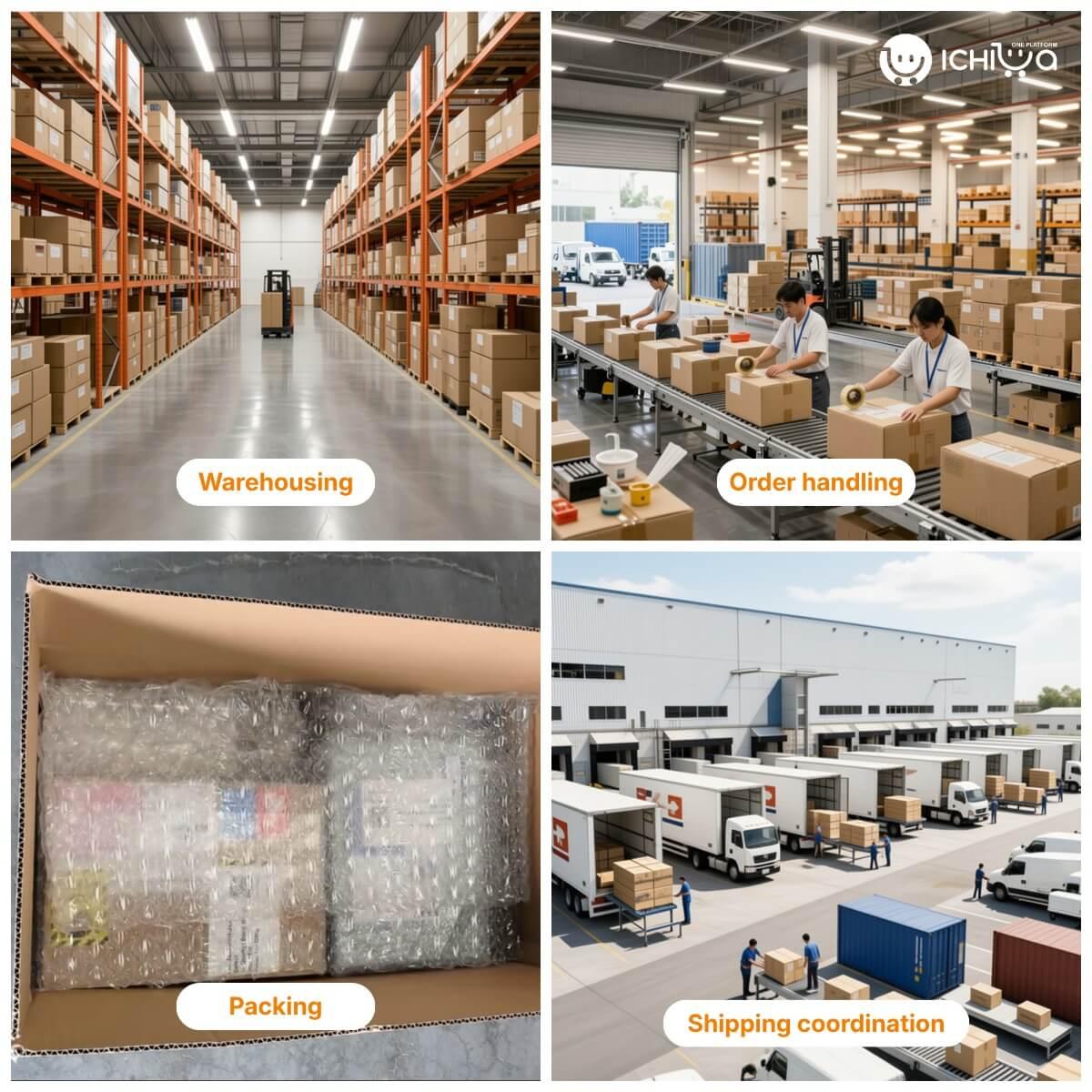
IChiba can support sellers who need cross-border ecommerce and fulfillment operations for Japan. This can be useful for sellers that want to sell on Amazon Japan but do not yet have a local warehouse or operations team.
Relevant support areas can include:
Warehousing
Order handling
Packing
Shipping coordination
Cross-border operations
Multi-channel fulfillment support
IChiba does not replace Amazon FBA in every case. FBA is still a strong option for validated products that need Prime eligibility and fast delivery.
The better way to view IChiba is as a fulfillment support option for sellers who need more operational flexibility, want to test Japan before committing large inventory to FBA, or plan to sell across Amazon and other channels.
Yes. Sellers can sell on Amazon Japan without living in Japan if they meet Amazon’s registration and verification requirements.
However, sellers outside Japan need a reliable plan for shipping, returns, customer service, and fulfillment. This is often where operational risk appears.
If sellers do not have a warehouse or order-handling team in Japan, they can consider FBA or a fulfillment partner. IChiba can support sellers that need warehousing, packing, shipping coordination, and cross-border order operations in Japan.
Not always. A Japanese company is not always required to sell on Amazon Japan.
Sellers may register as individuals or businesses depending on their situation and Amazon’s verification requirements. However, business registration and clear company documents can help sellers who plan to operate long term, manage more SKUs, or build a brand.
Sellers should always check the latest requirements in Seller Central or Amazon Global Selling before applying.
Beauty and skincare, anime and collectibles, health supplements, home appliances, electronics accessories, apparel, and lifestyle products can all be worth researching.
But these are not automatic winners. Many high-demand categories are also highly competitive in Japan.
The best products usually have clear demand, manageable shipping size, complete specifications, low compliance risk, reasonable return risk, and enough margin after Amazon fees, shipping, tax, and fulfillment.
Yes. Amazon FBA is available in Japan.
With FBA Japan, sellers ship products to Amazon fulfillment centers. Amazon can then handle storage, order processing, shipping, customer service, and returns for FBA orders.
FBA can help sellers compete with faster delivery and Prime eligibility. Sellers still need to manage inbound shipping, prep, labeling, storage fees, and inventory planning.
Sellers need to create a shipping plan in Seller Central, prepare products according to Amazon’s requirements, label them correctly, and ship them to the assigned fulfillment center.
For cross-border sellers, the hard parts are often inbound shipping, import procedures, customs duties, consumption tax, labeling, and packaging requirements.
If sellers are not familiar with importing products into Japan, they should work with a logistics provider or fulfillment partner to reduce errors before inventory reaches Amazon’s warehouse.
It depends on the seller’s account setup and marketplace access.
Some sellers can expand to Japan through Amazon Global Selling or Seller Central. However, Japan-specific settings may still be required, including payment, tax, listing language, product restrictions, and fulfillment setup.
Sellers should not assume that an account used for the US or Europe can sell on Amazon Japan without additional setup.
Selling on Amazon Japan can be a strong growth path for global sellers, but it should not be rushed.
Sellers need more than account approval. They need the right account type, accurate fee calculation, Japanese language localization, product-market validation, and a fulfillment model that can meet buyer expectations.
The safest approach is to start with a focused SKU group, validate demand, calculate landed cost, optimize listings, and launch with controlled ads before scaling.
For sellers without local operations in Japan, fulfillment should be planned early. FBA can work well for validated products that need Prime delivery. FBM or a fulfillment partner can be better when sellers need more control, want to test products, or plan to fulfill across multiple channels.
The goal is not only to sell on Amazon Japan or list products there. The goal is to build an operation that protects customer experience, controls cost, and keeps profit margin healthy while selling in Japan.

Work with us
Our solutions
Address:
 〒136-0082, Japan, Tokyo, Koto-ku, Shinkiba 3-5-6, 5F
Connect us:


Japan
〒136-0082, Japan, Tokyo, Koto-ku, Shinkiba 3-5-6, 5F
Texas, USA
1606 Audrey Dr, Garland, TX 75040, United States
California, USA
1316 John Reed Ct, City of Industry, CA 91745, United States