

News
Ichiba OnePlatform Team - 17/06/2026
In this article
A Japanese dropshipping platform can help global sellers source authentic products from Japan, manage fulfillment, and sell to international buyers without building a full local operation from day one.
Japan has strong product appeal across many ecommerce niches, from beauty products and anime merchandise to golf equipment, lifestyle goods, traditional items, hobby products, and premium niche goods. Many buyers are willing to pay for Japanese quality, design, rarity, and authenticity. For sellers, that creates a real opportunity. The challenge is that sourcing from Japan is not always simple.
Many Japanese marketplaces require local accounts, Japanese payment methods, a Japan shipping address, or the ability to understand product information in Japanese. Sellers also need to manage domestic shipping in Japan, international shipping, consolidation, tracking, and customer expectations. If every step is handled manually, the model can become difficult to scale.
That is why a Japan focused dropshipping platform matters. The right platform can help sellers access Japanese products, purchase through proxy or sourcing support, manage fulfillment, and ship products to global customers. For beginners, it lowers the barrier to entry. For growing ecommerce businesses, the right platform can support order management, automation, integration, and better operational control.
However, not every Japanese dropshipping platform is built for the same type of seller. Some platforms are better for proxy buying and product testing. Some focus on fulfillment and logistics. Others combine sourcing, automation, order management, and cross-border operations for sellers that want to scale.
This guide explains what a Japanese dropshipping platform is, the main types of Japan focused dropshipping platforms, how to compare them, and how IChiba OnePlatform can support sellers who want to build a serious Japanese product business.
A Japanese dropshipping platform is a platform that helps sellers source, purchase, handle, and ship products from Japan to international customers without holding inventory in their own warehouse.
Depending on the platform, it may support several parts of the workflow, including product sourcing, proxy buying, warehouse receiving, package consolidation, international fulfillment, order management, tracking updates, and cross-border shipping.
For global sellers, the biggest value is access and control. A seller may want to sell Japanese products, but may not have a local company, warehouse, payment method, or team in Japan. A Japanese dropshipping platform helps reduce that gap by providing the operational layer between Japan-based supply and global demand.
These platforms are useful for several seller types:
Beginners testing Japanese products
Resellers sourcing Japan-only or limited items
Shopify and WooCommerce sellers building niche stores
Marketplace sellers looking for authentic Japanese inventory
Cross-border ecommerce businesses that need Japan-based fulfillment
Sellers looking for a more scalable Japan sourcing and dropshipping platform
The key point is that a platform should do more than help sellers buy products. A strong platform should also help sellers manage the operational flow after the product is found.

Not all Japan focused dropshipping platforms should be evaluated in the same way. Each type serves a different stage of the seller journey.
A new seller may need a simple platform to access Japanese marketplaces and test demand. A seller with stable orders may need better fulfillment and shipping control. A business that wants to scale across channels may need automation, integrations, order management, inventory workflow, and data.
Proxy-based platforms act as a buyer on behalf of the seller or customer. Users choose products from Japanese marketplaces or online stores, and the platform purchases the item, receives it in Japan, then ships it overseas.
Common examples include Janbox, ZenMarket, and Buyee.
This type of Japanese dropshipping platform is suitable for:
Beginners
Low-volume testing
Collectors and niche buyers
Sellers sourcing rare or secondhand goods
Sellers testing Japan-only products before scaling
The biggest advantage of proxy-based platforms is ease of access. Sellers can buy from Japanese marketplaces without managing a local account, domestic payment method, or Japan receiving address. This makes proxy platforms useful for testing product demand, especially for collectibles, hobby goods, auction items, secondhand products, and limited-edition products.
Proxy platforms are also useful when product availability is scattered across many marketplaces. For example, a seller sourcing anime figures, trading cards, vintage fashion, or rare golf items may need access to multiple Japanese marketplaces instead of one supplier catalog.
However, proxy-based platforms have clear limits. They usually involve more manual steps and are not always built for automation. When order volume increases, buying item by item, consolidating packages manually, and updating orders by hand can become slow. For serious ecommerce scaling, proxy buying is often a starting point, not the final operating model.
Fulfillment-based platforms focus more on warehouse handling, logistics, packing, shipping, and delivery control. Instead of only helping sellers buy products, they help sellers manage what happens after products are sourced.
This type of platform is better for sellers with stable demand or businesses that want more control over shipping and customer experience. It may support storage, package consolidation, batch processing, repacking, international shipping, tracking, and return handling.
Fulfillment-based platforms are best for:
Scaling ecommerce businesses
Sellers with repeat orders
Resellers handling multiple SKUs
Cross-border stores that need better delivery control
Sellers that want a more stable fulfillment workflow from Japan
At this stage, the challenge is no longer only finding products. Sellers need to process orders correctly, keep delivery timelines clear, control shipping cost, and reduce fulfillment errors. A product may have strong demand, but if the shipping process is slow, expensive, or unclear, customers may not return.
For sellers researching logistics and fulfillment speed, this guide on fast dropshipping suppliers can also provide useful context.
Hybrid platforms combine sourcing, product management, order management, fulfillment, and automation. This model is more suitable for sellers who want to move beyond manual proxy buying and build a more scalable ecommerce operation.
A hybrid Japan sourcing and dropshipping platform may support integrations with Shopify, WooCommerce, marketplaces, or API-based workflows. It can help sellers manage products, orders, inventory, fulfillment, and performance data from a more centralized system.
This type of platform is best for:
Global sellers selling across multiple channels
Dropshipping businesses that need automation
Resellers handling higher order volume
Sellers managing Japanese products across several markets
Teams that want to reduce manual work and improve control
When sellers want to scale, hybrid platforms usually have a stronger advantage. Instead of only helping sellers buy products from Japan, they support the full workflow from sourcing to fulfillment and growth.
Choosing the best Japanese dropshipping platform is not only about finding a platform that can buy products from Japan. Sellers need to ask whether the platform fits their business stage, product category, order volume, and scaling goals.
A beginner testing demand may prioritize easy marketplace access. A seller with stable orders may need stronger fulfillment and tracking. A business selling across multiple ecommerce channels may need integration, automation, and centralized operations.
Marketplace access shows where sellers can source products from.
A useful platform should help sellers access the right Japanese product sources, such as Rakuten, Yahoo Auctions, Mercari, Amazon Japan, local stores, suppliers, or wholesale sources. However, access to many sources is not enough. Sellers should also check whether the platform is better for retail sourcing, B2B sourcing, or both.
If a seller focuses on collectibles, secondhand goods, limited items, or Japan-only products, marketplace access is important. If the seller wants to build a more stable product catalog, access to reliable suppliers or wholesale sources becomes more important.
For sellers that want to evaluate supplier quality, this guide on reliable Japanese suppliers is a useful internal resource.
Fulfillment capability determines whether the platform can support sellers after an order is created.
Sellers should check whether the platform only supports purchasing, or whether it also supports warehouse handling, consolidation, repacking, international shipping, tracking, and return support. When order volume grows, fulfillment has a direct impact on customer experience and profit margin.
A strong Japanese dropshipping platform should help sellers answer practical questions:
Where are products received?
Can multiple packages be consolidated?
Is repacking available?
Can the platform ship to the target market?
Are tracking updates clear?
Can shipping costs support the target margin?
Is return handling available?
If fulfillment is weak, sellers may have attractive products but still struggle to scale.
Automation and integration become important when sellers no longer want to process every order manually.
If a seller uses Shopify, WooCommerce, marketplaces, or multiple storefronts, integration helps reduce manual work. Orders can be processed faster, fulfillment can be coordinated more clearly, and tracking can be updated with fewer errors.
Automation is especially important when sellers manage many SKUs or growing order volume. If every order requires copy-pasting customer details, checking stock manually, and updating tracking by hand, the business will be difficult to scale.
A serious Japan focused dropshipping platform should help sellers reduce repeated manual tasks and create a more reliable workflow.
A platform can be good for product testing but weak for scaling.
Scalability should be evaluated by how well the platform handles more SKUs, more orders, more channels, and more markets. If a platform works only for one-off purchases, sellers may reach a limit once demand increases.
The right platform depends on the seller’s goal. For small tests, a proxy-based platform may be enough. For a long-term ecommerce business, fulfillment-based or hybrid platforms are often stronger because they support more parts of the operation.
Cost is one of the most important factors when choosing a Japanese dropshipping platform.
Sellers should calculate:
Product cost
Service fees
Domestic shipping in Japan
International shipping
Storage fees
Handling fees
Consolidation fees
Currency conversion
Return or refund cost
Platform and payment fees
Advertising cost
A product with a good sourcing price may not have a good margin after shipping, handling, and platform fees. This is especially true for Japanese products that are heavy, fragile, oversized, or expensive to return.
Sellers should calculate landed cost before scaling. A Japan sourcing and dropshipping platform is only useful if it helps the seller protect margin while improving access and fulfillment.
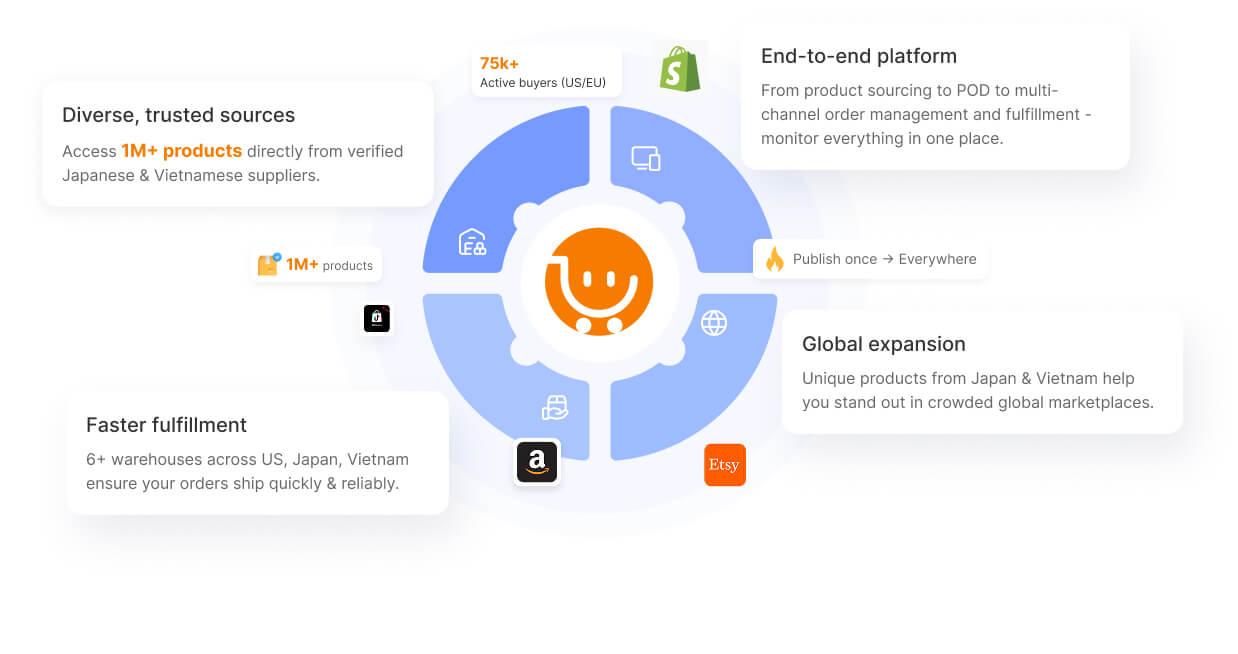
IChiba OnePlatform is built for global sellers that want to build a Japanese product business more seriously, not only buy items one by one.
For many sellers, the biggest challenge is not finding one Japanese product to sell. The harder challenge is building a repeatable workflow for sourcing, order management, fulfillment, data, and channel expansion. If everything is handled manually, a seller may test a few orders successfully but struggle to scale with consistency.
IChiba OnePlatform can work as a Japan sourcing and dropshipping platform that supports sellers from product sourcing to fulfillment and order management. Instead of connecting multiple disconnected tools and partners, sellers can manage more of the workflow through a centralized system.
The strength of IChiba OnePlatform is operational control. Sellers can manage product data, process orders, coordinate fulfillment, monitor shipping, and use data to make better scaling decisions.
For global sellers selling Japanese products, this matters. A business cannot scale sustainably if it depends on manual sourcing, scattered spreadsheets, and tracking updates handled by hand. Sellers need a system that helps control the flow from product to delivery.
Japanese product sourcing is the foundation of any dropshipping business built around Japan.
Sellers need to find products with demand, margin, and a clear fit for the target market. Potential categories include Japanese cosmetics, anime merchandise, golf equipment, traditional goods, lifestyle products, hobby goods, and premium niche products.
IChiba OnePlatform can help sellers access Japanese products and build a clearer sourcing workflow. Instead of choosing products only by instinct, sellers can focus on items that are easier to explain, easier to ship, and more suitable for global buyers.
Good sourcing is not only about finding cheap products. It is about finding products that can be sold consistently, have enough information for strong listings, maintain margin after fulfillment, and compete in the target market.
Sellers exploring product categories can also read more about Japan dropshipping suppliers, Japanese beauty dropshipping suppliers, and dropshipping golf equipment from Japan.
Fulfillment determines the customer experience after an order is placed.
A good Japanese dropshipping platform should help sellers manage the flow from order to delivery. This includes receiving products, handling packages, packing, international shipping, tracking updates, and order status monitoring.
IChiba OnePlatform can help reduce manual coordination in this process. When orders, fulfillment, and shipping are managed in a more centralized workflow, sellers can control operations more easily than if every step is handled through separate tools.
For resellers and ecommerce sellers that are scaling, end-to-end fulfillment helps reduce errors, improve processing speed, and create a clearer customer experience.
Sellers can also explore IChiba’s dropshipping solution to understand how sourcing, fulfillment, and cross-border shipping can work together in one system.
Flexible integration is important for sellers using Shopify, WooCommerce, marketplaces, or multiple storefronts.
When a platform connects with the selling workflow, sellers do not need to handle every order manually. Orders can be synced more smoothly, fulfillment can be coordinated faster, and tracking can be updated more clearly.
This is especially useful for sellers selling across several channels or planning to expand into new marketplaces later. A system with better integration helps sellers scale without increasing manual work at the same pace as order volume.
For sellers comparing platforms, this guide on dropshipping platforms and software can be a useful reference.
Dropshipping should not depend only on guesswork.
Sellers need to know which products have real demand, which markets respond well, which channels create healthy margins, whether shipping cost is hurting profit, and which products should be scaled.
Data and analytics help sellers make better decisions. Instead of testing products only by feeling, sellers can use performance data to optimize catalog, pricing, fulfillment, and marketing.
With IChiba OnePlatform, operational data can help sellers move from manual product testing to more controlled growth. That shift is important for any seller trying to build a sustainable Japanese product business.
To scale a Japanese dropshipping business, sellers need more than a good platform. They need to choose the right niche, price products correctly, optimize logistics, and use the right marketing channels.
Some Japanese product categories have strong potential with global buyers:
Japanese cosmetics
Anime merchandise
Golf equipment
Traditional goods
Home and lifestyle products
Hobby and collectible products
Premium niche products
These categories often work because they offer something different from generic products. Buyers may be interested in Japanese quality, design, authenticity, rarity, culture, or brand reputation.
Sellers should prioritize products with strong visuals, clear information, manageable shipping, and enough margin. Products that are too heavy, fragile, difficult to return, or legally complex should be reviewed carefully before scaling.
Japanese products often work better with premium positioning than low-price competition.
If sellers compete only on price, margins can become weak because sourcing, fulfillment, and international shipping from Japan are not always cheap. A better strategy is to focus on authenticity, quality, rarity, product story, and buying experience.
Suggested margin ranges can be used as a starting point:
Product type | Suggested margin |
Standard products | 30-50% |
Niche or premium products | 50-100% |
These ranges should be treated as a guideline, not a fixed rule. Sellers still need to calculate product cost, platform fees, shipping, fulfillment, ads, payment fees, and returns before setting the final price.
Logistics has a direct impact on margin and customer experience.
Sellers can use consolidated shipping to reduce cost per item. If order volume becomes stable, they can consider local warehousing or regional hubs in key markets such as Southeast Asia or the United States.
A good logistics strategy should answer:
Where will the product ship from?
How long does processing take?
Can packages be consolidated?
How will tracking be updated?
Does shipping cost fit the target margin?
What happens if a return is requested?
If logistics is unclear, sellers may struggle to scale even when product demand is strong.
Marketing for a Japanese dropshipping business should focus on trust and product education.
Useful channels include SEO for long-tail keywords, TikTok and Instagram for visual products, influencer marketing for niche goods, marketplace SEO for existing demand, and content marketing for product education.
Japanese products often need more explanation than generic products. Buyers may want to know where the product comes from, why it is authentic, how it is used, and what makes it different. Content should not focus only on discounts. It should explain why the product is worth buying and who it is for.
Japan dropshipping will continue moving toward more automation, faster cross-border logistics, and stronger global access to Japanese brands.
AI and automation will play a bigger role in product sourcing, product analysis, pricing, inventory planning, and order routing.
Sellers can use automation to find promising products, analyze demand, route orders, predict inventory needs, and optimize catalogs. As SKU count and order volume grow, automation helps reduce manual work and operational errors.
Cross-border logistics will continue to improve through better tracking, faster customs clearance, more fulfillment options, and more regional warehouse hubs.
This makes selling Japanese products globally more practical, especially for sellers without their own local operations in Japan. However, faster logistics does not always mean cheaper logistics. Sellers still need to balance delivery speed, shipping cost, and margin.
More Japan D2C brands are becoming global-ready.
This creates more opportunities for global sellers, resellers, and platform partners. Sellers that can connect Japanese products with global buyers while managing sourcing, fulfillment, and marketing well will have a stronger advantage.
In the future, Japanese dropshipping may become less about simply buying from marketplaces and shipping abroad. It may become more about deeper collaboration between sellers, Japanese brands, suppliers, fulfillment platforms, and global ecommerce channels.
The best Japanese dropshipping platform depends on the seller’s goal, product category, order volume, and fulfillment needs.
If the seller only wants to test products or buy Japan-only items at low volume, proxy-based platforms can be useful. If the seller wants to scale and needs better sourcing, fulfillment, order management, integration, and operational control, IChiba OnePlatform can be a stronger option.
IChiba OnePlatform is suitable for global sellers that want to build a scalable Japanese product business with support for product sourcing, order management, fulfillment workflow, integration, and data-driven operations.
Yes. Dropshipping in Japan can be integrated with Shopify depending on the platform and workflow.
Sellers should check whether the platform supports Shopify, WooCommerce, API, or manual order processing. Integration helps reduce manual work, process orders faster, and make fulfillment updates clearer.
For sellers that want to scale, integration is important because it connects the selling channel with the sourcing and fulfillment workflow.
Yes. Japan dropshipping can be automated when the platform supports order routing, inventory sync, fulfillment workflow, and channel integration.
Automation becomes important when sellers manage many SKUs, many orders, or multiple sales channels. If everything stays manual, sellers will struggle to scale without increasing errors.
A hybrid platform like IChiba OnePlatform can help sellers build a clearer workflow from sourcing to order management and fulfillment.
Yes. Serious Japanese fulfillment platforms should provide tracking updates.
Sellers should check tracking visibility, carrier options, delivery time, shipping fees, and customer notification workflow before choosing a platform. Clear tracking reduces customer support pressure and improves buyer trust.
For cross-border ecommerce, tracking is not only a shipping detail. It is part of the customer experience.
A Japanese dropshipping platform can help global sellers source authentic products from Japan, manage order fulfillment, and scale across ecommerce channels. But the right platform depends on the seller’s stage and goal.
Proxy-based platforms are useful for beginners, product testing, and low-volume sourcing. Fulfillment-based platforms are better for sellers that need stronger logistics control. Hybrid platforms are more suitable for sellers that want to combine sourcing, order management, fulfillment, integration, and automation.
For sellers that want to build a serious Japanese product business, IChiba OnePlatform can support sourcing, fulfillment, order management, flexible integration, and data-driven scaling from one centralized workflow.
The goal is not only to access Japanese products. The goal is to build a dropshipping operation that can scale globally with better control, clearer fulfillment, and stronger profit potential.

Work with us
Our solutions
Address:
 〒136-0082, Japan, Tokyo, Koto-ku, Shinkiba 3-5-6, 5F
Connect us:


Japan
〒136-0082, Japan, Tokyo, Koto-ku, Shinkiba 3-5-6, 5F
Texas, USA
1606 Audrey Dr, Garland, TX 75040, United States
California, USA
1316 John Reed Ct, City of Industry, CA 91745, United States