

News
Ichiba OnePlatform Team - 18/06/2026
In this article
Yahoo Shopping Japan is one of the major ecommerce channels in Japan, especially for sellers that want to reach Japanese buyers or build a business around authentic Japanese products. Compared with Amazon Japan and Rakuten Ichiba, Yahoo Shopping Japan has its own traffic ecosystem, buyer behavior, seller fee structure, and promotion model.
For global sellers, Yahoo Shopping Japan can be attractive because it is connected to the Yahoo Japan and PayPay ecosystem. Japanese shoppers use the marketplace to buy many product categories, including beauty products, fashion, food, home goods, electronics, hobby items, collectibles, and everyday consumer goods.
However, selling on Yahoo Shopping Japan is not as simple as creating an international marketplace account and uploading products. The platform is built mainly for sellers that can operate in Japan. Global sellers often face requirements around business setup, Japanese address and phone information, bank or payment setup, Japanese-language store operation, customer support, product compliance, and local fulfillment expectations.
That is why sellers should understand the platform before entering. They need to know what Yahoo Shopping Japan is, whether foreigners can sell on Yahoo Shopping Japan, what store-opening requirements apply, how much it costs, how to localize product pages, and how to build a reliable fulfillment workflow.
This guide explains how to sell on Yahoo Shopping Japan, what global sellers should prepare, which costs to calculate, how SEO and marketing work, and how IChiba OnePlatform can support sellers that want to source, manage, and sell Japanese products across ecommerce channels.
Yahoo Shopping Japan is an ecommerce marketplace under the Yahoo Japan ecosystem. It allows sellers to open stores and sell products directly to buyers in Japan. Alongside Amazon Japan, Rakuten Ichiba, Mercari, and niche marketplaces, Yahoo Shopping Japan is one of the channels sellers often consider when entering the Japanese ecommerce market.
One of the platform’s important advantages is its connection to Yahoo Japan and PayPay. Buyers may discover products through marketplace search, Yahoo-related traffic, point incentives, campaigns, and other promotional touchpoints inside the ecosystem.
Popular categories on Yahoo Shopping Japan include:
Beauty and skincare
Fashion and accessories
Food and regional goods
Home and lifestyle products
Electronics and gadgets
Hobby products
Anime merchandise and collectibles
Golf equipment
Traditional Japanese goods
Daily consumer products
For sellers, Yahoo Shopping Japan can be a useful way to reach Japanese buyers. For international buyers and resellers, it can also be a valuable product research channel. Sellers can study product prices, listing formats, product images, reviews, and category demand from Japan-based stores.
However, using Yahoo Shopping Japan for research or sourcing is different from opening a seller store. Buying from Yahoo Shopping Japan through a proxy service is much easier than operating an official store on the platform. Sellers should be clear about the goal before choosing a model.
Yahoo Shopping Japan matters because it gives sellers access to a mature ecommerce market with strong buyer expectations.
Japanese buyers often care about product clarity, trust, shipping accuracy, customer service, and return policies. A product may have strong demand, but weak product pages, vague delivery timelines, or poor Japanese copywriting can hurt conversion.
For global sellers that want to sell directly to Japanese customers, Yahoo Shopping Japan can provide marketplace exposure inside a local ecosystem. For sellers that are not ready to operate directly in Japan, the platform can still help with market research, product discovery, and price benchmarking.
For resellers and dropshipping businesses selling Japanese products globally, Yahoo Shopping Japan can also be useful as a product research or sourcing reference. Sellers can look at what Japanese buyers are purchasing, how local sellers position products, and which categories have strong listing activity.
The key is to separate three use cases:
Using Yahoo Shopping Japan to research Japanese products
Using Yahoo Shopping Japan as a sourcing reference
Opening a store to sell on Yahoo Shopping Japan directly
Each use case requires a different level of setup, compliance, and operational readiness.
Foreigners may be able to sell on Yahoo Shopping Japan, but in practice, direct selling usually requires a local setup in Japan or a partner that can support local operations.
Yahoo Shopping Japan is mainly designed for business operators in Japan. Its official store-opening guidance states that applicants need information such as Yahoo! JAPAN ID, credit card information, company information, representative information, bank account information, required documents for corporations or sole proprietors, and product information. It also states that applicants generally need an existing business such as an ecommerce site, physical store, or farm with operating history.
Source: Yahoo Shopping Japan Store Opening Requirements
This means global sellers should not treat Yahoo Shopping Japan as a marketplace that can be opened only with an overseas email address and card. Sellers should expect local business readiness, Japanese-language operation, payment setup, and fulfillment preparation.
For companies without a Japanese entity, address, phone number, bank account, or local staff, working with a local partner, distributor, ecommerce service provider, or operation platform may be a more practical route.
The exact requirements for opening a Yahoo Shopping Japan store may change depending on seller type, product category, and current platform rules. Sellers should always check the latest official Yahoo Shopping Japan guidance before applying.
In general, sellers should prepare for local business requirements such as:
Japanese business registration or local business presence
Corporation or sole proprietor setup
Japanese address
Japanese phone number
Bank account information
Credit card information
Business verification documents
Representative information
Product category and compliance information
Japanese-language store operation
Shipping and return policy
Customer support workflow
Yahoo Shopping Japan’s official guidance notes that corporations may need to provide a certified copy of company registration and other documents, while sole proprietors may need to provide business-opening notification documents and personal identification documents.
Source: Yahoo Shopping Japan Identification Documents
Sellers should also check category-specific requirements. Some categories may require additional permits or product documents, including used goods, alcohol, medicine, contact lenses, branded goods, and other regulated products.
For global sellers, this is where preparation matters. A seller may have strong products, but if the business setup, documents, payment information, or category compliance is not ready, the store-opening process can become difficult.
The main challenge for global sellers is not only submitting an application. The harder part is operating a store in a way that matches Japanese ecommerce expectations.
Yahoo Shopping Japan is a Japanese-first platform. Product titles, descriptions, store pages, policies, customer messages, support replies, and campaign content need to be written in natural Japanese.
Machine translation or direct English-to-Japanese translation may make a store look unprofessional. Japanese ecommerce copy should be clear, polite, specific, and structured around how local buyers search and compare products.
For example, a product page should not only say that an item is “high quality.” It should explain materials, size, origin, compatibility, use case, care instructions, shipping timeline, and return conditions where relevant.
Sellers should check tax, consumer law, product labeling, product safety, return policy, and category-specific compliance before selling.
Products such as cosmetics, supplements, food, electronics, baby products, medical-related items, secondhand goods, branded goods, and products with health-related claims may require extra care. A product that sells well in another market may not be ready for Japan if labeling, claims, instructions, or import requirements are not suitable.
Sellers should treat compliance as part of product selection, not something to check after launch.
Payment setup is another practical barrier.
Yahoo Shopping Japan’s store-opening guidance includes bank account information among the required application information, and the platform’s payment and settlement processes are designed around local store operation.
Source: Yahoo Shopping Japan Store Opening Requirements
For overseas sellers, this can be a major hurdle. Without a local bank account, local business setup, or partner support, direct operation may not be practical.
Japanese customers often expect polite, clear, and responsible communication.
Sellers should prepare support workflows for product questions, delivery delays, cancellations, returns, refunds, damaged items, and after-sales issues. Response quality matters. A slow or unclear reply can hurt trust, especially for unfamiliar brands or imported products.
If a seller cannot provide Japanese customer support, working with bilingual staff or an operation partner is strongly recommended.
To sell on Yahoo Shopping Japan, sellers should prepare in stages: business setup, store application, localization, payment and shipping setup, then marketing and promotion.
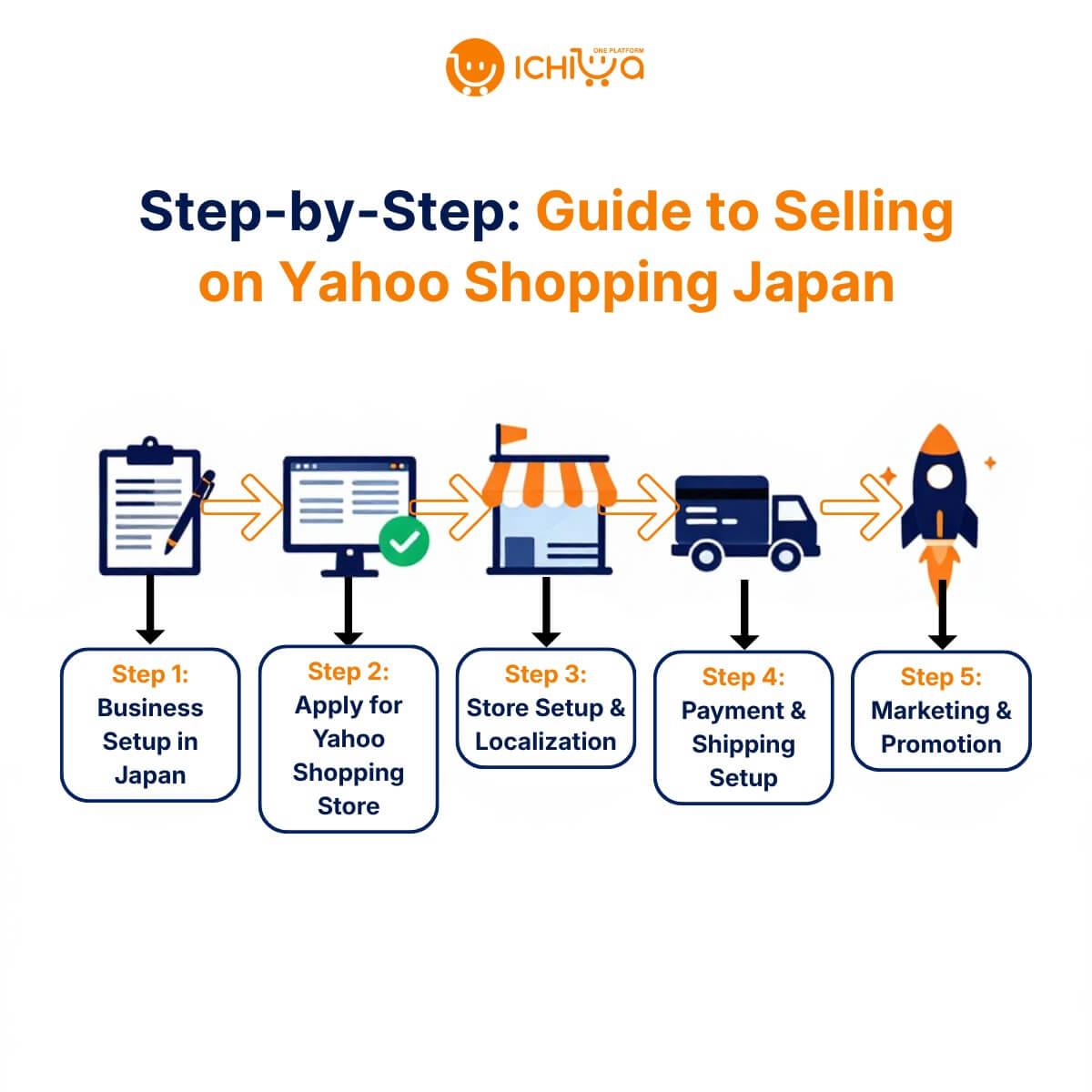
The first step is to confirm whether the seller has the right local setup.
Global sellers should check whether they need a Japanese company, branch, sole proprietor setup, distributor, local operator, or ecommerce service partner. This step is critical because many later steps depend on local business information, payment setup, address, documents, and Japanese-language operation.
Sellers should prepare:
Business registration information
Company name and registered address
Representative information
Business number or corporate number where applicable
Tax-related information
Japanese address and phone number
Bank or payment information
Identity verification documents
Product category information
Compliance documents if required
Before applying, sellers should also check whether their products are suitable for the Japanese market. Categories such as health products, cosmetics, food, electronics, children’s products, used goods, and branded goods should be reviewed carefully.
After preparing the business setup, sellers can apply to open a store on Yahoo Shopping Japan.
The application may require business information, identity verification, contact details, product information, credit card information, and bank account information. Yahoo Shopping Japan’s official store-opening page lists the information and documents applicants should prepare before applying.
Source: Yahoo Shopping Japan Store Opening Requirements
Global sellers may face difficulty at this stage if they do not have local documents or Japanese-language support. If the seller has no team in Japan, it may be safer to work with a local service partner that can help with store setup, documentation, localization, and ongoing operations.
After approval, sellers need to build store pages and product listings that feel natural to Japanese buyers.
Localization is not only translation. Sellers need to adapt product titles, descriptions, images, policies, FAQs, banners, campaign pages, and customer support content for the Japanese market.
A Yahoo Shopping Japan store should include:
Store logo
Store banner
Clear category structure
Product collections
Product titles in Japanese
Detailed product descriptions
High-quality images
Shipping policy
Return policy
FAQs
Customer support information
Mobile-friendly layout
Japanese buyers often review information carefully before purchasing. If the product page lacks specifications, has unclear photos, weak copywriting, or vague shipping and return policies, conversion can suffer.
For sellers that want to build a broader Japan-focused ecommerce strategy, this guide on dropshipping to Japan can provide useful context around buyer expectations, localization, payment, and fulfillment.
Payment and shipping should be prepared before sellers drive traffic to the store.
Sellers need to set up payment flows according to Yahoo Shopping Japan’s supported system, and they need a clear shipping model. If products are already in Japan, domestic fulfillment can improve delivery speed and customer experience. If products are shipped cross-border, sellers need to clearly explain processing time, international shipping time, tracking, customs responsibility, and return conditions.
Important shipping details include:
Shipping fee
Delivery timeline
Carrier
Tracking update
Return process
Damaged item policy
Cancellation policy
Customer support contact
For global sellers, Japan-side warehousing or fulfillment partners can reduce operational risk, especially if they plan to sell seriously in Japan.
After the store, product pages, payment, and shipping setup are ready, sellers need to focus on marketing.
Yahoo Shopping Japan should not be treated as a marketplace where opening a store automatically creates sales. Sellers still need SEO, campaigns, discounts, point incentives, product page optimization, and external traffic.
Marketing should start with Japanese keyword optimization in product titles, descriptions, and category pages. Sellers can then test promotions, seasonal campaigns, point-based incentives, or external traffic from Instagram, TikTok, influencer content, and SEO content.
The goal is not only to bring more traffic. The goal is to bring the right buyers to product pages that already have enough information and trust to convert.
Yahoo Shopping Japan is often known for having an attractive fee structure, but sellers should not confuse “free initial and monthly fees” with “no operating cost.”
The official Yahoo Shopping Japan cost page states that initial cost, monthly system usage fee, and sales royalty are free. However, it also lists other costs such as store point contribution, campaign contribution, affiliate partner reward, affiliate fee, and payment service fees when payment services are used.
Source: Yahoo Shopping Japan Fees
Sellers should check the following cost items:
Initial cost
Monthly system usage fee
Sales royalty
Store point contribution
Campaign contribution
Affiliate partner reward
Affiliate fee
Payment service fee
Optional promotion cost
Store operation cost
The low fixed-cost structure can make Yahoo Shopping Japan attractive compared with some other marketplaces. However, sellers still need to calculate promotion, points, affiliate-related fees, customer service, localization, and fulfillment.
A seller may pay little to open the store, but still spend significantly on campaigns, content, customer support, and shipping.
Hidden costs can have a large impact on profit margin.
Common hidden costs include:
Japanese localization
Japanese copywriting
Product image preparation
Store design and banners
Customer service
Product compliance review
Domestic fulfillment
Warehousing
Return handling
Refund buffer
Marketing and campaign spend
For global sellers, these costs can be as important as marketplace fees. A product with a strong sourcing price may still have weak profit after localization, fulfillment, campaign participation, and returns.
Before selling on Yahoo Shopping Japan, sellers should build a cost sheet.
Cost item | What to calculate |
Product cost | Sourcing or purchase cost |
Marketplace cost | Points, campaigns, affiliate-related fees, and platform costs |
Payment cost | Payment processing or settlement-related costs |
Localization | Translation, Japanese copywriting, store content |
Product images | Product photos, banners, lifestyle shots |
Fulfillment | Warehousing, packing, domestic or international shipping |
Returns | Return handling, refunds, damaged products |
Marketing | Ads, campaigns, influencers, external traffic |
Operation | Staff, partner fees, customer service |
If the margin only looks healthy when these costs are ignored, the product may not be ready to scale on Yahoo Shopping Japan.
IChiba OnePlatform can support global sellers that want to build a Japanese product business in a more structured way, instead of handling every order manually.
For many sellers, the hardest part is not finding one Japanese product. The harder part is managing sourcing, product data, orders, fulfillment, shipping, and multiple sales channels in a workflow that can scale.
Yahoo Shopping Japan can be a valuable channel, but it also requires local readiness, Japanese-language operation, payment setup, store localization, and clear fulfillment. Without a strong operating workflow, adding another channel can create more complexity instead of more growth.
IChiba OnePlatform helps sellers connect key parts of a Japanese product business: sourcing, catalog management, order management, fulfillment, and cross-border operations. For resellers and dropshipping sellers, the platform can help reduce manual work and improve control when selling Japanese products across multiple ecommerce channels.
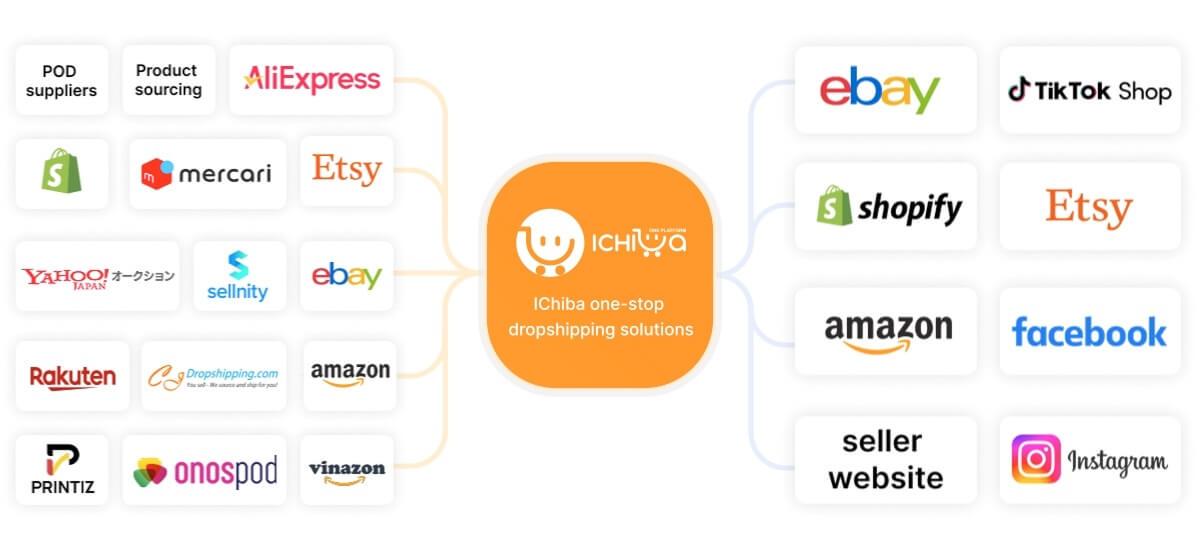
IChiba OnePlatform is designed for global sellers that need operational support around Japanese products.
Instead of managing disconnected suppliers, spreadsheets, warehouses, and shipping updates, sellers can use a more centralized workflow for:
Product sourcing
Supplier and catalog management
Inventory and order management
Fulfillment coordination
Shipment tracking
Cross-border ecommerce operations
Multi-channel selling support
The value is not only product access. The bigger value is workflow control. Sellers can manage the process after a product is sold, which is often where dropshipping and reselling operations become difficult.
For sellers that need support with Japanese product sourcing, this guide on how to find reliable suppliers from Japan is also useful.
Dropshipping and reselling often create problems around sourcing, inventory accuracy, tracking, and fulfillment.
IChiba OnePlatform can help sellers build a clearer workflow from sourcing to fulfillment. Sellers can manage product data, track orders, coordinate fulfillment, and handle cross-border shipping in a more centralized system.
This is especially useful for sellers working with Japanese products, because product sources may be spread across suppliers, marketplaces, warehouses, or local partners. Without a good system, sellers may face SKU errors, unclear order status, delayed tracking, and customer support problems.
Sellers can also explore IChiba’s dropshipping solution to understand how sourcing, fulfillment, and cross-border shipping can work together in one platform.
Yahoo Shopping Japan can be challenging for foreign sellers because of business setup, language, payment, fulfillment, and customer support requirements. Sellers need more than a seller account. They need an operation that can run reliably.
IChiba OnePlatform can act as an operating layer behind the business, helping sellers manage Japanese product sourcing, order workflows, and fulfillment more clearly. For sellers that want to sell on Yahoo Shopping Japan or expand across other ecommerce channels, this can reduce operational risk and support scaling.
The goal is not only to open a store. The goal is to build a Japanese product operation that can handle orders, fulfillment, and customer experience consistently.
For sellers planning to manage more than one channel, this guide on multi-channel ecommerce inventory management is a relevant internal resource.
ảnh: How IChiba OnePlatform Enables Selling on Yahoo Shopping Japan for Dropshipping & Reselling.jpg
To sell successfully on Yahoo Shopping Japan, sellers need to optimize both marketplace search and external traffic. Product pages should be written for Japanese buyers, not simply translated from English.
Japanese SEO should start with native keyword research.
Sellers need to study how Japanese buyers search for products, not only translate English keywords. Useful research sources may include Yahoo Japan search behavior, Google Japan, search suggestions, competitor listings, and marketplace category pages.
Product titles should include important information such as:
Product type
Brand
Main feature
Size
Color
Material
Model
Use case
Occasion keyword when relevant
Descriptions should explain what the product is, who it is for, how to use it, which details matter, and what buyers should know about shipping and returns.
A strong product page helps both search visibility and conversion.
Conversion on Yahoo Shopping Japan depends heavily on trust.
Sellers should prepare:
High-quality product images
Lifestyle shots
Detail photos
Complete product specifications
Clear price
Clear shipping timeline
Return policy
Seller information
Reviews and ratings
FAQs
Mobile-friendly layout
Product images are especially important. Buyers should be able to understand the product’s size, material, use case, condition, and packaging from the page.
For secondhand goods, collectibles, branded goods, and imported products, sellers should be even more transparent. Missing condition details or unclear product photos can lead to returns, complaints, or low conversion.
Campaigns and discounts can increase traffic and conversion, but sellers need to protect margin.
Yahoo Shopping Japan supports promotion models such as campaigns, point-based incentives, and seasonal offers. Sellers can test:
Seasonal campaigns
Point-based incentives
Bundle offers
Free shipping thresholds
Limited-time promotions
New arrival campaigns
However, promotions should not be used blindly. Sellers should calculate product cost, marketplace cost, payment cost, shipping, fulfillment, returns, and marketing before increasing discounts or points.
A strong campaign needs a strong product page. If the listing is weak, more traffic may not turn into more orders.
Sellers should not rely only on marketplace traffic.
External traffic can come from:
TikTok
Influencer marketing
SEO content
Global marketplaces
Community channels
Email or retargeting
For products such as beauty, fashion, anime merchandise, hobby goods, lifestyle products, and traditional Japanese goods, visual content can be powerful. Sellers should use content to explain product origin, authenticity, use cases, and differences from generic alternatives.
For broader product planning, sellers can refer to guides on Japan dropshipping suppliers, beauty dropshipping suppliers, and dropshipping golf equipment from Japan.
Not every product is suitable for Yahoo Shopping Japan. Sellers should choose products with clear demand, strong product information, good images, manageable shipping, and healthy margin.
Product categories worth researching include:
Japanese beauty and skincare
Fashion and accessories
Food and regional goods
Home and lifestyle products
Electronics and gadgets
Anime merchandise and collectibles
Hobby products
Golf equipment
Traditional Japanese goods
A suitable product usually has clear buyer demand, enough product information, attractive images, manageable fulfillment, and a margin that can support promotions and customer service.
For global sellers, Japanese products can have strong positioning because of quality, authenticity, rarity, or cultural value. However, sellers still need to check compliance, shipping, and return risk before scaling.
Yahoo Shopping Japan can be a valuable channel, but global sellers often underestimate what it takes to operate in Japan.
The first mistake is assuming that Yahoo Shopping Japan can be opened as easily as a general international marketplace.
In practice, sellers need to prepare business setup, Japanese-language operation, payment, compliance, and fulfillment. If these parts are unclear, the seller may face problems during application or after orders start coming in.
Direct translation is rarely enough.
Japanese ecommerce copy needs to sound natural, clear, and complete. Buyers often care about specifications, materials, size, origin, usage, delivery, and return policies. If the copy is too short or machine-translated, the product page may feel untrustworthy.
Shipping and returns directly affect customer experience.
Sellers should clearly explain processing time, delivery time, carrier, tracking, shipping fees, and return conditions. If customers discover delivery delays or extra costs after ordering, trust can drop quickly.
This is even more important for cross-border shipping.
Yahoo Shopping Japan may have attractive store-opening costs, but that does not mean sellers get free traffic.
Sellers still need SEO, campaigns, product page optimization, external traffic, and trust-building. Without a marketing plan, a store can be open but still generate few orders.
Foreigners may be able to sell on Yahoo Shopping Japan, but direct selling usually requires Japanese business readiness, local information, or a service partner.
Sellers should prepare for requirements such as business information, Japanese address, phone number, bank or payment setup, Japanese-language operation, and fulfillment workflow. The latest requirements should always be checked on the official Yahoo Shopping Japan seller pages before applying.
Proxy services can help buyers or resellers purchase products from Yahoo Shopping Japan without handling local accounts, payments, or Japanese shipping addresses themselves.
Examples may include Janbox, Buyee, ZenMarket, or other Japan proxy platforms. However, proxy buying is different from selling on Yahoo Shopping Japan. A proxy service helps users buy from Yahoo Shopping Japan, while opening a seller store requires a separate seller operation and usually stronger local readiness.
Yahoo Shopping Japan can be useful for dropshipping in two ways.
First, sellers can use it to research Japanese products, pricing, images, descriptions, and local demand. Second, sellers that want to sell directly on Yahoo Shopping Japan need local setup, compliance, fulfillment, and Japanese customer support.
Direct dropshipping on Yahoo Shopping Japan should not be treated as a simple model. Global sellers may need a partner or a platform such as IChiba OnePlatform to support sourcing, order management, and fulfillment.
In most cases, sellers should expect to need Japanese business presence or local setup to sell on Yahoo Shopping Japan directly.
Requirements may vary depending on seller type, category, and current platform policies. Sellers should check the official Yahoo Shopping Japan guidance or work with a local partner before choosing the selling model.
Yahoo Shopping Japan can be a valuable ecommerce channel for sellers that want to reach Japanese buyers or build a business around Japanese products. But it is not a simple marketplace for global sellers without preparation.
Sellers need to understand store-opening requirements, business setup, payment, compliance, localization, shipping, returns, and customer support. Costs also need to be calculated carefully. Free initial fees or monthly system fees do not mean the business has no operating cost.
For global sellers, resellers, and dropshipping businesses, the safer approach is to define the goal first: use Yahoo Shopping Japan for research, sourcing, or direct selling. After that, sellers should prepare localized product pages, a reliable fulfillment workflow, and a clear marketing strategy.
IChiba OnePlatform can support sellers that need a more controlled way to source Japanese products, manage orders, coordinate fulfillment, and expand across ecommerce channels. The goal is not only to open a store on Yahoo Shopping Japan, but to build a Japanese product operation that can grow sustainably.

Work with us
Our solutions
Address:
 〒136-0082, Japan, Tokyo, Koto-ku, Shinkiba 3-5-6, 5F
Connect us:


Japan
〒136-0082, Japan, Tokyo, Koto-ku, Shinkiba 3-5-6, 5F
Texas, USA
1606 Audrey Dr, Garland, TX 75040, United States
California, USA
1316 John Reed Ct, City of Industry, CA 91745, United States